AI Agent Launch Framework: 5 Steps to Safe Automation
Learn the 5-step AI agent launch framework to automate routine customer inquiries with clear scope, robust knowledge bases, and structured human handoffs.
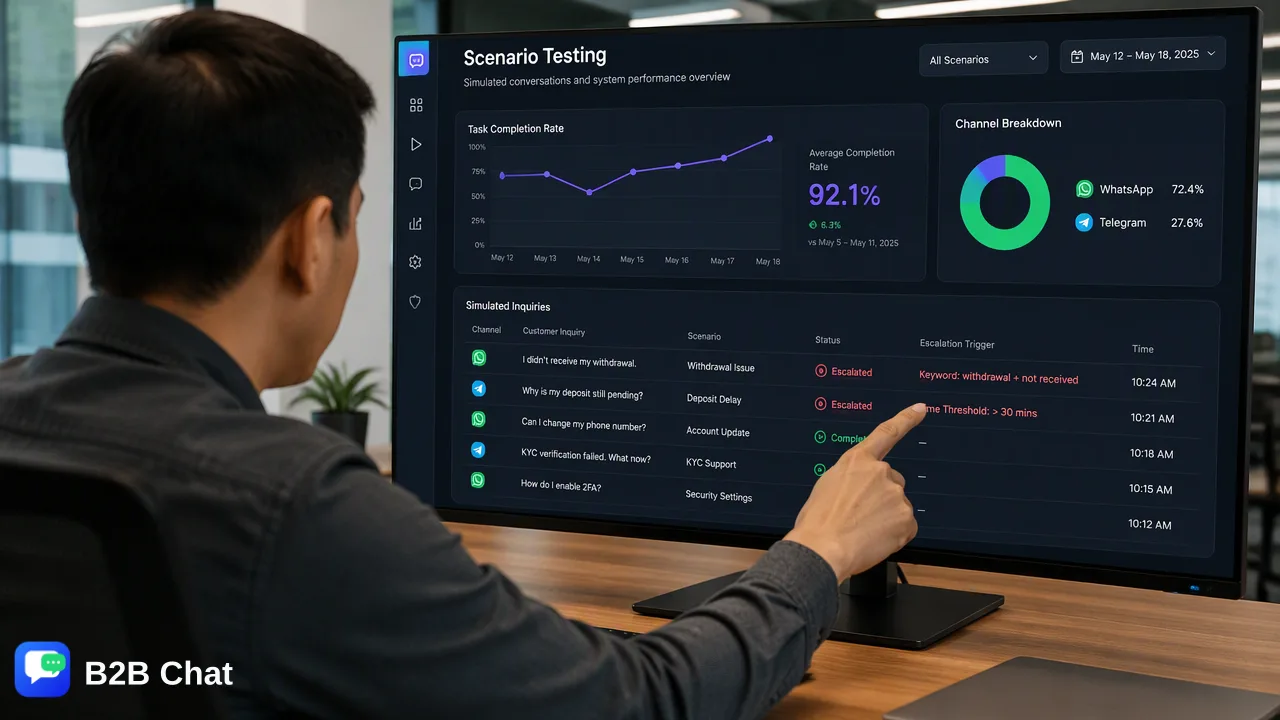
Deploying customer-facing AI agents requires a phased, risk-managed framework focused on scoping routine tasks, building knowledge bases, and managing human handoffs.
Deploying an AI customer service agent requires a structured, phased rollout that prioritizes operational stability over unrestricted automation. Organizations succeed by identifying a single, high-volume task, building a precise knowledge foundation, establishing definitive triggers for human escalation, and validating workflows with real-world pilot scenarios. Rather than replacing human personnel, this disciplined deployment model positions automation as an assistant for routine conversations, maintaining service quality while preserving human oversight for complex customer needs.
Phase 1: Applying the AI Agent Launch Framework to Initial Scopes
A successful AI implementation begins with deliberate constraints. Attempting to automate every customer inquiry at launch introduces unpredictable conversational branches and exposes operations to preventable edge cases. Instead, teams should identify one repetitive, high-volume inquiry type with standardized outcomes, such as common delivery updates, business hours, or standard intake questions.
Targeting a well-defined use case allows support leads to map conversational variations accurately and establish clear boundaries. By demonstrating reliable handling on a focused task, organizations build operational confidence and create a repeatable blueprint before expanding automation into broader support workflows.
Phase 2: Grounding Responses in Curated Knowledge Bases
The quality of an automated response depends entirely on the accuracy and structure of the reference material supplied to the system. An AI customer service agent relies on playbooks, structured FAQs, and explicit operational policies to interpret user inquiries and draft appropriate replies.
In B2B Chat, Smart Service evaluates multi-turn context to understand customer intent across parallel conversations. To maximize response reliability, teams must provide clean, comprehensive documentation that covers standard workflows, approved terminology, and boundary limits. Regularly refining this knowledge base with historical conversation examples ensures that automated replies remain aligned with operational facts.
Phase 3: Defining Structured Human Handoff Triggers
Automating customer interactions without a clear escalation mechanism creates severe operational risk. AI agents excel at handling routine, predictable replies, but ambiguous inquiries, policy exceptions, and emotionally charged customer complaints require human intervention.
Workflow designers should establish explicit boundary rules that trigger a transfer to a human specialist. Key escalation criteria often include consecutive unrecognized intents, explicit requests for a human agent, or sensitive transactional keywords. Viewing automated agents as first-line decision-support tools keeps operational control firmly in the hands of experienced staff while resolving routine volume efficiently.
Phase 4: Validating Workflows Through Staged Scenario Testing
Before opening automated channels to the entire customer base, teams should conduct controlled testing against realistic dialogue scenarios. Simulating genuine customer phrasing, typographical errors, and non-linear questioning exposes gaps in the knowledge base and highlights edge cases that prompt configurations might miss.
Organizations benefit from rolling out the agent to an internal pilot cohort or a small percentage of incoming inquiries. This phased approach allows support managers to observe conversation handling in real time, adjust response guidelines, and verify that human handoffs trigger reliably before initiating a full-scale deployment.
Phase 5: Measuring Success Through Task Completion Rates
Evaluating automated customer service requires moving past basic deflection numbers. A deflected ticket indicates that a conversation concluded without staff involvement, but it provides no proof that the customer achieved their intended outcome.
Operational teams should monitor task completion rates, evaluating whether the inquiry reached a verified resolution within the automated exchange. Analyzing multi-turn conversation logs helps identify recurring drop-off points, unhandled intents, and opportunities to clarify reference playbooks, driving continuous operational enhancement over time.
Multi-Channel Centralization for Cross-Border Support
For cross-border teams, managing automated and human workflows across dispersed channels requires unified operational oversight. Customer interactions frequently span different chat ecosystems, creating operational silos if handled separately.
B2B Chat provides a desktop client for Windows and macOS that centralizes WhatsApp, Telegram, and LINE messaging accounts into a single workspace. Unifying accounts in one operational interface allows teams to deploy automated first-line replies while enabling live agents to monitor incoming chats and intervene smoothly whenever human review is required.
FAQ
How do teams determine if a task is suitable for AI automation?
Tasks suitable for AI automation feature predictable inputs, standardized solutions, and high recurring inquiry volume. Routine order inquiries, basic account queries, and standard onboarding questions represent strong starting points because they operate within structured parameters.
What is the role of human agents in an AI-automated workflow?
Human agents provide contextual judgment, handle sensitive escalations, and oversee automation quality. Rather than eliminating human involvement, automated workflows position staff as specialized problem-solvers who handle conversations requiring nuanced discretion or policy exceptions.
How can organizations ensure an AI agent maintains brand consistency?
Organizations maintain consistency by grounding the AI in curated playbooks, approved response templates, and clear conversational guidelines. Regularly auditing conversation logs and updating knowledge repositories helps the system maintain tone and factual accuracy across ongoing interactions.
Learn More
Choose the product information that fits the next step in your workflow.