Choosing the Right AI Agent Platform: A Framework for Mid-Market Messaging Teams
Evaluate AI agent platforms for mid-market messaging. Learn how multi-channel aggregation, context-aware AI, and human handoff streamline operations.
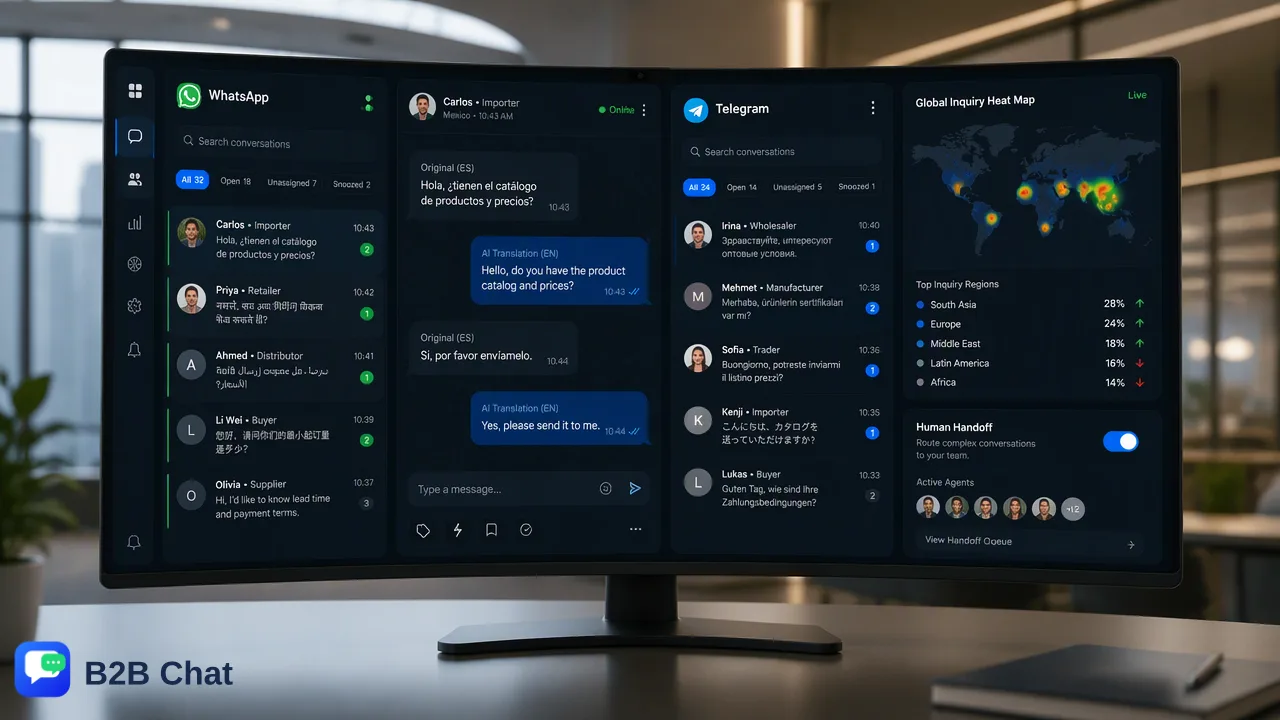
A strategic evaluation framework for mid-market messaging teams assessing AI agent platforms, focusing on multi-channel consolidation, context-aware automation, human handoff, and sustainable usage scaling.
Selecting an AI agent platform for business messaging requires moving past standalone auto-responders. Mid-market organizations need a unified workspace that consolidates high-volume conversational channels—specifically WhatsApp, Telegram, and LINE—while pairing context-aware conversational automation with structured human-agent handoffs. Evaluating platforms across channel aggregation, multi-turn contextual understanding, multilingual readiness, and scalable usage-based operational models helps teams maintain lead quality and handle growing message volumes across distributed regions.
The Challenge of Scaling Messaging for Mid-Market Teams
Mid-market outreach and customer operations face distinct communication challenges as conversational volume expands. Fast-growing organizations frequently manage inbound interest across varied customer touchpoints. When team members juggle disparate mobile devices or disconnected web instances, conversations become siloed. Response histories scatter across multiple logins, tracking becomes irregular, and prospective buyers experience disjointed onboarding steps.
Native messaging applications are fundamentally built for individual user communication rather than coordinated corporate queues. When several team members log in across multiple local numbers or shared accounts without centralized tooling, supervisor visibility drops. Handoffs between shifts become cumbersome, customer context is lost between updates, and inbound leads risk slipping through operational cracks.
Addressing this bottleneck requires moving away from single-channel mobile devices toward a consolidated desktop environment. By aggregating primary messaging networks—such as WhatsApp, Telegram, and LINE—into a unified desktop client for Windows or macOS, organizations gain full oversight over conversation queues. Unifying account sessions under structured management gives managers clear operational control while standardizing incoming message handling across international territories.
Core Evaluation Criteria for AI Agent Platforms
A comprehensive ai agent platform evaluation framework must weigh functional operational architecture above surface-level bot templates. Messaging operations require systems that integrate daily communication channels, contextual intelligence, and cross-border capabilities into one dependable layer.
| Evaluation Criterion | Core Operational Focus | Impact on Messaging Teams |
|---|---|---|
| Multi-Channel Consolidation | WhatsApp, Telegram, and LINE aggregation within a unified desktop client | Centralizes conversation queues and eliminates scattered device logins |
| Context-Aware Automation | Multi-turn conversational understanding for routine inquiries | Handles first-line inquiries accurately by evaluating conversation context |
| Multilingual Communication | Real-time bi-directional translation supporting 200+ languages | Helps cross-border teams support international prospects in native languages |
| Administrative Governance | Device activation codes, team consoles, and message governance rules | Standardizes team access, compliance filters, and customer history |
In international trade, cross-border commerce, and regional support, multilingual fluency is essential. Platforms equipped with automated language detection and real-time bi-directional translation across more than 200 languages allow customer service representatives to communicate with global buyers without language barriers. By utilizing context-aware phrasing tailored to industry terminology, teams maintain professional tone and operational clarity across every localized market.
Preventing Lead Leakage: The Role of Human-AI Handoff
Automated conversational flows offer rapid initial responsiveness, yet unassisted AI-only architectures introduce substantial business risks. When prospective high-value clients submit intricate product requirements, specialized trade conditions, or edge-case support questions, rigid chatbot logic can easily stall. Abandoned queries or inappropriate responses degrade trust and can cause qualified leads to look elsewhere.
An effective conversational framework deploys an AI agent to handle first-line triage, answer standard questions, and establish qualification parameters across parallel, multi-turn interactions. By processing standard informational requests simultaneously, the platform helps customer teams avoid long queue delays. Meanwhile, complex customer queries remain visible within the team console, allowing human operators to take over the dialogue as soon as detailed consultation is needed.
Mid-market organizations should evaluate whether an AI platform supports this hybrid workflow. Systems that provide comprehensive CRM consoles—featuring customer records, greeting configurations, keyword response libraries, and warm-up scheduling—allow operations managers to structure how automation interacts with daily agent workflows. Combining automated baseline replies with prompt human intervention maintains conversation momentum and protects prospective pipeline opportunities.
Operational Efficiency and Cost-to-Usage Scaling
Beyond message routing and conversational automation, mid-market organizations must inspect platform licensing and deployment models. Many traditional customer service platforms impose rigid, seat-based subscriptions or restrictive port charges that penalize expanding operations. When companies must purchase expensive licenses simply to connect seasonal accounts or run regional outreach numbers, operating overhead escalates rapidly.
Evaluating cost models based on actual operational usage provides much greater flexibility. Architectural models where messaging ports are openly accessible without time-based constraints, coupled with prepaid per-request usage for AI translation and AI customer service, align overhead directly with genuine business volume. Teams scale up communication during peak cycles and scale back during calmer periods without carrying unneeded infrastructure expense.
Operational security and session stability also warrant close scrutiny during selection. Platforms utilizing independent desktop activation codes separate administrative console accounts from client machine sessions. Administrators can bind specific working sessions to dedicated company workstations or allow flexible access across rotating team members. Paired with centralized controls over sensitive terms, greetings, and gradual session warm-up rules, teams establish a stable operational foundation that expands sustainably alongside mid-market communication demands.
FAQ
Why is multi-channel aggregation important for mid-market messaging?
Mid-market organizations often communicate with customers across different applications depending on regional preference, such as WhatsApp, Telegram, or LINE. Managing these touchpoints in isolated browser tabs creates fragmented records and uneven team response times. A centralized desktop workspace aggregates these channels into a single operational interface, helping support and outreach teams track customer history consistently across accounts.
How does context-aware AI improve customer service quality?
Context-aware AI examines prior conversational turns and specific customer intent rather than relying solely on static keyword matching. By evaluating the thread context, an AI agent can address routine inquiries, gather preliminary project or qualification details, and maintain an ongoing conversational flow before routing complex requirements to specialized staff.
What is the operational risk of relying solely on automated AI messaging?
Deploying fully isolated automation without human oversight risks stranding qualified prospective clients when inquiries exceed standard question patterns. When prospective buyers encounter nuanced technical questions or specific commercial terms, an unassisted automation flow can lead to frustration. A hybrid model ensures that automated initial qualification smoothly escalates into human review.
How should teams balance automated AI replies with human assistance?
The most effective architecture assigns first-line routine triage, frequent operational answers, and basic qualification to conversational AI agents, while routing custom scoping, negotiation, and high-touch account management directly to human operators. Clear visibility inside a shared workspace lets staff intervene as soon as a conversation demands human discretion.
Learn More
Choose the product information that fits the next step in your workflow.