8 Practical Use Cases for AI Agents in WhatsApp Sales and Support
Explore 8 practical AI agent use cases for WhatsApp sales and support, from lead qualification and triage to context-aware translation and human review.
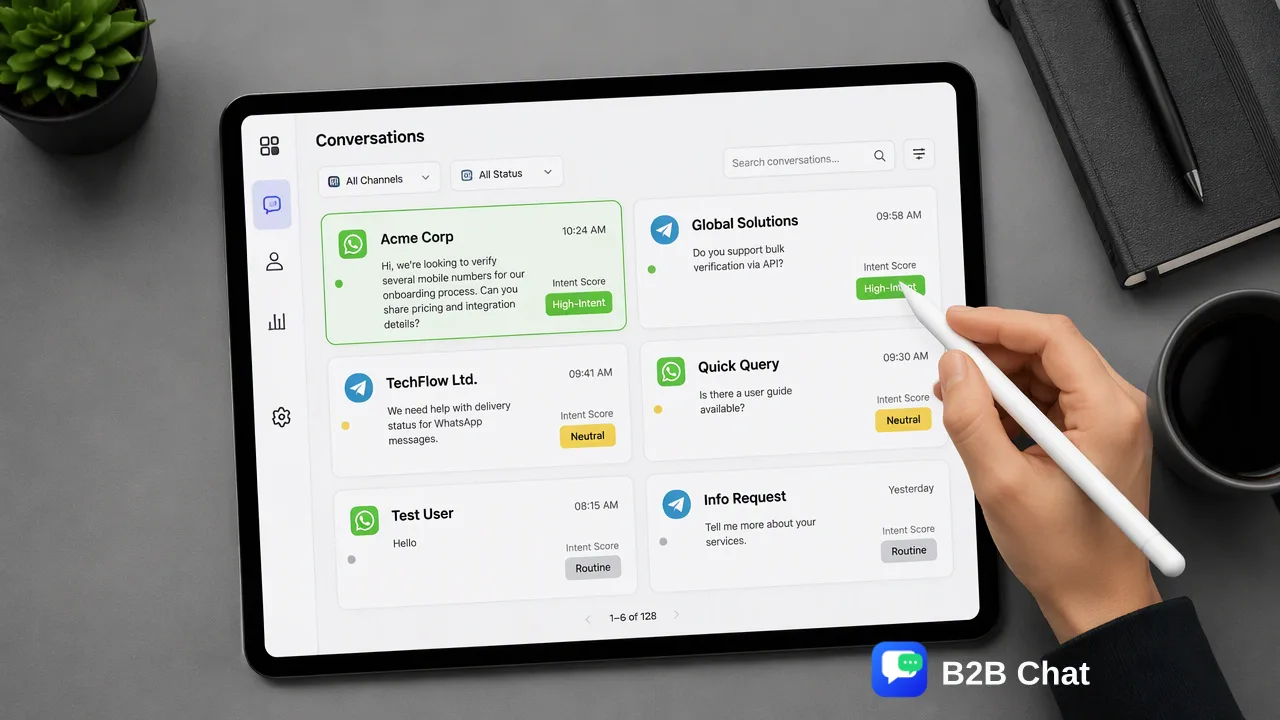
Discover eight practical use cases for AI agents across WhatsApp sales and customer support, detailing how context-aware automation, conversation triage, and multilingual capabilities assist messaging teams.
AI agents enhance WhatsApp sales and customer support workflows by replacing rigid decision trees with context-aware natural language processing. By evaluating conversation history, message context, and customer intent, an AI agent can assist teams with real-time lead qualification, personalized product suggestions, shared inbox triage, and automated first-line inquiries. Working alongside human agents in a centralized messaging client, AI automation helps teams maintain responsive communication across global accounts without losing conversational nuance.
The Evolution: From Rigid Decision Trees to Context-Aware AI Agents
Customer communication on messaging channels has shifted away from static interactive voice response (IVR) style menus. Early WhatsApp bots forced prospects through brittle button flows and predefined keyword prompts. When a user presented an unexpected question or combined several requests, traditional bots stalled, requiring immediate manual intervention. Context-aware AI agents operate differently by evaluating the full dialogue thread. Rather than isolating individual keywords, these systems interpret customer intent, conversational tone, and prior touchpoints. This contextual comprehension assists organizations in handling fluid conversational paths, clarifying ambiguous questions, and gathering necessary details before routing the chat to an account manager or support specialist.
1. Real-Time Lead Qualification and Intent Scoring
Inbound chat volume often contains a mix of exploratory inquiries, technical questions, and ready-to-buy prospects. An AI agent deployed on WhatsApp can analyze incoming inquiries in real time, assessing customer intent and urgency through dialogue signals. Instead of making leads complete long web forms, the agent asks conversational qualifying questions regarding company size, timeline, and functional requirements. By evaluating buyer responses, the AI helps categorize inquiries, giving sales representatives immediate context so they can focus attention on high-intent prospective deals.
2. Tailored Product and Catalog Recommendations
Browsing complex catalogs directly inside messaging apps can overwhelm customers if presented as endless PDF attachments or static links. An AI agent references specific customer preferences expressed during chat to recommend relevant offerings. When a prospect asks about specifications, pricing tiers, or inventory compatibility, the agent synthesizes catalog details into concise conversational summaries. This guided discovery assists buyers in finding appropriate solutions directly within their WhatsApp chat interface.
3. Automated Follow-Ups and Cold Lead Re-Engagement
Sales leads frequently stall when prospects step away from active chats. AI agents can monitor conversation staleness and support structured re-engagement strategies for dormant discussions. By reviewing previous conversational threads, the agent can generate natural, personalized follow-up messages tailored to the customer's stated requirements. This maintains contact continuity without requiring representatives to manually track and draft check-in messages across dozens of open chats.
4. Context-Aware Multilingual Customer Service
Cross-border commerce requires teams to manage communications in multiple regional languages. Basic machine translation often struggles with industry terminology, colloquialisms, and conversational register. Using specialized translation capabilities, such as those available in B2B Chat, customer messages across 200+ languages are automatically detected and translated with expressions adjusted to match conversation context. This assists domestic support teams in reading inbound inquiries and drafting accurate outbound responses in the customer's native language. | Capability | Traditional Chatbot | Context-Aware AI Agent | | :--- | :--- | :--- | | Intent Parsing | Keyword matching | Semantic context and history | | Language Support | Pre-configured multilingual menus | Automatic detection across 200+ languages | | Response Style | Static, hard-coded scripts | Adaptive, natural tone | | Escalation Model | Disconnects on unexpected input | Intelligently triages and assists human reps |
5. Shared Inbox Triage and Conversation Prioritization
High-volume WhatsApp business accounts risk cluttered shared inboxes where critical customer tickets can get buried under routine administrative questions. AI agents assist in triaging incoming traffic by classifying conversation topics, sentiment, and stated urgency. By categorizing inquiries—such as billing issues, product bugs, or purchase orders—the system helps route specific threads to designated department folders or specialists. This prioritization supports team workflows by highlighting urgent items before routine queries.
6. 24/7 Automated First-Line Inquiry Assistance
Operating across international time zones makes around-the-clock staffing challenging for growing teams. AI customer service agents handle initial customer touches by interpreting customer intent directly from incoming messages and dialogue context. The system handles routine questions such as operational hours, return policies, order tracking, and account setup guidelines. Providing prompt, automated first-line assistance keeps prospects engaged during off-hours while compiling interaction records for human teams arriving on shift.
7. Maintaining Brand Consistency Across Multiple Accounts
Organizations managing distributed regional operations often operate several WhatsApp, Telegram, or LINE accounts concurrently. Without centralized management, maintaining a cohesive communication standard across different operators can prove difficult. A unified workspace like B2B Chat lets teams aggregate multiple accounts into a single desktop application on Windows or macOS. AI agents working within this shared environment reference predefined brand guidelines and contextual chat histories, helping representatives maintain uniform tone, terminology, and messaging accuracy across diverse channels.
8. Human-in-the-Loop Review for High-Stakes Sales Pitches
While automation accelerates routine inquiries, enterprise contracts and custom negotiations require human judgment. A human-in-the-loop workflow leverages AI speed while preserving strategic control. In this model, the AI agent drafts contextual response recommendations based on customer questions and past interaction records. A human sales specialist reviews, edits, and approves the proposed message before transmission. This combined workflow assists sales teams in drafting responses quickly while maintaining strict oversight over commercial terms, pricing commitments, and relationship management.
FAQ
How do context-aware AI agents differ from traditional rule-based chatbots?
Traditional chatbots rely on strict keyword triggers and predetermined button trees, which often fail when customer phrasing deviates from preset scripts. In contrast, context-aware AI agents analyze full message history and situational context to interpret customer intent, helping teams deliver flexible, natural dialogue.
Can teams manage AI agents across multiple messaging channels simultaneously?
Yes. Platforms like B2B Chat provide downloadable desktop software for Windows and macOS that centralizes accounts across WhatsApp, Telegram, and LINE, allowing operators to oversee multi-account messaging and AI-assisted workflows within a unified workspace.
Why is human oversight recommended for AI-assisted sales conversations?
Human-in-the-loop review ensures that complex inquiries, negotiated terms, and strategic sales pitches remain aligned with company policy and relationship nuances before messages are dispatched to prospective buyers.
How does contextual translation assist global WhatsApp support?
Context-aware translation detects inbound customer languages across more than 200 languages and adapts translated phrasing to conversational context, helping international sales and support representatives communicate clearly with overseas prospects.
Learn More
Choose the product information that fits the next step in your workflow.