Rule-Based Automation vs. AI Agents: A Strategic Framework for Messaging Teams
Compare rule-based automation and AI agents to build a scalable, responsive messaging workflow across WhatsApp, Telegram, and LINE channels.
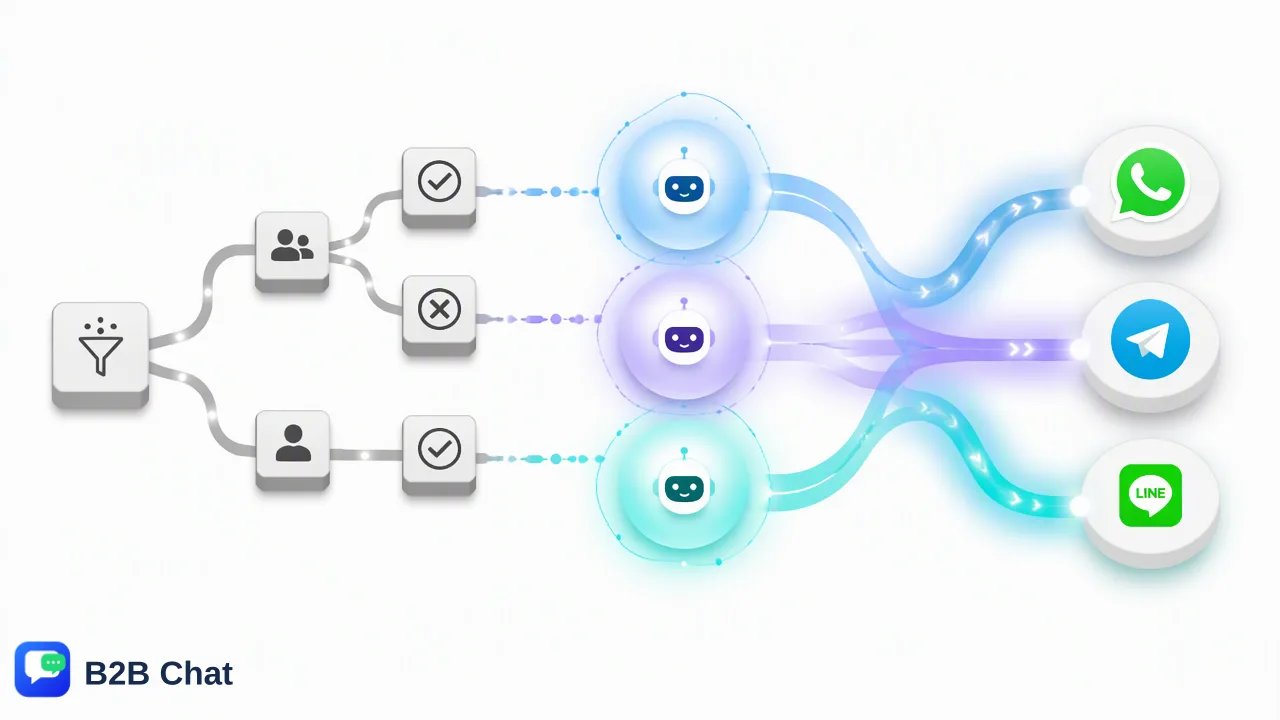
Compare rule-based automation and conversational AI agents to design an effective hybrid messaging stack for WhatsApp, Telegram, and LINE operations.
Modern messaging teams achieve the best operational balance by adopting a hybrid strategy rather than choosing strictly between rigid logic and machine learning. In the comparison of ai agent vs rule-based automation, rule-based systems provide predictable execution, strict operational control, and consistency for structured, repetitive tasks such as routing and menu navigation. In contrast, AI agents contribute conversational flexibility, interpret customer intent from context, and handle dynamic, non-linear inquiries across messaging channels like WhatsApp, Telegram, and LINE. Combining both approaches helps organizations maintain structural governance while scaling responsive first-line customer interactions.
The Evolution of Messaging Automation
Customer communication across private-domain channels and social messaging apps has shifted dramatically from static broadcast channels into dynamic, multi-turn dialogues. Early messaging workflows relied almost exclusively on linear if-then trees. While these mechanisms helped teams manage basic triage, modern consumer expectations demand immediate comprehension of unstructured text across global platforms including WhatsApp, Telegram, and LINE. Evaluating an ai agent vs rule-based automation strategy requires understanding where deterministic branching succeeds and where it creates operational friction. As conversation volumes increase across international markets, messaging operations must evolve beyond rigid keyword triggers to maintain high-quality communication without exponentially expanding manual support overhead.
Rule-Based Systems: The Foundation of Consistency
Rule-based automation operates strictly on predefined logic paths, deterministic decision trees, and keyword triggers. When an incoming message matches a set parameter, the system triggers a predetermined action, such as dispatching a canned confirmation or assigning a tag. These deterministic systems offer distinct operational strengths for enterprise communications:
- Predictability and Governance: Every interaction follows documented paths, ensuring that policy statements, initial disclosures, and transactional confirmations remain standard across all users. - Administrative Control: Operations teams can easily inspect, modify, and audit each conditional rule without managing probabilistic outcomes or model drift. - Low Processing Overhead: Simple trigger-action sequences process quickly without requiring machine learning inference for straightforward tasks like business-hour notifications or numeric menu selections. However, rule-based systems show significant limitations when customer inquiries deviate from anticipated scripts. Typos, compound questions, regional slang, or non-linear requests frequently trigger fallback errors, forcing conversations back to the beginning or immediately requiring human escalation.
AI Agents: Scaling Conversational Flexibility
Conversational AI agents apply natural language processing and contextual understanding to interpret customer intent rather than scanning for exact keyword matches. Instead of forcing users down rigid branches, an AI agent evaluates the nuance of an incoming query, considers conversation context, and assists with automated first-line responses. In practical messaging environments, AI agents introduce key capabilities that complement deterministic rules:
- Intent Recognition: AI models interpret varied phrasings of the same question, understanding customer needs even when messages include colloquialisms or unstructured descriptions. - Contextual Awareness: By evaluating conversation history, AI systems maintain coherence over multi-turn dialogues, preventing repetitive questioning. - Multilingual Adaptation: Global operations frequently receive inbound messages across dozens of languages. Context-aware AI translation covering 200+ languages automatically detects incoming dialects and adjusts expressions to maintain natural phrasing across cross-border markets. Rather than fully replacing human representatives, conversational AI serves primarily as an operational assistant. It automates initial triage, answers routine contextual questions, and prepares draft responses, helping human agents focus on high-value, sensitive negotiations.
Comparative Analysis: Rule-Based Logic vs. AI Agents
Understanding how each technology performs across operational dimensions helps teams allocate customer touchpoints effectively:
| Operational Dimension | Rule-Based Automation | AI Agents |
|---|---|---|
| Core Mechanism | Pre-defined conditional trees and keywords | Intent understanding and context analysis |
| Best Use Cases | Menus, opt-ins, business hours, routing | Open-ended inquiries, multi-turn triage |
| Response Adaptability | Fixed and static | Context-aware and dynamically formulated |
| Error Handling | Repetitive fallbacks on unexpected inputs | Semantic clarification and flexible interpretation |
| Multilingual Support | Requires manual translation per template | Automatic language detection across 200+ languages |
| Maintenance Requirement | Continual manual expansion of rule lists | Prompt governance and intent fine-tuning |
Building a Hybrid Messaging Stack
The most efficient messaging architectures avoid an all-or-nothing approach. Instead, leading messaging teams combine rule-based structure for routine administrative governance with AI agents for conversational adaptability. An effective hybrid framework structures customer communication into distinct operational layers:
- Deterministic Front-End Routing: Use rule-based automation to handle initial consent verification, account verification prompts, and top-level channel routing. 2. AI-Assisted First-Line Engagement: Route unstructured user messages to AI agents capable of understanding intent, querying internal product knowledge, and handling context-aware translation across WhatsApp, Telegram, or LINE. 3. Human Escalation and Oversight: When inquiries involve complex negotiations, edge cases, or sensitive account actions, the system routes the thread to human agents with full conversational context. Organizations operating across multiple social channels can deploy this hybrid framework using centralized client workspaces. Connecting multiple WhatsApp, Telegram, and LINE accounts inside a desktop application on Windows or macOS helps teams centralize multi-account management, apply unified rule trees, and leverage contextual AI assistance from a single operational hub.
FAQ
When should a team prioritize rule-based automation over AI?
Teams should prioritize rule-based automation when interactions demand strict adherence to static procedures, predictable routing, or rigid compliance boundaries. Tasks such as opt-in capture, deterministic menu selection, keyword-triggered disclaimers, and standard operational hour notices benefit from the total control and auditability that rule engines provide.
How does AI improve the efficiency of customer service teams?
AI improves team efficiency by evaluating incoming natural language, detecting user intent, and assisting with contextual first-line responses. By analyzing conversational context rather than relying solely on exact keyword matches, AI agents help triage inquiries and draft relevant replies, which reduces manual repetitive sorting for human operators.
Can AI agents handle multi-channel messaging effectively?
AI agents handle multi-channel messaging effectively when deployed within a unified messaging workspace that connects accounts across platforms like WhatsApp, Telegram, and LINE. Combined with contextual language processing and automated translation across 200+ languages, AI agents support consistent communication across disparate global channels.
Learn More
Choose the product information that fits the next step in your workflow.