AI-Assisted Customer Service: A Practical Guide for Global Teams
Learn how AI-assisted customer service helps global teams interpret message intent, manage multilingual chats, and support first-line messaging workflows.
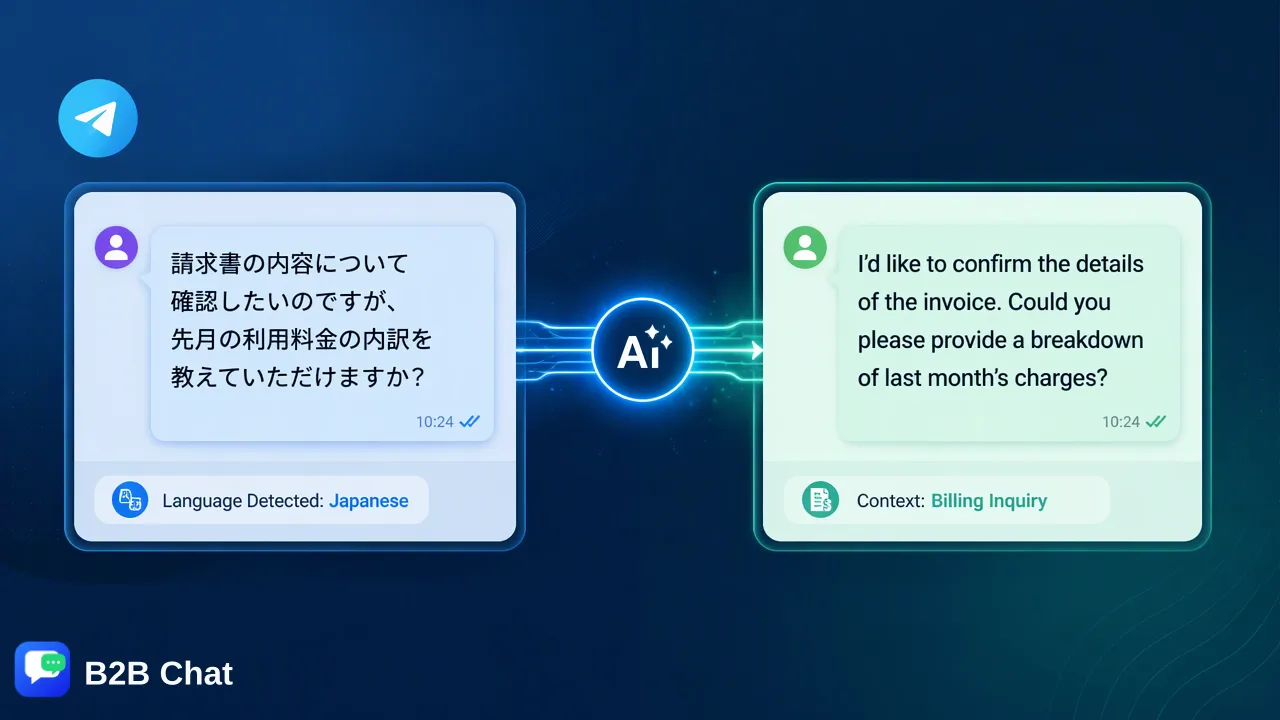
A practical guide on implementing AI-assisted customer service across WhatsApp, Telegram, and LINE. Learn how intent interpretation and context-aware translation assist first-line support while human agents maintain ownership of complex customer outcomes.
AI-assisted customer service uses artificial intelligence to interpret customer intent from incoming messages and conversation context, assisting human agents with automated first-line responses. For global teams operating across social messaging channels such as WhatsApp, Telegram, and LINE, this approach supports inquiry triage and multilingual communication across more than 200 languages, while keeping complex problem resolution and final customer outcomes under human ownership.
The Evolution of Global Customer Service Across Messaging Channels
Global customer support has shifted rapidly from traditional ticketing portals and email queues to direct social messaging environments. Customers increasingly initiate conversations through chat applications such as WhatsApp, Telegram, and LINE, expecting quick acknowledgments and contextual replies. For international organizations, managing support across these distributed channels introduces distinct operational friction. First, teams must navigate channel fragmentation. When support agents switch between standalone mobile apps or browser windows to check individual WhatsApp numbers, Telegram groups, or LINE accounts, context is easily lost. Critical customer messages can be delayed or overlooked, and maintaining uniform service standards across accounts becomes difficult. Second, global audiences communicate in dozens of local languages and regional idioms. Supporting international users historically required staffing regionally localized teams across multiple time zones, driving up administrative complexity and operational overhead. Modern AI-assisted workflows address these operational demands by centralizing multi-platform customer conversations within dedicated desktop environments—such as downloadable clients for Windows and macOS—while utilizing artificial intelligence to assist first-line interactions. Rather than attempting to automate every dialogue entirely, AI-assisted customer service focuses on assisting support teams with message categorization, intent detection, and context-informed language handling.
Interpreting Intent and Conversation Context with AI
A core limitation of conventional keyword-matching bots is their inability to parse nuance. A customer stating "I cannot access my order details after updating my email" contains multiple operational topics: an account modification and an access failure. Rigid rule-based systems often misroute such inquiries or reply with irrelevant pre-scripted links. AI customer service interprets customer intent by analyzing incoming messages within the broader conversation context. By evaluating recent message history, the system determines whether an inbound message represents a standard product question, a repeated service complaint, a billing inquiry, or an urgent operational issue. Once intent is identified, the system assists in generating context-appropriate first-line responses. In routine scenarios, such as inquiries about business hours, catalog availability, or standard documentation steps, the system can draft or deliver an immediate response. This workflow helps support personnel by managing repetitive first-contact volume, giving human agents more capacity to concentrate on nuanced troubleshooting, relationship management, and edge-case resolution.
Bridging Multilingual Support with Context-Aware Translation
Cross-border operations require clear, natural communication across language barriers. Basic word-for-word machine translation often fails in fast-paced messaging environments because it ignores technical terminology, conversational phrasing, and regional idioms. In a customer-support context, an awkward or mistranslated sentence can create confusion and frustrate users. AI translation integrated into messaging workspaces automatically detects incoming languages and translates customer messages across 200+ languages. Crucially, the translation expression adjusts dynamically based on the surrounding conversation context. Rather than translating an isolated phrase literally, the engine considers previous interactions to select appropriate technical terminology, tone, and grammatical structure. | Translation Capability | Generic Machine Translation | Context-Aware AI Translation | | :--- | :--- | :--- | | Language Scope | Often restricted to major language pairs | Covers 200+ languages with automatic detection | | Contextual Adjustment | Treats each sentence independently | Adapts expressions based on dialogue history | | Tone Consistency | Often overly formal or literal | Aligns phrasing with natural support conversation | | Operational Application | Manual copy-pasting between browser tabs | Embedded directly within multi-channel chat workflows | By embedding context-aware translation into daily workflows, support representatives can read incoming foreign-language inquiries in their preferred working language and compose replies that are translated accurately for the customer.
Maintaining Human Ownership and Structured Escalation
Deploying artificial intelligence in customer service should not mean disconnecting human representatives from the process. Customer outcomes depend on accountability, empathy, and sound business judgment. Fully autonomous systems introduce risks of miscommunication when edge cases or emotionally charged situations arise. In an AI-assisted framework, artificial intelligence functions as a first-line support co-pilot rather than a complete replacement for human staff. Teams establish clear escalation boundaries where the AI handles initial greeting, intent categorization, and standardized first-line responses, but routes ambiguous or sensitive interactions to human agents. To build a reliable escalation workflow, organizations should structure responsibilities clearly:
- First-Line Triage: AI analyzes incoming intent, classifies the issue, and provides immediate answers to standard, repetitive inquiries. - Agent Review: Human agents review AI-generated response suggestions for complex tickets, adjusting nuances before sending. - Direct Intervention: When an interaction involves account security, high-value commercial transactions, or multi-faceted technical issues, human agents take full control of the dialogue. - Continuous Context Preservation: As interactions escalate from automated triage to live human handling, the complete conversational context and translation history remain accessible to the agent in one place. This division of labor helps organizations maintain consistent first-line response speeds while ensuring that experienced professionals retain final ownership over customer satisfaction and dispute resolution.
Centralized Workspace Workflows for WhatsApp, Telegram, and LINE
Managing global messaging operations at scale requires practical infrastructure. When agents must juggle multiple devices or browser sessions to service different regions, workflow friction increases. B2B Chat provides a unified customer-service workspace designed for cross-border teams operating across WhatsApp, Telegram, and LINE. Delivered as a downloadable client for Windows and macOS, the workspace aggregates accounts into a single interface. Support agents can connect multiple messaging accounts, monitor inbound message queues across channels, and apply AI translation and automated first-line assistance without switching tools. | Operating Channel | Primary Support Characteristics | AI-Assisted Operational Role | | :--- | :--- | :--- | | WhatsApp | Primary channel for global trade, personal queries, and order updates | Contextual triage, auto-replies for routine inquiries, and language translation | | Telegram | Popular for international communities, technical discussions, and broadcast updates | Multi-account management, intent routing, and real-time community inquiries | | LINE | Essential for key Asian markets (Japan, Taiwan, Thailand) | Context-aware translation, conversational first-line response, and localized support | By bringing multi-account aggregation, context-aware AI translation, and intent-driven first-line support into one client, global organizations reduce tool switching and support their front-line personnel in maintaining professional communication worldwide.
FAQ
How does AI-assisted service differ from fully automated bots?
Fully automated bots attempt to handle customer conversations end-to-end without human intervention, which can lead to friction when handling complex or ambiguous requests. AI-assisted service acts as an operational partner: it interprets customer intent and conversation context to assist in generating first-line responses, while human agents oversee the conversation, manage escalations, and retain ownership of final customer outcomes.
How does context-aware AI translation improve multilingual chat support?
Context-aware AI translation supports over 200 languages and adjusts phrasing based on the ongoing dialogue rather than translating sentences in isolation. This ensures that technical terms, conversational tone, and regional expressions match the flow of customer-service discussions, reducing misunderstandings across international messaging channels.
Which messaging channels can teams manage within a single desktop workspace?
Teams can connect and operate multiple accounts across WhatsApp, Telegram, and LINE using a downloadable client available for Windows and macOS. This centralizes multi-account messaging, AI translation, and customer-service automation into a single interface.
What is the primary role of AI in first-line customer service?
The primary role of AI in first-line support is to interpret customer intent from incoming messages and conversational history. It assists teams by generating immediate first-line replies to routine queries and categorizing incoming volume, allowing human agents to concentrate on complex issue resolution.
Learn More
Choose the product information that fits the next step in your workflow.