Balancing AI Automation and Human Oversight in Business Messaging
Build a balanced ai-assisted customer service workflow across WhatsApp, Telegram, and LINE using automated first-line replies and human oversight.
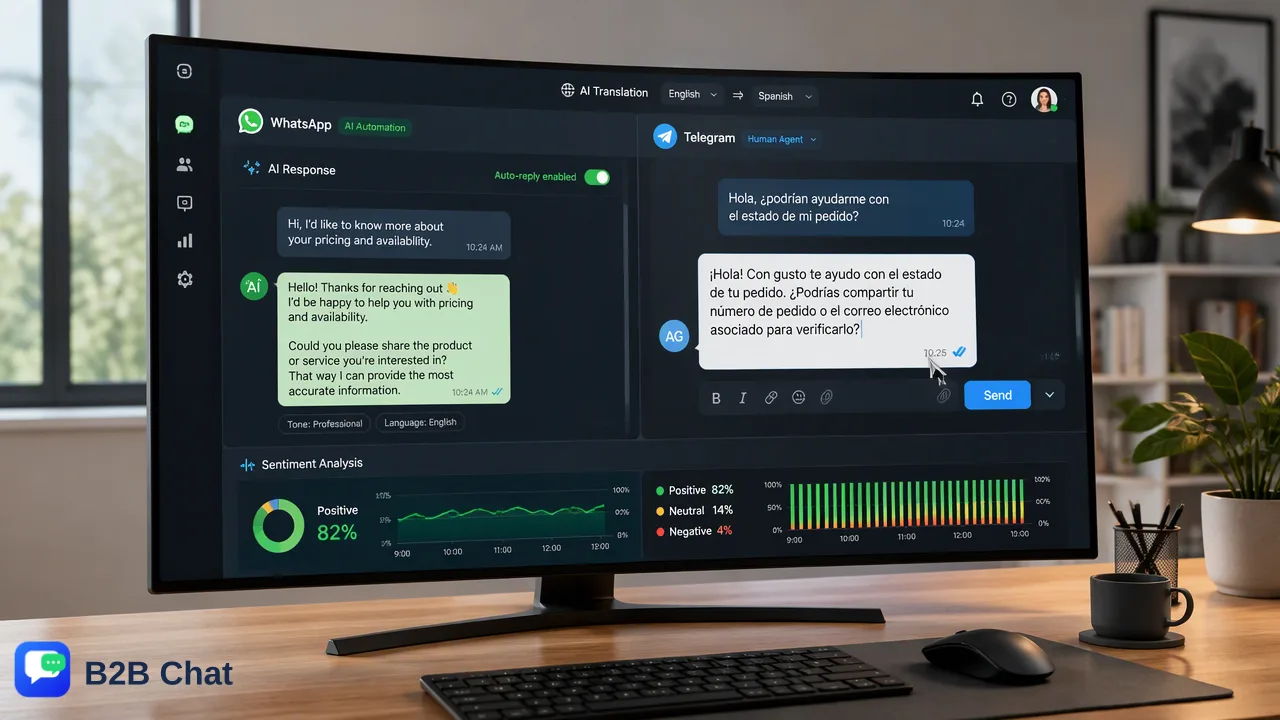
Learn how an ai-assisted customer service workflow balances automated first-line replies with human oversight across WhatsApp, Telegram, and LINE.
An effective ai-assisted customer service workflow combines automated first-line messaging with structured human oversight. In modern social messaging, AI models interpret incoming customer intent and address high-volume, routine inquiries such as FAQs, order lookups, and basic status updates around the clock. Meanwhile, human agents step in to resolve nuanced, high-stakes, or emotionally sensitive inquiries. Operating this hybrid model within a shared workspace ensures that both automated assistants and human representatives share conversation history, supporting operational continuity and preventing customer frustration across platforms like WhatsApp, Telegram, and LINE.
The Strategic Role of AI in Modern Messaging
Customer communication across direct messaging apps moves quickly, and global audiences often expect immediate responses regardless of operating hours or time zones. Implementing an ai-assisted customer service workflow helps organizations address this expectation by managing first-line interactions at scale. Automated customer-service capabilities excel at structured, repetitive tasks. When an incoming message arrives on WhatsApp, Telegram, or LINE, conversational AI tools interpret the customer's intent from the message and preceding context. These systems can autonomously resolve frequent queries, including:
- Answering routine operational FAQs such as business hours, return policies, and service guidelines. * Providing self-service updates, tracking information, and status checks. * Collecting preliminary account details, inquiry descriptions, and user preferences before routing to an agent. Deploying automated assistants for these standard tasks reduces routine operational bottlenecks and helps maintain continuous coverage outside standard business hours. Instead of requiring human agents to compose identical responses throughout the day, the automated layer provides immediate confirmation and resolution for standard scenarios, reserving team capacity for specialized cases.
Defining the Human-in-the-Loop Model
While automated messaging handles high-frequency inquiries efficiently, relying solely on automated responses introduces operational risks. Routine language models lack human empathy, contextual discretion, and situational judgment. A human-in-the-loop framework ensures that business messaging maintains qualitative standards during critical interactions. Human intervention remains essential for inquiries that involve sensitive complaints, exceptions to standard policy, complex technical troubleshooting, and high-stakes relationship management. If a customer expresses disappointment, confusion, or urgency, an automated script can feel dismissive. In an effective hybrid framework, automation acts as an assistant rather than an autonomous decision-maker for sensitive interactions. To manage this transition smoothly, organizations configure specific routing criteria. Triggers for human handoff often rely on conversational cues, sentiment indicators, and user intent classification:
| Interaction Type | Recommended Handling | Primary Objective |
|---|---|---|
| Routine FAQs & Status Checks | Automated First-Line AI | Provide immediate resolution around the clock |
| Initial Information Gathering | Automated Data Collection | Collect account details and query context |
| Sensitive Complaints & Disputes | Direct Human Routing | Apply empathy, discretion, and problem resolution |
| High-Value Negotiations | Specialized Human Agent | Exercise business judgment and relationship care |
| When these routing boundaries are clearly established, automation handles the volume while human representatives focus where their judgment delivers the greatest value. |
Operationalizing Hybrid Support with a Unified Workspace
A hybrid messaging model requires technical infrastructure that prevents fragmented communication. If automated assistants and human representatives operate in separate tools, handoffs become disjointed, leading to duplicated questions and customer frustration. Operationalizing an ai-assisted customer service workflow requires a centralized client where multiple social accounts and platforms converge. B2B Chat provides a downloadable workspace for Windows and macOS, designed to aggregate WhatsApp, Telegram, and LINE accounts into a single operating environment. This architecture allows customer service teams to manage multi-login accounts from one desktop interface without continuously juggling physical devices or browser profiles. Within this unified workspace, automated tools and human operators share the same conversation history. When a customer inquiry moves from an automated first-line reply to a live specialist, the agent can review the exact transcript, the customer's stated problem, and any gathered preliminary details. This shared context helps the human agent step into the dialogue smoothly, without asking the customer to repeat information. Furthermore, for cross-border teams managing private-domain traffic and global customer communities, the platform incorporates context-aware AI translation across more than 200 languages. Because the translation adapts expression based on surrounding conversation context, human operators can review incoming messages and send localized replies accurately. Unifying multi-account management, contextual translation, and automated first-line response within a single downloadable client helps cross-border teams scale their messaging operations while preserving attentive oversight.
FAQ
When should teams escalate a conversation from AI to a human agent?
Teams typically establish escalation triggers based on intent complexity, customer sentiment, and specific inquiry types. When an incoming message involves formal complaints, contract negotiations, high-value account issues, or repeated expressions of frustration, the workflow routes the conversation directly to a human specialist. Escalation is also warranted when an inquiry falls outside the scope of predefined first-line topics or when an automated response requires nuanced human judgment.
What operational benefits does a unified messaging workspace provide?
A unified messaging workspace centralizes multiple accounts and platforms into a single interface. By connecting channels like WhatsApp, Telegram, and LINE, support teams review and respond to inquiries without switching between disparate browser tabs or individual mobile devices. This centralized environment also preserves the complete conversation history, so when a conversation transitions from an automated assistant to a live team member, all prior context remains intact.
How does multilingual translation function within a hybrid messaging model?
In cross-border customer operations, automated translation detects incoming languages and converts text according to conversational context across more than 200 languages. In a hybrid setup, this capability assists human agents by translating incoming customer queries into the agent's preferred working language and converting outgoing replies back into the customer's native language, helping international teams maintain consistent communications.
Learn More
Choose the product information that fits the next step in your workflow.