How to Safely Implement AI-Assisted Drafting in Your Customer Support Workflow
Learn how to safely implement an ai-assisted customer support workflow using human-in-the-loop validation, bounded context, and multi-channel aggregation.
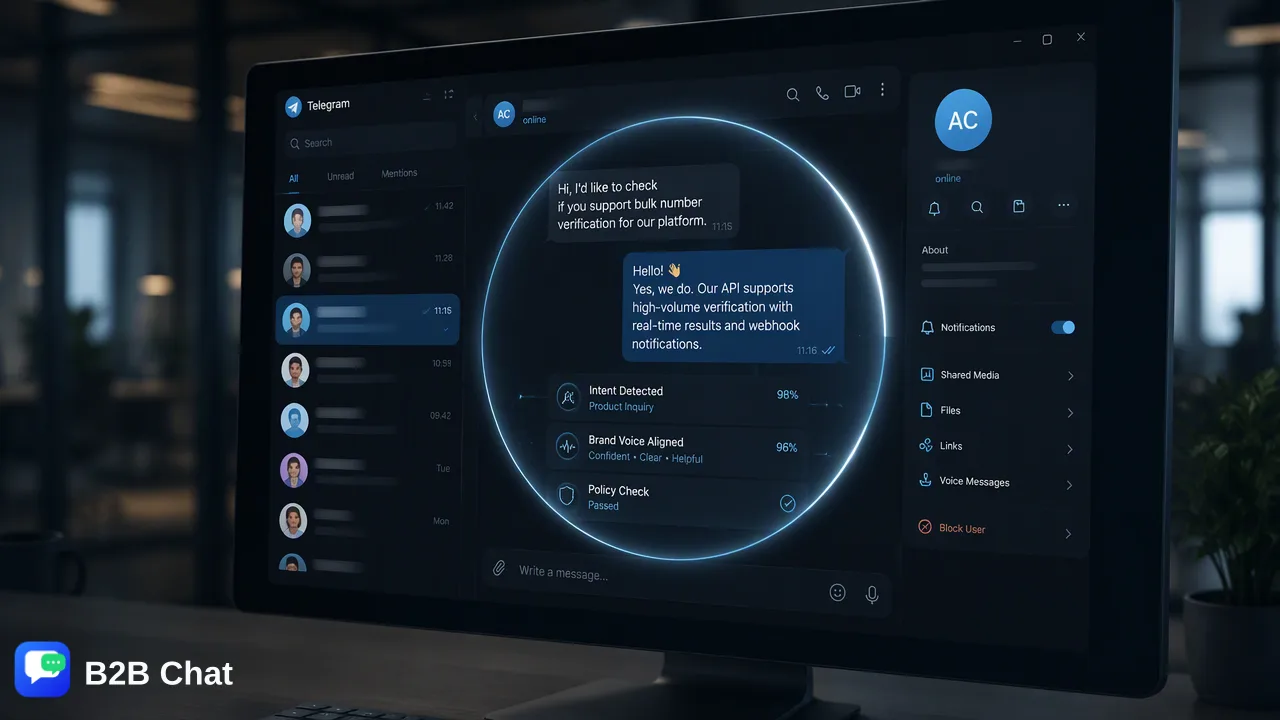
Learn how to safely implement an AI-assisted customer support workflow by utilizing human-in-the-loop validation, bounded context, and multi-channel account aggregation.
An ai-assisted customer support workflow improves operational efficiency by automating research and response generation, but maintaining safety requires a strict human-in-the-loop model. By treating AI outputs as internal proposals rather than final replies, teams can maintain brand consistency, support accuracy through context-aware validation, and mitigate the risks associated with fully autonomous bots in high-volume messaging environments. Implementing bounded context and a two-step review process helps organizations scale their support operations across multiple messaging channels while keeping human agents in control of the final customer interaction.
The Shift from Autonomous Bots to AI-Assisted Drafting
The traditional approach to automated customer service often relied on fully autonomous bots designed to deflect tickets and reply to users without human intervention. While this model can handle basic inquiries, it frequently struggles with complex issues, leading to generic responses, frustrated customers, and potential brand damage. To achieve operational excellence, organizations are shifting toward an ai-assisted customer support workflow. In this model, AI agents function as sophisticated research assistants rather than autonomous replacements for human staff. The AI interprets customer intent from incoming messages and conversation context to assist automated first-line responses, but it does not have the final authority to send them. This operational shift prioritizes human-in-the-loop systems. By treating AI-generated outputs as internal proposals, support managers and technical leads can verify that every message aligns with the company's brand voice and operational guidelines. Human oversight remains critical because human agents possess the contextual judgment and empathy that AI currently lacks. When the AI handles the repetitive tasks of reading, interpreting intent, and drafting a baseline response, human agents are freed to focus on reviewing, refining, and personalizing the communication. This collaborative approach leverages the speed and analytical capabilities of AI while maintaining the safety, accuracy, and brand consistency that human validation provides.
Designing for Bounded Context
A critical component of a safe ai-assisted customer support workflow is the principle of bounded context. Bounded context refers to the practice of strictly limiting the data and historical conversation scope that an AI agent can access when generating a response. Without these boundaries, AI models risk pulling in irrelevant information, hallucinating facts, or exposing sensitive data from unrelated interactions. By designing the workflow around a bounded context, organizations keep the AI focused exclusively on the immediate customer inquiry and the specific parameters of the current thread. In practical application, this means the AI Customer Service tool must interpret customer intent derived solely from the incoming messages and the immediate conversation context. By restricting the AI's analytical scope to the active dialogue, the generated drafts remain highly relevant to the customer's actual problem. This localized context restricts the AI from making assumptions based on broad, generalized training data that may not apply to the specific brand or product in question. Furthermore, when utilizing AI Translation features, adjusting the translation expression based strictly on the conversation context helps maintain industry-specific terminology or nuanced customer phrasing. Limiting the data scope not only improves the accuracy of the internal proposals but also significantly reduces the risk of inappropriate or off-brand messaging reaching the human review stage.
Implementing a Two-Step Validation Workflow
To safely deploy AI in a high-volume support environment, organizations must implement a structured two-step validation workflow. This process separates the generation of a response from the act of sending it, effectively gating the AI's output behind human approval. The first step involves pre-drafting intent detection. When a customer message arrives, the AI Customer Service capability analyzes the incoming text and the surrounding conversation context to interpret the customer's intent. Based on this analysis, the system generates an automated first-line response proposal. Instead of dispatching this message immediately, the system presents it to the human agent as a draft. The second step is post-drafting human review. The human agent evaluates the proposed draft, checking it for accuracy, tone, and completeness. If the draft is appropriate, the agent can approve and send it; if it requires adjustment, the agent can edit the text before dispatching. This two-step validation process is particularly critical for mitigating race conditions in busy inboxes. In environments where customers send multiple rapid-fire messages, an autonomous bot might trigger overlapping or contradictory replies while a human agent is simultaneously reviewing the thread. By treating the AI strictly as a research assistant that prepares drafts, the workflow supports a single coordinated response, maintaining clarity and professionalism in the customer interaction.
Scaling Support Across Messaging Channels
Organizations operating in global markets require infrastructure that can handle multiple communication channels simultaneously. B2B Chat provides a customer-service and social-messaging workspace designed specifically for this purpose, focusing on WhatsApp, Telegram, and LINE account management. By utilizing a single downloadable client available for both Windows and macOS, support teams can connect and operate multiple accounts from one centralized interface. This account aggregation and multi-login capability reduces the friction of switching between different devices or browser tabs, helping agents manage outbound marketing and inbound support efficiently. When scaling an ai-assisted customer support workflow across these platforms, organizations can leverage Smart Customer Service capabilities, which are available at $0.02 per request. Because the platform operates with fully open ports, unlimited registrations, and no stated port quantity or usage-duration limits, teams can scale their account infrastructure alongside their support volume. Furthermore, for cross-border operations, AI Translation capabilities automatically detect and translate customer messages across more than 200 languages. Available at $0.002 per request, this translation function adjusts expressions based on the conversation context, helping the AI-assisted drafts maintain appropriate nuance regardless of the customer's native language. By combining multi-account management with context-aware AI drafting and translation, teams can maintain consistent service quality across WhatsApp, Telegram, and LINE.
FAQ
How does AI-assisted drafting differ from an autonomous chatbot?
AI-assisted drafting functions as a research and preparation tool rather than an independent communication agent. While an autonomous chatbot interprets messages and replies directly to the customer without human intervention, an assisted workflow uses AI to interpret customer intent from incoming messages and conversation context to assist automated first-line responses. These responses are generated as internal drafts that a human agent must review, edit, and approve before dispatching.
Why is human review necessary for AI-generated responses?
Human review supports accuracy, maintains brand consistency, and helps avoid race conditions in busy support inboxes. While AI can rapidly analyze conversation context and propose a reply, human agents provide the necessary judgment to verify that the tone and information align with company guidelines. Gating the AI output behind human approval mitigates the risk of sending generic, inaccurate, or overlapping messages to customers.
How can teams keep AI responses consistent with brand voice?
Teams can maintain brand voice by utilizing bounded context and enforcing a two-step validation process. By restricting the AI's analytical scope strictly to the immediate conversation context, the system generates highly relevant internal proposals. Furthermore, adjusting translation expressions based on conversation context helps maintain appropriate nuance. Finally, treating every AI output as a draft for human review provides a final quality check before the message reaches the customer.
What platforms can be integrated into an AI-assisted support workflow?
Organizations can integrate WhatsApp, Telegram, and LINE accounts into a centralized support workflow. Using a workspace like B2B Chat, teams can connect and operate multiple accounts from a single downloadable client available for Windows and macOS. This account aggregation supports outbound marketing and inbound support across global markets from one unified interface.