AI Sales Agent Testing Strategy: A Human-in-the-Loop Framework
Learn how to implement an AI sales agent testing strategy using a human-in-the-loop framework to support accurate, brand-consistent messaging workflows.
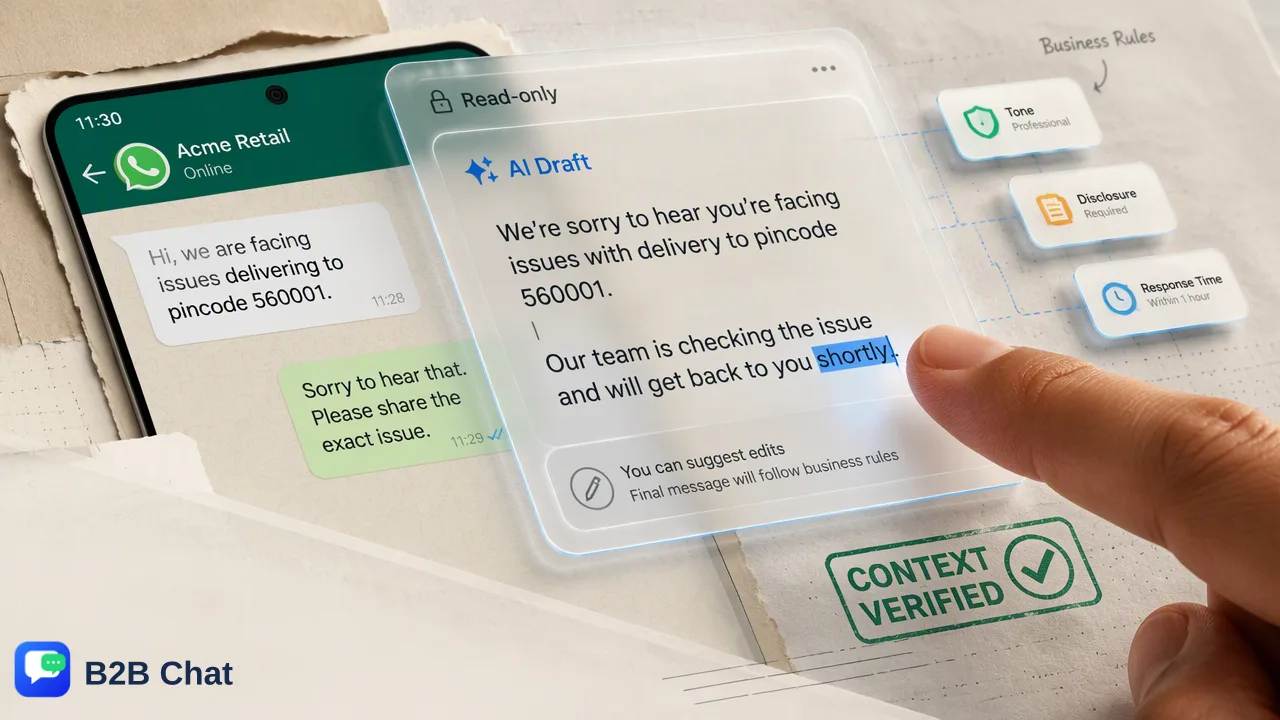
Learn how to implement a human-in-the-loop framework for AI sales agents using read-only preview modes, bounded context, and centralized messaging workspaces to support accurate customer communications.
An effective AI sales agent testing strategy relies on a human-in-the-loop framework to balance automation speed with operational accuracy. Implementing a read-only preview mode allows AI tools to draft responses based on conversation context while requiring human approval before any message is sent. By validating AI-generated drafts against business rules and checking conversation context before and after processing, organizations can maintain high service standards and mitigate brand-damaging errors. This approach supports the safe integration of AI customer service capabilities into multi-platform messaging workspaces, helping teams assist first-line responses without losing human oversight.
The Challenge of Scaling AI in Messaging
Start by addressing global marketing and customer-support teams managing high volumes of private-domain traffic. When scaling operations across multiple regions, teams face the challenge of maintaining rapid response times without sacrificing accuracy. AI customer service agents interpret customer intent from incoming messages and conversation context to assist automated first-line responses. However, deploying these models without an AI sales agent testing strategy introduces operational risks. Unsupervised AI can misinterpret nuanced customer inquiries, apply the wrong tone, or hallucinate policy details. For cross-border ecommerce teams, these errors can damage brand trust and disrupt the sales funnel. The challenge lies in harnessing the speed of AI while maintaining strict quality control over the final output. A human-in-the-loop (HITL) framework addresses this tension by inserting human oversight into the critical path between AI generation and message delivery, supporting a balance between automation and personalized service.
Designing a Human-in-the-Loop Workflow
A robust AI sales agent testing strategy relies heavily on a read-only preview mode. In this workflow, the AI processes incoming messages and generates a draft response, but it lacks the permission to send the message directly to the customer. Instead, the draft is surfaced in the messaging workspace for a human agent to review, edit, or approve. This read-only approach supports strict quality assurance, helping teams keep automated errors from reaching the end user. Beyond simple drafting, designing a safe workflow involves deploying agentic tools that perform specific, limited tasks. Rather than granting an AI open-ended control over the conversation, organizations can restrict the AI to bounded functions, such as calculating pricing based on a standardized rate card or looking up shipping policies. By limiting the scope of the AI's actions, teams reduce the surface area for potential errors. The human agent acts as the final decision-maker, evaluating whether the AI's specific output aligns with the broader context of the customer relationship. This collaborative model allows support operators to handle higher volumes of inquiries while retaining the nuanced judgment required for complex sales conversations.
Best Practices for AI-Assisted Communication
Implementing a human-in-the-loop framework requires structured operational practices to support efficiency and accuracy across messaging channels. First, teams should use bounded context to filter out irrelevant data before the AI processes a conversation. Providing an AI model with an entire, unfiltered chat history can lead to confusion or context collapse. By bounding the context—supplying only the most recent messages, relevant user metadata, and specific product details—organizations help the AI generate more accurate and focused drafts. Second, it is critical to validate AI decisions against business rules before surfacing them for human approval. If an AI drafts a response offering a discount, the system should cross-reference that draft against current promotional guidelines. Drafts that violate business rules can be flagged or discarded before a human agent ever sees them, reducing cognitive load and streamlining the review process. Third, teams must check conversation context twice: once before the AI begins processing and again after the draft is generated. Live messaging environments are highly dynamic. A race condition can occur if a human agent manually replies to a customer while the AI is simultaneously generating a draft. By verifying the conversation state immediately before surfacing the draft, the system can detect if a human has already intervened, helping teams avoid duplicate or conflicting responses.
Leveraging AI Tools for Consistent Support
Executing an AI sales agent testing strategy requires a centralized environment where human operators can efficiently manage drafts and live conversations. B2B Chat provides a comprehensive customer service tool for WhatsApp, Telegram, and LINE, allowing teams to connect and operate multiple accounts from a single downloadable client for Windows and macOS. This messaging aggregation supports outbound marketing and support by reducing tool switching and consolidating the review queue. Within this unified workspace, AI capabilities assist the human-in-the-loop workflow. AI customer service interprets customer intent to assist first-line responses, generating drafts that human agents can quickly review. For global operations, AI translation automatically detects and translates customer messages across 200+ languages. The translation expression is adjusted based on conversation context, providing human agents with accurate, localized drafts that require minimal editing. By centralizing account management and integrating context-aware AI tools, organizations can scale their multilingual conversations and first-line replies while maintaining the safety and oversight of a human-in-the-loop framework.
FAQ
Why is human oversight necessary for AI sales agents?
Human oversight supports quality control and brand consistency. While AI customer service agents interpret customer intent from incoming messages and conversation context to assist automated first-line responses, they can occasionally misinterpret nuance or generate inaccurate information. A human-in-the-loop framework mitigates these risks by requiring human approval before any message is delivered.
How does a read-only preview mode work in a messaging workspace?
In a read-only preview mode, the AI processes incoming messages and generates a draft response without sending it. The draft is displayed in the workspace for a human operator to review, edit, or approve. This workflow helps teams catch errors and refine the tone, serving as a core component of a safe AI sales agent testing strategy.
Can AI agents handle multi-platform messaging like WhatsApp and Telegram?
Yes, AI capabilities can be integrated across multiple channels. B2B Chat supports WhatsApp, Telegram, and LINE, allowing users to manage multiple accounts in one place. This centralized approach enables teams to apply a consistent human-in-the-loop review process across all supported messaging platforms from a single desktop client.
How do teams mitigate the risk of AI sending incorrect information to customers?
Teams can mitigate this risk by implementing bounded context to filter irrelevant data before AI processing, validating AI drafts against strict business rules, and checking the conversation context twice to account for race conditions. Combining these practices with a mandatory human review step helps maintain accurate and reliable customer communications.