What Is Conversational Commerce? A Guide to Unifying Messaging, Sales, and Support
Explore how a conversational commerce platform connects WhatsApp, Telegram, and LINE to streamline customer sales and support workflows globally.
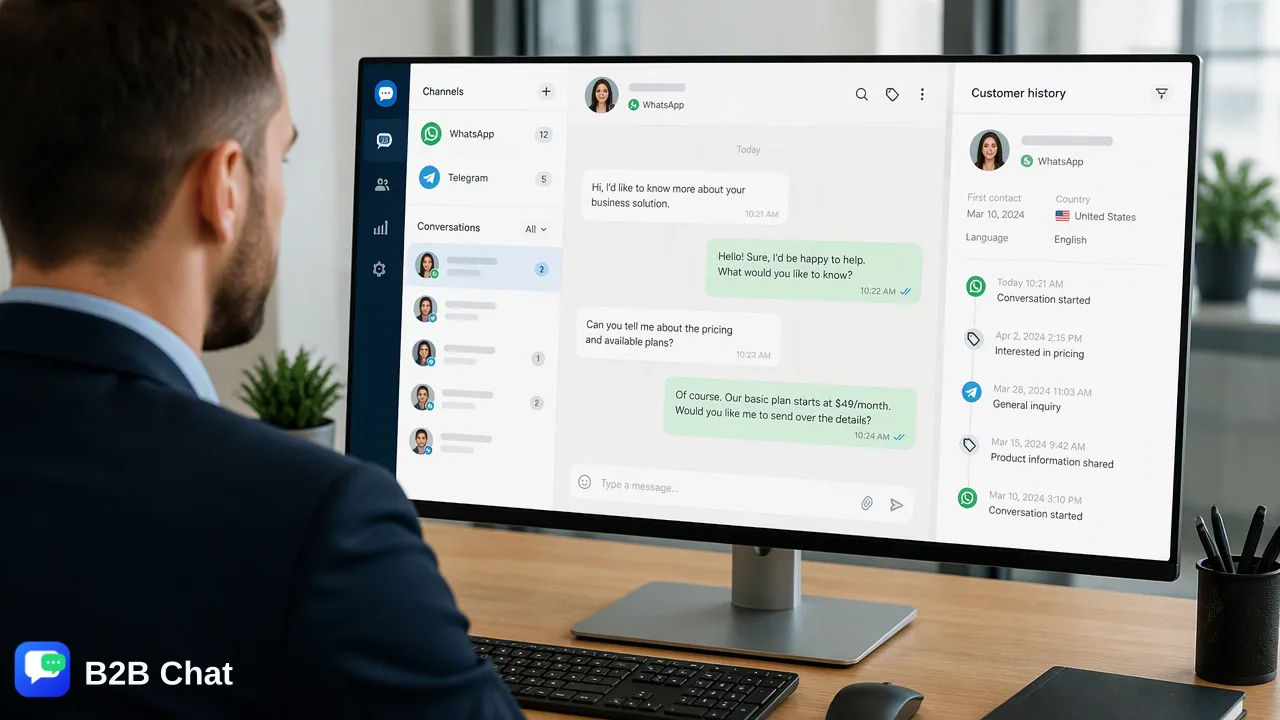
Learn how a conversational commerce platform unifies messaging apps like WhatsApp, Telegram, and LINE with sales and support workflows, using AI translation and automated context to scale global interactions.
Conversational commerce is an operational strategy that positions messaging applications at the center of business interactions, bridging the divide between customer support and sales. By consolidating channels such as WhatsApp, Telegram, and LINE into a unified workspace, organizations can manage customer inquiries, share catalog details, and coordinate transactions directly within ongoing chat threads. Supported by context-aware AI translation and automated first-line response systems, a conversational commerce platform transforms fragmented touchpoints into a continuous, contextual dialogue that helps teams improve response speed and support customer retention across international markets.
The Evolution of Customer Interaction
For years, commercial customer communication followed a disjointed, transactional model. Prospective buyers discovered products on websites, submitted inquiries through static web forms, and waited hours or days for email responses. When post-purchase questions arose, customers were redirected to separate support portals or ticketing queues that possessed little or no awareness of previous sales discussions. This fragmented approach introduced friction, slowed sales momentum, and created an impersonal buying experience. Conversational commerce fundamentally alters this dynamic by shifting the primary interface of business interaction to direct messaging applications. Rather than forcing prospects through rigid marketing funnels, organizations meet buyers where they already communicate daily—in chat threads across platforms such as WhatsApp, Telegram, and LINE. By uniting sales outreach, product discovery, and customer service inside real-time messaging, organizations bridge the traditional operational gap between customer acquisition and support. A conversation that begins as an inquiry about product dimensions can seamlessly transition into order confirmation, delivery coordination, and post-purchase check-ins within the exact same chat thread. This shift allows teams to maintain conversation history, reduce coordination handoffs, and deliver a consultative customer experience that supports higher engagement throughout the customer lifecycle.
Core Architecture of a Conversational Commerce Platform
To execute a messaging-first commercial strategy, organizations cannot simply distribute mobile handsets to individual agents. Relying on disconnected personal devices creates operational blind spots, risks data loss, and makes collaboration across distributed teams impossible. A dedicated conversational commerce platform provides the necessary centralized infrastructure to manage messaging channels systematically. At its core, a conversational commerce platform provides multi-channel aggregation. It consolidates multiple accounts across WhatsApp, Telegram, and LINE into a unified desktop application—supported on both Windows and macOS operating systems. This setup supports multi-login operations, allowing commercial teams to operate several communication lines simultaneously from one centralized console without constantly logging in and out of different browser instances. | Operational Capability | Traditional Disconnected Setup | Unified Conversational Commerce Platform | | :--- | :--- | :--- | | Account Management | Multiple mobile devices or separate browser sessions | Centralized desktop client managing multi-channel logins | | Channel Scope | Fragmented monitoring across WhatsApp, Telegram, and LINE | Aggregated operational inbox for all supported networks | | Context Retention | Isolated chat history on individual team member phones | Unified conversational history accessible for collaborative review | | Global Scalability | Manual translation and localized staff per region | Automated multi-language translation and AI-assisted workflows | By integrating messaging streams with internal operational workflows, CRM context, and product catalogs, unified platforms equip customer-facing agents with context-aware data. When a contact reaches out, agents can review previous inquiries, refer to available inventory, and provide accurate answers without transferring the customer across departments.
Scaling Global Operations Through AI and Automation
As messaging channels become the primary channel for buyer engagement, conversation volumes can quickly overwhelm manual teams. Inquiries arrive at all hours, particularly for enterprises conducting cross-border trade across divergent time zones. Artificial intelligence and conversational automation serve as critical operational infrastructure to maintain responsiveness without linearly expanding staffing requirements. Automated AI customer service operates by analyzing inbound messages and complete chat history to interpret customer intent. Rather than deploying rigid, keyword-matching bots that frustrate users with repetitive menus, modern AI tools assess context to assist first-line communication. These systems can answer standard product questions, confirm operational details, and qualify prospective buyers 24/7. When specialized negotiation or high-touch intervention is required, the system routes the thread to human operators with full conversational history intact. ``` Incoming Inbound Message (WhatsApp, Telegram, LINE) │ ▼ [Intent Understanding & Conversation Context Analysis] │ ├─► Standard Inquiry ──► Automated First-Line AI Response │ └─► Complex Commercial Request ──► Context-Prepared Human Operator Review
For cross-border commerce, language barriers represent another substantial operational hurdle. Conversational commerce tools like B2B Chat integrate real-time AI translation covering more than 200 languages. Rather than relying on rigid, word-by-word dictionary translation, context-aware engines evaluate the tone and flow of the interaction to adjust phrasing appropriately. This capability allows regional support representatives to converse fluently with international prospects in their native language, breaking down communication barriers and accelerating global sales cycles.

## Transforming the End-to-End Customer Journey

Adopting a conversational commerce approach restructures how buyers interact with commercial organizations throughout their entire lifecycle. Instead of experiencing the buying journey as a series of disconnected, single-use forms and emails, customers experience a continuous, personalized conversation that evolves alongside their needs. This continuous engagement model supports measurable operational improvements across several key dimensions:
* **Faster Response Times:** Real-time messaging interfaces and automated first-line AI assistance help teams respond to incoming prospects immediately, preventing leads from seeking alternatives. * **Informed Lead Qualification:** Through interactive dialogue, teams can assess customer requirements, clarify specifications, and determine purchase intent before routing the lead to senior account executives. * **Reduced Friction in the Sales Cycle:** Product recommendations, spec sheets, and checkout links can be distributed directly inside the messaging conversation, minimizing steps between interest and purchase. * **Proactive Post-Purchase Support:** After a transaction is completed, the same messaging channel serves as an immediate conduit for tracking updates, usage guidance, and follow-up support, contributing to stronger customer retention. By consolidating accounts across WhatsApp, Telegram, and LINE into an integrated workspace, businesses maintain complete visibility over their customer conversations. Teams can review interactions, maintain brand consistency, and support long-term private-domain customer relationships that contribute to commercial growth.

## FAQ

### What is a conversational commerce platform?

A conversational commerce platform is a centralized software workspace that integrates direct messaging channels—such as WhatsApp, Telegram, and LINE—with business operations, product data, and customer management workflows. It allows commercial teams to conduct consultations, handle inbound inquiries, qualify prospective leads, and deliver ongoing service within a single, persistent conversation interface rather than directing users through disconnected web forms or ticketing queues.

### How does AI improve customer service efficiency?

AI enhances service efficiency by evaluating incoming messages and full conversational context to interpret customer intent automatically. Rather than requiring human agents to manually sort and triage every interaction, AI customer service tools assist by generating automated first-line responses, addressing routine inquiries 24/7, and routing complex operational issues to human staff with conversation context already organized.

### Why is channel aggregation important for global businesses?

Global customers rely on diverse regional messaging applications, with preferences varying across WhatsApp, Telegram, and LINE. Operating these applications through separate devices or browser tabs creates communication silos, slow response times, and fragmented customer history. Multi-channel aggregation unifies multiple accounts into a single desktop client, helping teams oversee international conversations without constant application switching.

### Can AI translation handle industry-specific terminology?

Modern AI translation systems evaluate surrounding message context rather than translating isolated words literally. In B2B Chat, context-aware translation covers more than 200 languages and dynamically adjusts expressions based on the conversation flow, which helps teams communicate nuanced product specifications, technical details, and regional phrasing accurately during cross-border sales and support.

## Learn More

Choose the product information that fits the next step in your workflow.

- [View the product documentation →](https://b2bchat.ai/)
- [Talk to the team →](https://b2bchat.ai/)