Running Cross-Border Ecommerce Customer Conversations in One Workspace
Streamline cross-border ecommerce customer communication by consolidating WhatsApp, Telegram, and LINE accounts into one workspace with AI translation.
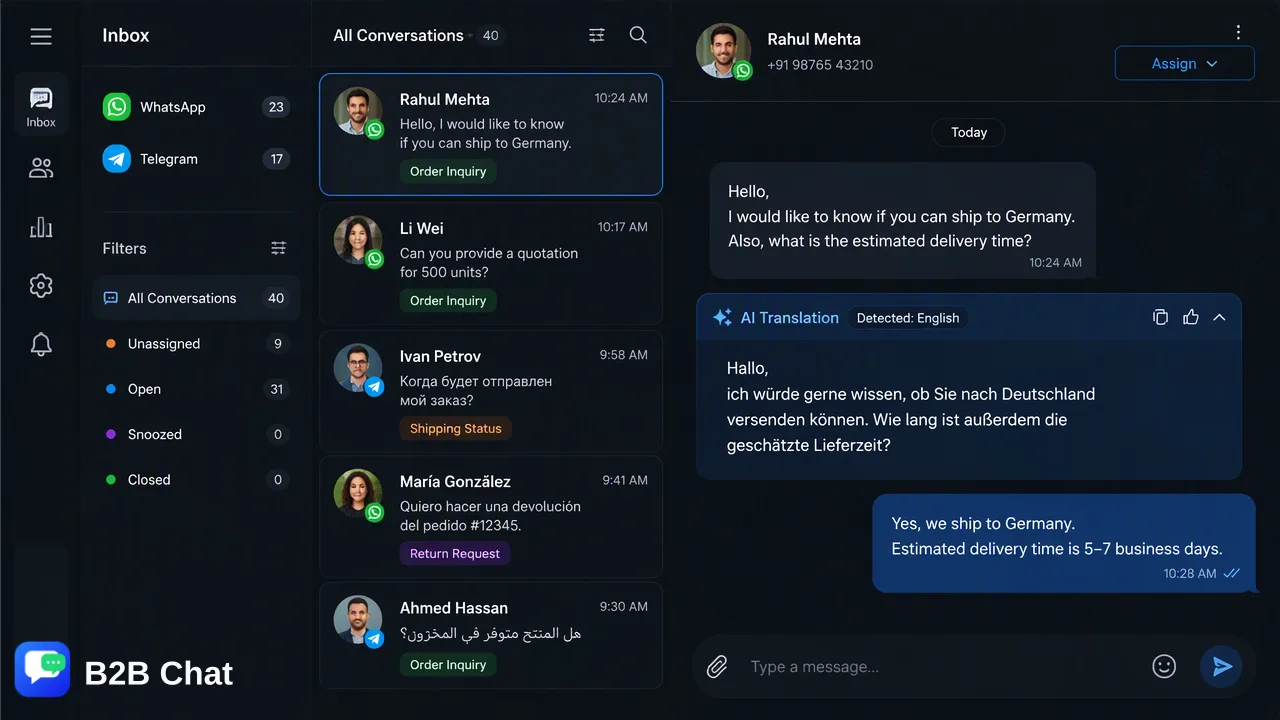
Learn how global ecommerce teams can consolidate WhatsApp, Telegram, and LINE accounts into a single workspace, utilizing AI translation and intent recognition to streamline multilingual customer support.
Cross-border ecommerce teams can streamline customer support by consolidating WhatsApp, Telegram, and LINE accounts into a single, unified workspace. By utilizing integrated AI translation and intent-based response tools, organizations can manage multilingual inquiries efficiently. This centralized approach supports consistent service across diverse international markets, helping teams identify complex cases and route them appropriately without constantly switching between different regional messaging applications.
The Challenge of Fragmented Global Support
Operating in multiple international markets requires organizations to maintain a presence on the messaging platforms their buyers prefer. For many regions, this means balancing customer interactions across WhatsApp, Telegram, and LINE. When teams handle these channels natively, they face operational silos. Support staff must constantly switch between different devices, browser tabs, or applications to monitor incoming messages, which fragments the customer service workflow. This fragmentation complicates cross-border ecommerce customer communication. A team managing a promotional campaign in Southeast Asia might receive inquiries on LINE, while simultaneously fielding order updates from European buyers on WhatsApp and Telegram. Without a centralized view, tracking conversation history, maintaining consistent response times, and transferring complex cases to specialized agents becomes difficult. The lack of a unified interface also makes it harder to oversee outbound marketing efforts and coordinate multi-region support schedules, ultimately straining internal resources and delaying first-line responses.
Consolidating Channels into a Single Workspace
To address the inefficiencies of fragmented communication, organizations can centralize their messaging operations using a unified downloadable client. B2B Chat provides a comprehensive customer service tool that supports WhatsApp, Telegram, and LINE within one interface. Available for both Windows and macOS, this desktop client helps teams connect and operate multiple regional accounts simultaneously. Account aggregation and multi-login capabilities form the foundation of this workflow. Instead of distributing separate devices to individual agents, a cross-border ecommerce team can manage outbound marketing and inbound support from a single dashboard. The platform supports fully open ports with unlimited registrations, meaning there is no stated limit on the number of accounts or the duration of usage. This architecture supports scaling operations as organizations enter new markets and add regional messaging profiles. By bringing all channels into one workspace, support managers gain a clearer view of overall message volume. Agents can monitor a unified inbox, categorize incoming queries by region or platform, and maintain a continuous conversation history. This consolidation reduces tool switching and provides the necessary context for teams to handle high-volume customer interactions efficiently.
Bridging Language Barriers with AI Translation
Serving a global customer base introduces significant language barriers. Hiring native speakers for every active market is often impractical for growing ecommerce operations. To maintain high-quality cross-border ecommerce customer communication, teams can integrate AI translation directly into their messaging workspace. The B2B Chat platform includes a Smart Translation feature designed to automatically detect and translate customer messages across more than 200 languages. When a buyer sends a product inquiry in their native language, the system identifies the language and provides an immediate translation for the support agent. This capability helps teams understand incoming requests without relying on external translation websites or third-party browser extensions. Beyond basic word-for-word conversion, the translation expression is adjusted based on conversation context. This context-aware translation is critical for ecommerce interactions, where specific product terms, shipping statuses, or billing inquiries require precise phrasing. By maintaining the contextual meaning of the conversation, agents can draft accurate replies in their own language, which the system then translates back to the customer's preferred language. This workflow supports clear, professional communication across diverse regions while reducing the friction typically associated with multilingual support.
Optimizing Response Workflows
High-volume ecommerce events, such as international sales or holiday promotions, often generate a surge of repetitive customer inquiries regarding order status, shipping times, and product availability. To manage this influx, organizations can utilize AI customer service tools to assist with first-line responses. Within the unified workspace, the Smart Customer Service capability interprets customer intent from incoming messages and the surrounding conversation context. By understanding what the buyer is asking, the system can assist agents in generating automated first-line responses. This intent understanding helps teams address common questions immediately, providing buyers with quick updates while keeping the support queue manageable. It is important to note that this AI assistance is designed to support the workflow, not to act as a total replacement for human support staff. Complex cases—such as disputed charges, damaged shipments, or nuanced product troubleshooting—still require human review. The AI tools help categorize and handle the initial interaction, giving human agents the context they need to step in and resolve escalated issues. This collaborative workflow helps routine queries receive prompt attention while specialized team members focus their efforts on high-value customer interactions.
FAQ
How can teams manage multiple WhatsApp, Telegram, and LINE accounts simultaneously?
Organizations can use a unified downloadable client, such as B2B Chat for Windows or macOS, to connect and operate multiple messaging accounts in one place. This account aggregation supports multi-login workflows, helping teams handle outbound marketing and inbound support without switching between different applications.
Does the AI translation tool support regional dialects or specific language contexts?
The integrated AI translation feature automatically detects and translates messages across more than 200 languages. It adjusts the translation expression based on the conversation context, which helps maintain accurate communication for specific ecommerce inquiries and product terminology.
How does the workspace help in routing complex customer queries?
By centralizing conversations and utilizing AI to interpret customer intent, the workspace assists in generating automated first-line responses for routine questions. This initial categorization helps human agents identify complex cases faster, providing them with the necessary conversation history to review and resolve escalated issues effectively.
What operating systems support the unified messaging client?
The B2B Chat platform is delivered as a downloadable desktop client and offers dedicated downloads for both Windows and macOS environments.