The Complete Guide to Cross-Border Messaging Operations
Learn how to manage cross-border messaging operations across WhatsApp, Telegram, and LINE using centralized workspaces and AI-assisted workflows.
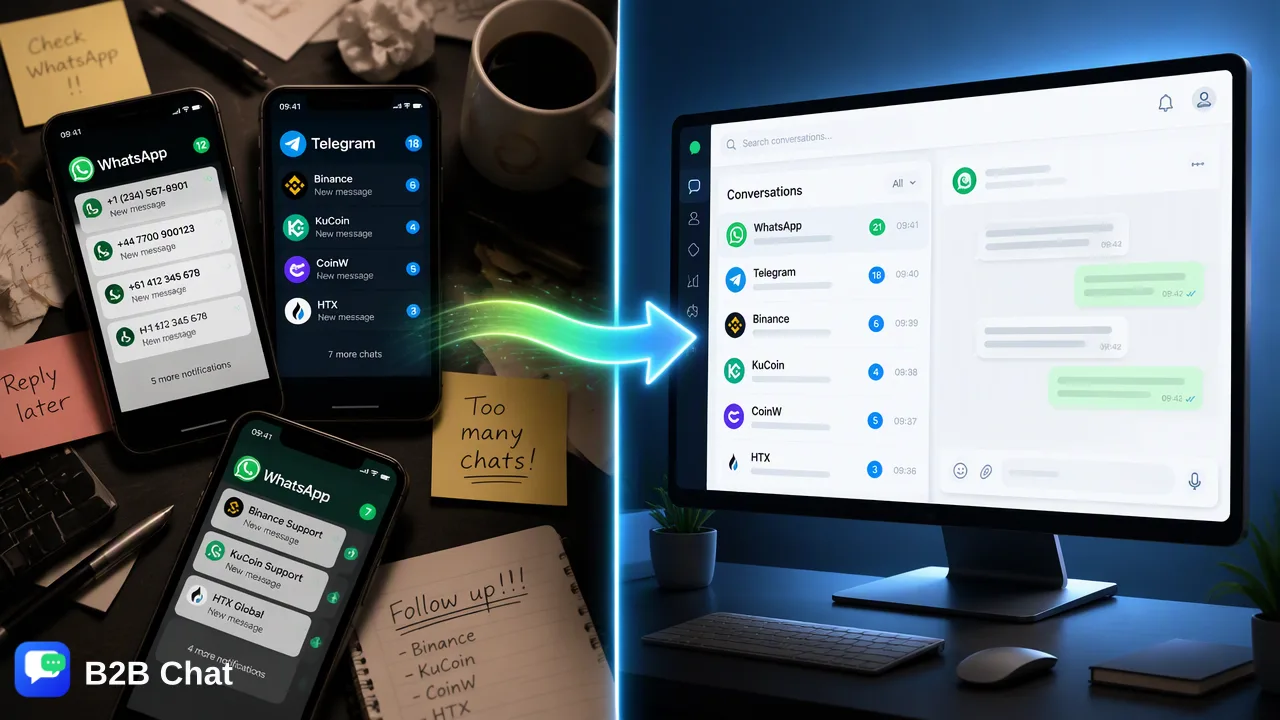
An operational guide detailing how global support and marketing teams organize multi-account messaging across WhatsApp, Telegram, and LINE using centralized workspaces, context-aware AI translation, and assisted first-line customer service.
Cross-border messaging operations involve the centralized administration of multi-platform customer communications across diverse regional markets, primarily utilizing channels such as WhatsApp, Telegram, and LINE. Operating effectively across international jurisdictions requires teams to consolidate disparate regional accounts into a single operating environment, implement real-time context-aware translation covering over 200 languages, and deploy intent-based artificial intelligence to assist first-line customer inquiries while routing complex issues to human specialists.
The Operational Complexities of Global Customer Messaging
Operating customer communication across international borders requires navigating regional ecosystem preferences and fragmented channel usage. While domestic operations frequently standardize on a single channel such as email or SMS, international audiences rely heavily on social chat applications. Consumer preferences vary substantially by region: WhatsApp maintains strong adoption in Europe, Latin America, and parts of Southeast Asia; Telegram is prevalent across Eastern Europe and specialized communities; and LINE dominates key Asian markets such as Japan, Taiwan, and Thailand. When organizations expand globally, customer operations face operational friction across several operational layers:
- Platform Fragmentation: Maintaining separate operational instances across WhatsApp, Telegram, and LINE forces agents to constantly toggle between varying interfaces and notification environments. * Session and Device Sprawl: Running multiple regional phone numbers or brand-specific handles across different territories typically involves multiple physical devices, separate browser profiles, or fragmented mobile applications. * Language Barriers: Customer inquiries arrive in dozens of native languages, creating response delays when internal teams lack native speakers for each target market. * Inconsistent Response Quality: Dispersed agents operating independently without unified conversation context often produce inconsistent customer experiences and variable inquiry resolution workflows. Managing cross-border messaging operations effectively requires moving away from decentralized devices toward standardized workflows, unified workspaces, and intelligent assistive tools.
Centralizing Multi-Platform Communication in a Unified Workspace
A primary objective in cross-border messaging operations is consolidating multi-account access. In traditional setups, managing several WhatsApp numbers or regional LINE handles requires juggling multiple handsets or desktop browser instances. Centralized desktop workspaces eliminate this friction by aggregating distinct platform accounts into a single management console. Platforms such as B2B Chat provide downloadable desktop clients for Windows and macOS, allowing operators to run multi-login sessions across WhatsApp, Telegram, and LINE from one workstation. By removing port quantity limits and supporting open account registrations, organizations can scale their regional communication handles according to operational demand. | Platform | Primary Regional Focus | Common Operational Use Case | | :--- | :--- | :--- | | WhatsApp | Europe, Latin America, Southeast Asia | Direct customer support, order updates, post-purchase inquiries | | Telegram | Eastern Europe, Central Asia, Global Communities | Community management, real-time broadcasts, technical support | | LINE | Japan, Taiwan, Thailand | Localized retail engagement, official brand accounts, private-domain support | Consolidating these platforms into a unified desktop client provides operational oversight. Team leads can monitor conversation streams across regions, prevent message drops caused by unmonitored devices, and standardize response assignments without relying on disconnected hardware.
Bridging Cross-Border Language Barriers with Context-Aware AI Translation
Language fragmentation represents an ongoing challenge for international customer service operations. Recruiting native-speaking agents for every prospective export market is rarely practical or cost-effective for growing teams. However, conventional automated translation tools often fail in messaging contexts because they translate text literally, missing idiomatic phrasing, regional slang, and conversational intent. Effective cross-border messaging workflows integrate real-time translation tools that feature automatic language detection across 200+ languages. In products like B2B Chat, the translation system evaluates incoming text alongside the prior conversational context to adjust expression and tone appropriately. This ensures that technical terminology, colloquial expressions, and customer sentiment are rendered accurately in the operator's working language. In daily operations, an inbound inquiry written in Japanese, Spanish, or Arabic is instantly translated into the agent's preferred language. When the agent drafts a reply, the translation engine formats the outbound response into natural, contextually appropriate target phrasing. This workflow enables centralized support desks to communicate clearly with international customers while preserving operational efficiency.
Deploying AI-Assisted First-Line Customer Service
Customer inquiry volumes in global e-commerce and digital services fluctuate significantly across time zones. International teams often struggle to maintain round-the-clock coverage for routine questions regarding order status, shipping policies, returns, or product availability. To address this, organizations implement AI-driven customer service systems to handle initial message triage. AI customer service capabilities in workspaces such as B2B Chat analyze incoming customer messages to interpret core user intent within the surrounding conversation context. Rather than acting as a rigid keyword-matching script, intent-understanding models determine the topic of inquiry and formulate relevant first-line responses. * Intent Recognition: Evaluates the customer's phrasing to categorize the query (e.g., tracking request, refund inquiry, technical specification). * Contextual Response Generation: References prior exchanges in the conversation history to deliver relevant, context-grounded preliminary answers. * Workload Triage: Resolves high-frequency, low-complexity questions instantly, reducing initial response latency during off-hours or peak volume windows. By deploying intent-aware AI for preliminary inquiries, support teams ensure consistent responsiveness while preserving human agent bandwidth for complex, sensitive, or high-value cases.
Establishing Review Workflows and Escalation Protocols
While automated translation and first-line response assistance streamline messaging operations, AI tools should be positioned as assistive decision-support systems rather than unmonitored human replacements. Maintaining high operational standards across diverse global markets requires clear escalation paths and continuous quality review. Organizations should implement structured handoff mechanisms between automated first-line handling and human specialists:
- Automated-to-Human Handover Triggers: Complex customer intents—such as dispute escalations, payment anomalies, or edge-case product complaints—must automatically trigger routing to human agents. * Translation Nuance Auditing: Periodic sampling of translated customer dialogues helps identify industry-specific terms or emerging local idioms that require internal documentation or prompt refinement. * Supervisory Dashboards: Operational managers should utilize the centralized workspace to inspect ongoing conversations across all active WhatsApp, Telegram, and LINE accounts, intervening when automated replies need manual adjustment. Combining centralized multi-channel aggregation, context-aware AI translation, and intent-driven first-line support with structured human oversight creates a reliable operational model for scaling international customer service.
FAQ
How can teams manage multiple WhatsApp, Telegram, and LINE accounts simultaneously?
Teams manage multiple regional accounts by deploying dedicated desktop workspaces available for Windows and macOS. These clients aggregate distinct sessions into a single interface, allowing operators to run concurrent logins across WhatsApp, Telegram, and LINE without switching between physical devices or browser profiles.
What role does AI play in cross-border customer service workflows?
Artificial intelligence functions primarily as a decision-support and first-line assistance layer. It evaluates incoming messages in the context of the conversation, identifies customer intent, and suggests or generates automated initial responses, allowing human support agents to focus on complex escalations.
How does context-aware AI translation handle nuance across languages?
Context-aware AI translation evaluates the complete conversational exchange rather than translating isolated words literally. It automatically detects the customer's language from more than 200 supported languages and adjusts phrasing and tone to suit customer service interactions.
What client operating systems are supported for centralized messaging workspaces?
Centralized messaging workspaces such as B2B Chat deliver their operational interface through downloadable desktop clients built for Windows and macOS environments, facilitating direct multi-account logins.
Learn More
Choose the product information that fits the next step in your workflow.