How to Automate Routine Customer Inquiries Without Losing the Human Touch
Learn how customer inquiry automation balances automated first-line replies with human escalation across messaging channels to protect service quality.
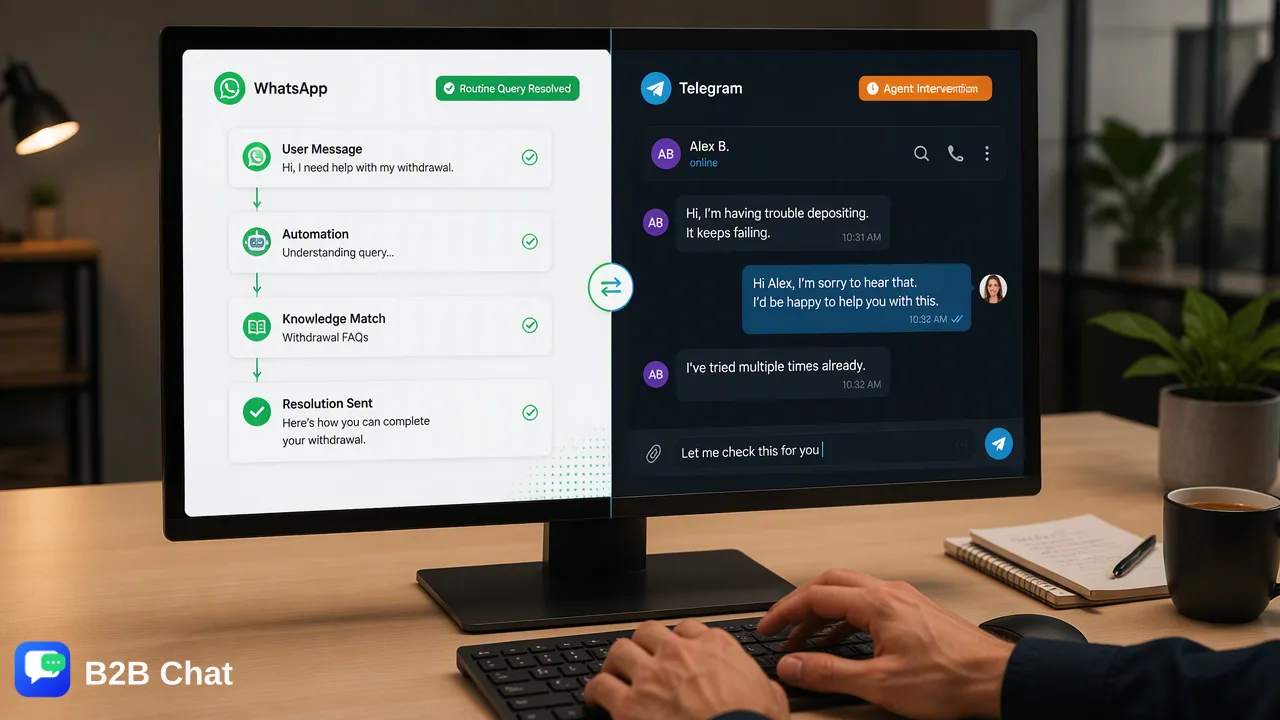
Learn how customer inquiry automation can resolve repetitive questions while preserving human oversight, seamless escalation, and brand trust across messaging channels.
Automating routine customer inquiries involves identifying repetitive, low-risk questions suitable for AI-assisted first-line responses while establishing clear escalation paths for complex issues. By adopting a human-in-the-loop workflow, organizations deploy automated systems to interpret incoming message context and answer standard questions, while reserving human teammates for sensitive, nuanced, or high-judgment conversations that require direct personal care.
The Strategic Balance: Automation vs. Human Empathy
Customer inquiry automation offers significant operational efficiency by providing 24/7 responsiveness for straightforward questions. However, attempting to replace human interactions entirely introduces service risks, especially when customers face nuanced problems or emotionally sensitive situations. A sustainable customer support model relies on a human-in-the-loop design. Under this framework, automation serves as an operational assistant rather than a substitute for human representatives. Automated tools evaluate incoming text and conversation context to assist with immediate first-line replies. When an exchange requires nuanced discretion, technical problem-solving, or empathetic listening, human agents intervene. Establishing transparent boundaries for automated interactions protects brand trust. Customers appreciate fast, accurate answers to predictable questions, but they expect clear pathways to reach a person when standard answers fail to resolve their concerns.
Identifying Inquiries for Automation
Deciding which conversations to automate requires categorizing incoming inquiries based on complexity and risk profile. Trying to automate high-judgment situations often results in customer frustration and repetitive back-and-forth exchanges. | Inquiry Category | Typical Inquiries | Recommended Handling | | :--- | :--- | :--- | | Low-Risk Routine | Operating hours, location details, basic service availability, standard FAQs | Automated first-line response | | High-Judgment | Service disputes, specialized customization, billing corrections | Human agent routing | | Emotionally Sensitive | Complaints, health or safety matters, critical account escalations | Immediate human intervention | Standard, repetitive queries represent the ideal operational scope for automated systems. When incoming inquiries deviate into high-judgment scenarios or sensitive service issues, automated systems should recognize their operational limits and defer to human staff.
Designing Seamless Escalation Workflows
An effective customer inquiry automation workflow depends on its handoff mechanism. When an automated system detects an issue beyond its programmed scope or fails to interpret customer intent with sufficient clarity, it must route the conversation to a human teammate without losing conversational context. Key escalation triggers include:
- Repetitive intent mismatch where the user indicates the automated answer did not resolve the inquiry. - Explicit customer requests to speak with a human team member. - Identification of sensitive vocabulary associated with disputes, dissatisfaction, or complex service problems. Centralizing messaging operations into a unified workspace—such as managing WhatsApp, Telegram, and LINE accounts together—allows support teams to oversee multiple active channels simultaneously. Teammates can view conversation threads, monitor automated exchanges, and take over dialogues when human intervention is warranted, eliminating the operational friction of switching between disconnected messaging tools.
Leveraging Context-Aware AI for Global Messaging
For businesses serving international markets across platforms like WhatsApp, Telegram, and LINE, language barriers can introduce friction into customer inquiry automation. Standard literal translation often misses conversational subtleties, resulting in awkward phrasing or misplaced tone. Context-aware translation evaluates the surrounding conversation rather than translating isolated terms verbatim. By automatically detecting incoming languages and adjusting phrasing across 200+ languages, translation tools help support teams provide coherent, culturally respectful replies. When combined with automated first-line assistance, international customers receive accurate initial responses in their preferred language while human agents retain full context during escalation.
FAQ
How do organizations determine which customer inquiries should be automated?
Teams evaluate inquiry types by examining complexity, predictability, and risk. Routine, repetitive questions with structured answers—such as standard operating hours, service catalogs, or recurring policy questions—are suitable for first-line automation. Conversely, issues involving billing discrepancies, customer frustration, nuanced exceptions, or sensitive topics are reserved for human intervention.
What is the role of a human agent in an AI-automated support workflow?
Human agents provide high-touch evaluation, empathy, and contextual judgment where automated rules or intent detection reach their limits. In a human-in-the-loop workflow, agents step in when conversations trigger escalation thresholds, handling sensitive customer challenges, resolving multi-step problems, and reviewing edge cases.
How can teams ensure automated responses maintain a natural conversational tone?
Teams keep automated responses natural by leveraging context-aware intent understanding rather than rigid, mechanical keyword matching. When automated systems interpret incoming context and adapt phrasing to match the conversation flow, initial responses feel responsive and helpful without overstepping into robotic or misleading assertions.
How does context-aware AI translation support customer inquiry automation?
Context-aware AI translation assists teams communicating across global audiences by detecting customer languages automatically and adjusting phrasing based on conversation history across 200+ languages. This helps support staff maintain clear, respectful cross-border communication without requiring separate regional desks for initial inquiries.
Learn More
Choose the product information that fits the next step in your workflow.