Customer Onboarding Checklist for Messaging Teams: 5-Stage Framework
Discover a 5-stage customer onboarding checklist for messaging teams to streamline handoffs, automate first-line support, and boost retention.
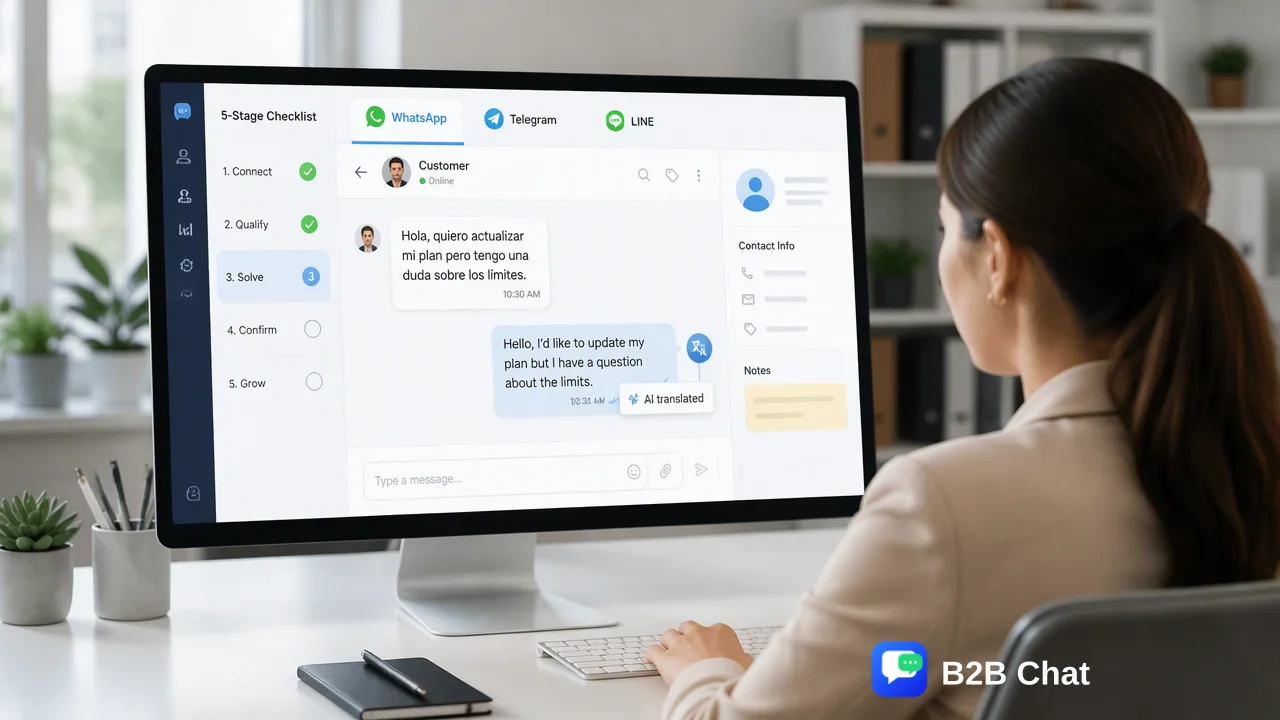
A comprehensive 5-stage customer onboarding checklist for messaging teams, covering the sales handoff, workspace setup, milestone achievement, proactive check-ins, and long-term cadences across WhatsApp, Telegram, and LINE.
A messaging-first onboarding checklist provides customer success teams with a structured, five-stage framework to guide new accounts from contract signing to sustainable product adoption. By coordinating engagement across conversational channels such as WhatsApp, Telegram, and LINE, teams maintain direct touchpoints, help mitigate early-stage churn, and guide customers toward their initial milestone. This framework spans five core stages: the sales-to-success handoff, workspace setup, first-win milestone definition, proactive conversational engagement, and ongoing operational cadences.
Stage 1: Structuring the Sales-to-Success Handoff
Information loss between sales and customer success is a frequent driver of early dissatisfaction. When handoffs fail to transfer client expectations, technical requirements, and agreed delivery timelines, the onboarding timeline stalls. In messaging-first workflows, capturing prior interaction context prevents repetitive questions and reassures the customer that their goals are understood. Teams should standardize this transition by documenting client priorities, key stakeholders, and designated channel contacts in a shared handoff summary. Establishing this baseline before introducing the onboarding manager maintains relationship continuity and sets clear expectations for the upcoming rollout.
Stage 2: Workspace Setup for a Customer Onboarding Checklist for Messaging Teams
Initial technical configuration sets the operational foundation for new accounts. In conversational onboarding, operational friction often stems from fragmented communication channels when teams attempt to juggle disparate chat apps across separate mobile devices or web tabs. Deploying a unified workspace—such as a downloadable desktop client for Windows or macOS—allows support and success teams to aggregate multiple WhatsApp, Telegram, and LINE accounts into a single interface. Centralizing multi-account management simplifies daily operations, reduces application switching, and helps prevent dropped conversations during critical setup steps. Teams can verify account connections and establish standardized access before initiating customer-facing configuration tasks.
Stage 3: Defining and Tracking the First Win Milestone
Onboarding workflows should not merely walk through feature menus; they must guide the customer toward a concrete first win that validates their purchase decision. This milestone represents the initial moment the customer realizes measurable value from the product or service. Success teams should define a realistic, time-bound objective tailored to the customer's primary operational focus during the initial kick-off call. To assist customers as they work toward this target, teams can configure automated first-line AI responses. By interpreting incoming messages and conversational context, AI customer service can assist with routine queries, answer setup questions, and provide immediate guidance around the clock.
Stage 4: Managing Proactive Conversational Support and Multilingual Delivery
Customer success requires proactive engagement rather than passive waiting for support tickets. Conducting scheduled, proactive check-ins across messaging channels helps managers identify friction points, implementation roadblocks, and hesitation before they turn into churn risks. For international operations, language barriers often complicate technical guidance and slow down customer comprehension. Integrating context-aware AI translation across 200+ languages enables success managers to automatically detect and translate incoming customer queries directly within their messaging workspace. Adjusting translation expression based on conversational nuances ensures that global customers receive clear, professional instructions in their native language, removing linguistic friction from the onboarding process.
Stage 5: Establishing Long-Term Cadences and Account Continuity
The final phase of onboarding involves transitioning customers from intensive implementation into a sustainable, long-term success cadence. Once the initial milestone is achieved and routine operational workflows are established, teams should formalize recurring touchpoints. These cadences may include periodic operational reviews, asynchronous updates, or access to official product update channels on platforms like Telegram. By analyzing conversational context and recurring inquiries gathered throughout the onboarding stages, teams gain visibility into customer needs and can adapt future guidance accordingly. This structured transition maintains account alignment without overburdening customer success resources.
FAQ
How can teams manage multiple messaging platforms during onboarding?
Teams can centralize conversational management by deploying a unified workspace via a downloadable desktop client for Windows or macOS. This allows managers to aggregate and operate multiple WhatsApp, Telegram, and LINE accounts within a single interface, eliminating the need to toggle between different browser tabs or mobile devices.
What role does AI play in assisting customer onboarding?
AI assistance helps customer success teams maintain responsiveness during high-volume periods. By interpreting incoming customer intent from conversation context, automated first-line responses can address routine setup questions and direct users through initial workflows, while reserving human intervention for nuanced account requirements.
How do organizations maintain clear communication with global customers?
Organizations can utilize context-aware AI translation supporting 200+ languages with automatic detection. This capability allows teams to receive and answer customer messages in the customer's preferred language while adjusting expressions to match conversational context, helping maintain clear international communication.
Learn More
Choose the product information that fits the next step in your workflow.