Deploying Your First Customer Service AI Agent: A Low-Disruption Strategy
Learn a low-disruption customer service AI agent deployment strategy. Discover how to phase rollouts and manage human-AI handoffs on WhatsApp and Telegram.
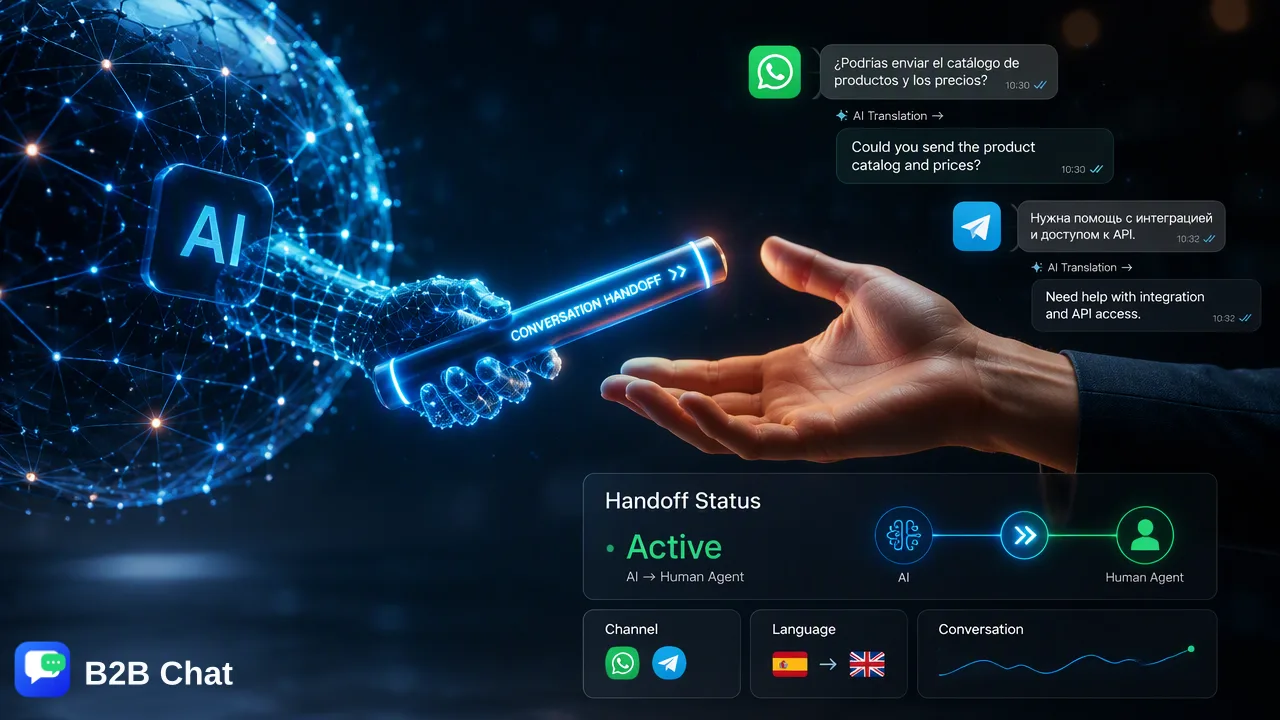
A practical, phased approach to integrating AI into messaging-based support workflows without compromising service quality or disrupting existing teams.
Deploying a customer service AI agent is most successful when organizations start with a single, high-volume, repetitive task rather than attempting full-scale automation immediately. By defining clear guardrails for when the AI must escalate a conversation to a human representative, teams can maintain service quality while the AI assists with routine first-line inquiries. Focusing on task completion rates rather than just deflection metrics helps measure success accurately and supports a smooth transition for support operations.
The Case for Incremental AI Deployment
Organizations often face the temptation of full-scale automation during an initial rollout. However, a successful customer service AI agent deployment strategy relies on starting with a single, high-volume use case. An incremental approach minimizes disruption to existing support teams and provides a controlled environment to evaluate performance. By deploying AI to assist with specific, well-defined interactions first, operations leaders can gather baseline data on how the system interprets incoming messages before expanding its responsibilities. This phased method supports a more stable integration into daily workflows, helping staff adapt to the new technology as a supplementary tool rather than an immediate replacement for their established processes.
Identifying the Right First Use Case
The foundation of a low-disruption rollout is selecting the appropriate initial task. Teams should prioritize repetitive, high-volume inquiries that consume significant human agent time. For global support operations managing communications through a downloadable client on Windows or macOS, centralizing these tasks is critical. B2B Chat provides a workspace to manage multiple WhatsApp and Telegram accounts in one place, helping teams deploy AI where message volume is highest. Within these channels, AI customer service tools can interpret customer intent from incoming messages and conversation context to assist in automated first-line responses. By focusing on routine questions—such as order status or basic troubleshooting—the AI handles the initial interaction, freeing human staff to address complex issues.
Establishing Human-AI Handoff Guardrails
A critical component of any customer service AI agent deployment strategy is defining explicit triggers for when a conversation must transition from the AI to a human agent. AI is designed to assist automated first-line responses, not to fully replace human support. Establishing clear escalation protocols helps route inquiries to a team member when they exceed the AI's scope. During this handoff, the AI utilizes conversation context to maintain continuity, providing the human representative with the necessary background to resolve the issue without asking the customer to repeat themselves. For international operations, this context awareness also extends to multilingual support, where AI translation can automatically detect and translate customer messages across 200+ languages, adjusting expressions based on the conversation context before the human agent takes over.
Testing and Measuring Success
Before a full customer-facing launch, organizations must validate the AI agent's performance. Testing the agent against realistic, edge-case scenarios helps identify potential gaps in intent understanding and verifies that the escalation guardrails function correctly. Once deployed, teams should measure success by evaluating task completion rates rather than relying solely on deflection metrics. Deflection only indicates that a human was not involved, whereas task completion confirms that the customer's underlying problem was actually resolved. Monitoring these metrics within the centralized WhatsApp and Telegram workspace helps support leaders refine the AI's responses iteratively, supporting the team without compromising the quality of the customer experience.
FAQ
How should teams choose the first task for an AI agent?
Organizations should prioritize repetitive, high-volume tasks that consume significant human agent time. Starting with a single, well-defined use case helps the AI assist with routine first-line responses without disrupting broader support operations.
What is the role of conversation context in AI customer service?
Conversation context helps the AI interpret customer intent more accurately from incoming messages. This context awareness supports the AI in providing relevant automated first-line responses and maintains continuity if the conversation must be escalated to a human representative.
How can organizations minimize team disruption when introducing a new AI agent?
Teams can minimize disruption by adopting an incremental deployment strategy. By avoiding full-scale automation immediately and instead focusing on specific high-volume inquiries, the AI acts as a support tool that assists human staff rather than overwhelming existing workflows.
When should an AI agent escalate a conversation to a human?
Explicit guardrails should be defined to trigger an escalation whenever an inquiry falls outside the AI's trained scope or requires nuanced human judgment. The AI handles the first-line response, and if the issue is complex, it transitions the conversation to a human while preserving the interaction history.