Customer Service Handoff Best Practices for Messaging Teams
Learn key customer service handoff best practices for messaging teams to preserve conversation context, structure shift changes, and boost support efficiency.
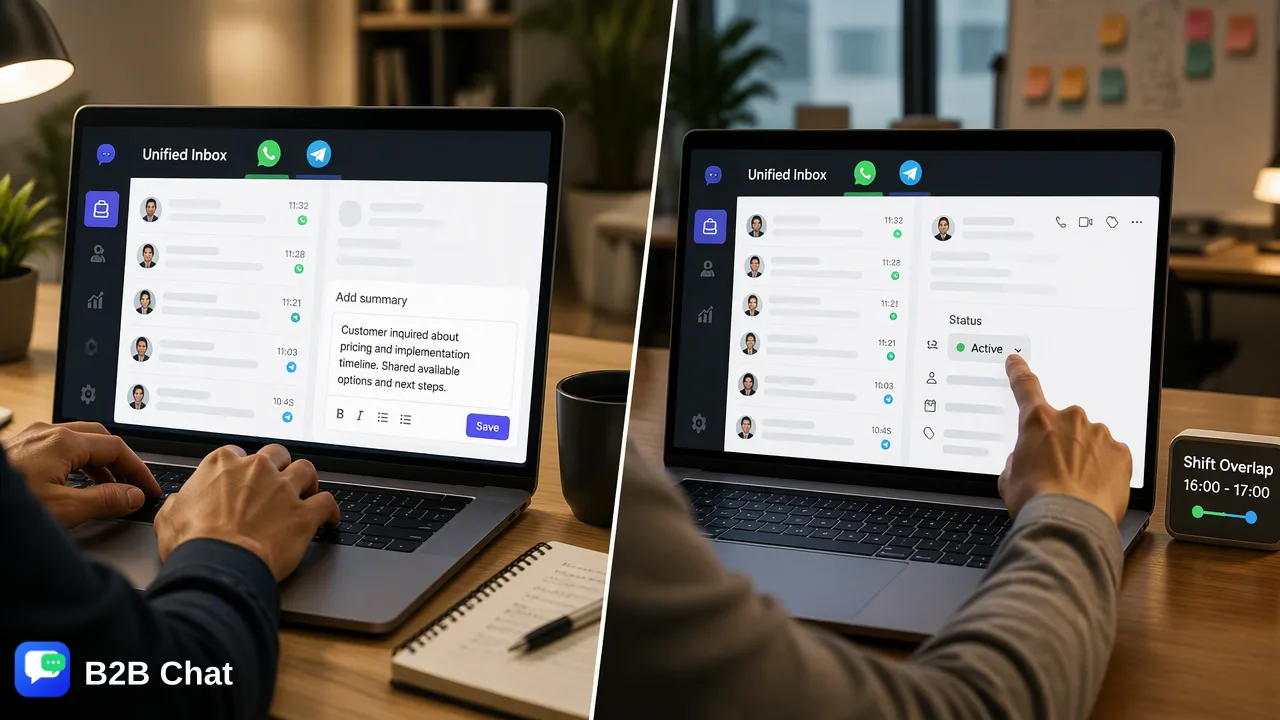
Discover customer service handoff best practices for messaging teams across WhatsApp, Telegram, and LINE, focusing on context retention and operational continuity.
Customer service handoff best practices in high-volume messaging rely on three core operational pillars: centralizing channel access to remove conversational silos, standardizing internal documentation so every agent records structured context, and using AI assistance to interpret customer intent across ongoing dialogues. In asynchronous messaging environments spanning channels like WhatsApp, Telegram, and LINE, continuity falters when agents rely on fragmented desktop windows or incomplete personal notes. By consolidating multiple accounts into a unified workspace and establishing clear shift-transition protocols, support teams can maintain seamless interaction history, minimize repetitive customer questioning, and support overall team efficiency.
Customer Service Handoff Best Practices: Centralize Messaging Channels
Operating customer support across decentralized messaging channels often leads to critical context gaps during agent transitions. When customer interactions take place across isolated mobile devices or individual web instances of WhatsApp, Telegram, and LINE, incoming shift workers cannot easily inspect previous message histories, pending issues, or prior commitments made to the client. To establish reliable customer service handoff best practices, operations teams should aggregate their communication endpoints into a centralized messaging workspace. Using a dedicated multi-account client—such as B2B Chat on Windows or macOS—enables support teams to monitor and operate several social messaging accounts simultaneously within one interface. Consolidating incoming inquiries into a single view removes information silos, reduces tool switching, and gives every agent immediate visibility into historical customer exchanges. | Operational Setup | Fragmented Channel Approach | Centralized Workspace Approach | | :--- | :--- | :--- | | Account Visibility | Isolated to specific devices or individual browser tabs | Shared across team members in a single desktop client | | Handoff Readiness | Relies on manual verbal updates or ad-hoc screenshots | Immediate access to historical logs and ongoing threads | | Channel Scope | Separate workflows for WhatsApp, Telegram, and LINE | Unified operation across WhatsApp, Telegram, and LINE | | Context Retention | High risk of lost details during shift rotations | Complete interaction trail remains intact for the incoming agent |
Standardize Internal Context Documentation
Even when conversation logs are fully visible, an incoming support representative should not be required to read hundreds of historical messages to understand the customer's current operational hurdle. Standardizing internal documentation protocols ensures that the transition between agents remains efficient and structured. Teams should implement a consistent internal handoff summary template covering three primary elements before reassigning a ticket or ending a shift:
- Core Customer Objective: The primary problem, request, or transaction the user is attempting to complete. * Steps Completed: Specific technical troubleshooting steps, verification checks, or transactional confirmations performed during the active shift. * Pending Actions and Ownership: Exactly what next step is required, who holds responsibility, and whether the interaction is waiting on customer input or internal review. Enforcing structured handover summaries directly supports support team efficiency. By systematically documenting conversation context, the incoming representative can resume the dialogue seamlessly without asking the customer to repeat previously provided information.
Leverage AI to Summarize Intent and Assist First-Line Interactions
High conversation volume can overwhelm support queues during peak operating hours and shift turnovers. Incorporating AI customer service assistance into messaging workflows helps teams interpret conversational context and discern customer intent more rapidly. Within modern messaging platforms, AI capabilities can interpret incoming customer messages to assist first-line triage and automated responses. This provides immediate operational context for complex tickets by highlighting the underlying issue before an agent takes over. When an escalation or shift change occurs, this automated intent recognition helps the arriving specialist quickly grasp the customer's operational urgency. AI customer service functionality does not replace the judgment, empathy, or technical troubleshooting of human operators. Instead, it functions as an assistive workflow layer. By automating routine introductory inquiries and surfacing contextual summaries, AI assistance reduces the time required for incoming agents to orient themselves, allowing human specialists to focus on high-touch problem resolution.
Establish Clear Accountability and Queue Protocols
A handoff is an active transfer of operational ownership, not a passive hand-off of chat logs. Without clearly defined queue governance, conversations can easily fall into administrative blind spots where neither the departing agent nor the arriving agent takes direct responsibility for resolution. To ensure operational accountability during shift transitions, support teams should establish explicit transition criteria:
- Formal Shift Overlaps: Schedule a structured fifteen-minute transition window where outgoing and incoming staff review unresolved priority conversations together. 2. Explicit Ticket State Marking: Clearly flag conversations as active, pending internal input, or waiting for customer response so incoming agents know precisely where immediate intervention is required. 3. Defined Escalation Channels: Maintain a direct escalation path—such as dedicated operational support groups—for conversations involving blocking technical issues or sensitive enterprise accounts. Treating handoffs as formal operational transitions preserves service consistency, protects response workflows, and ensures accountability across multi-agent messaging teams.
FAQ
How can teams maintain context when switching between messaging platforms?
Teams maintain context by consolidating disparate accounts into a unified desktop messaging workspace rather than toggling between disconnected browser sessions or native apps. Operating WhatsApp, Telegram, and LINE within a single client allows team members to review complete, uninterrupted chat logs across previous agent shifts before composing a reply.
What role does AI play in improving customer service handoffs?
AI assists the handoff process by analyzing conversation context and interpreting customer intent from incoming messages. Rather than replacing human agents, AI tools support the transition by handling routine first-line inquiries and clarifying the customer's core request, helping the incoming agent prioritize follow-up steps rapidly.
Why is centralized account management critical for team-based support?
Centralized account management eliminates individual device dependencies. When several agents manage customer communications across shared operational channels, a unified client ensures all assigned personnel share access to message history, active threads, and conversational context without creating isolated data silos.
Learn More
Choose the product information that fits the next step in your workflow.