How to Audit and Catch Missed Promises in Your Customer Support Workflow
Learn how customer support workflow automation and AI agents help teams audit chat history, catch missed promises, and improve service quality.
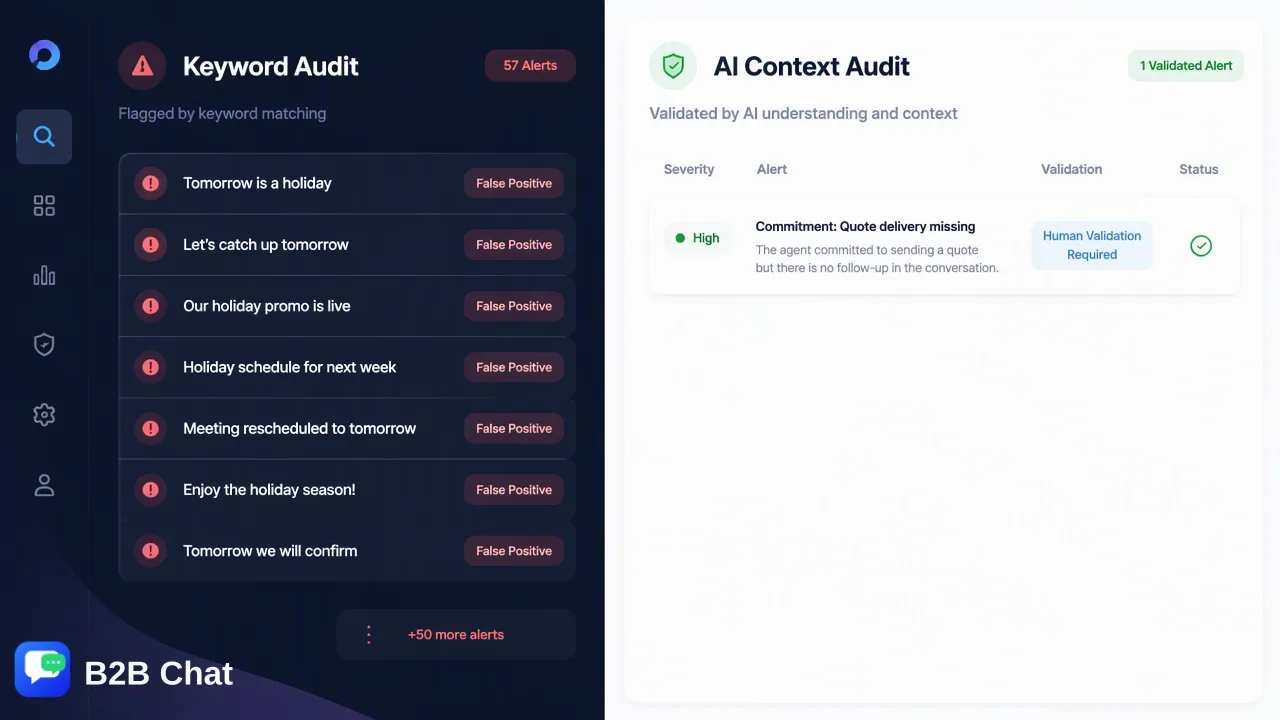
Learn how to deploy AI-driven customer support workflow automation to audit chat history, identify unfulfilled commitments, and implement human-in-the-loop validation.
To catch missed promises in customer support, teams must move beyond keyword-based alerts toward AI-driven context analysis. By auditing resolved chat conversations against specific business criteria, AI agents can identify discrepancies between agent commitments and final outcomes. Implementing a human-in-the-loop validation step supports accurate review of these findings before corrective action is taken. Centralizing multi-platform messaging into a single workspace improves the visibility of conversation history, helping organizations deploy customer support workflow automation effectively across channels like WhatsApp, Telegram, and LINE.
The Challenge of Tracking Commitments in Chat
Support teams often struggle to track verbal commitments made across fragmented messaging channels. In high-volume environments, agents handle hundreds of interactions daily across WhatsApp, Telegram, and LINE. During these conversations, agents frequently make commitments—such as promising a follow-up email, a specific callback time, or a customized quote. Tracking these commitments introduces a significant operational challenge because teams must distinguish between observable problems and assumed problems. Observable problems are easily tracked through standard ticketing metrics, such as a missing data field, an unassigned ticket, or a breached response-time SLA. Assumed problems, however, exist within the unstructured text of the conversation. An unfulfilled promise is an assumed problem; the ticket may be marked as resolved in the system, but the actual commitment made to the customer remains incomplete. When a customer support workflow automation system only tracks observable metrics, the organization risks a disconnect between reported resolution rates and actual customer outcomes. Assumed problems require a deeper layer of analysis because the evidence is buried within the natural language of the chat transcript. Without a systematic way to audit conversation history, these missed promises go unnoticed until the customer reaches out again, negatively impacting the overall service standard.
Why Keyword Rules Fail
Organizations frequently attempt to catch missed promises using basic keyword-based rules, but these static systems lack the nuance required to understand human intent. A keyword rule might flag words like "promise," "tomorrow," or "send," generating an alert every time these terms appear in a chat transcript. Keyword-based rules are insufficient for identifying fulfilled versus unfulfilled promises because they cannot distinguish between a casual mention and a formal commitment. When quality assurance teams are overwhelmed by false positives, the auditing process becomes inefficient, leading to alert fatigue. Supervisors may begin ignoring automated flags entirely, defeating the purpose of the tracking system. Furthermore, agents often use varied phrasing to make commitments, meaning a strict keyword filter will inevitably overlook non-standard promises. Effective customer support workflow automation requires a system capable of interpreting the actual context of the conversation rather than simply counting specific words.
Leveraging AI for Context-Aware Auditing
To accurately audit chat history, organizations can deploy AI agents that interpret customer intent and conversation context to assist in identifying unfulfilled commitments. Instead of relying on rigid rules, AI-driven customer support workflow automation analyzes the entire flow of a resolved chat to determine what was asked, what was offered, and what was ultimately delivered. For example, AI can flag a conversation where an agent promised a follow-up email that was never sent, comparing the chat transcript against the final resolution notes. To make this auditing process effective, teams need complete visibility into their messaging channels. B2B Chat provides a unified workspace for managing WhatsApp, Telegram, and LINE accounts, operating as a comprehensive desktop client for Windows and macOS. By centralizing multi-platform messaging into a single downloadable client, organizations consolidate their conversation history. This centralized approach helps AI agents consistently audit interactions across all supported channels, supporting the tracking of commitments made on Telegram just as rigorously as those made on WhatsApp or LINE. Furthermore, because B2B Chat supports AI translation across 200+ languages, teams can audit global conversations without requiring native speakers for every language.
Structuring the Auditing Workflow
Deploying AI agents for auditing requires clear business criteria to define what constitutes a promise within a specific operational context. Teams must structure the AI agent's toolset to read messages and internal policies without overstepping its analytical role. First, organizations should define the scope of commitments they want to track, such as callback times, document deliveries, or escalated reviews. The AI agent is then configured to audit resolved chat conversations against these specific business criteria. When the AI reviews a transcript, it cross-references the agent's statements with the required resolution steps. If the conversation context indicates a commitment was made but the resolution notes do not confirm its completion, the AI flags the interaction. Organizations must define the boundaries of the AI agent's toolset to read messages and policies without overstepping. This involves configuring the AI to recognize specific operational workflows, such as billing inquiries or technical troubleshooting, where commitments are most frequently made. This structured approach keeps the AI focused strictly on operational compliance, providing quality assurance teams with a targeted list of conversations that require further investigation.
Implementing a Human-in-the-Loop Validation Step
While AI agents excel at processing large volumes of conversation history, automated auditing should serve as a decision-support signal for human review rather than an autonomous corrective action. Implementing a human-in-the-loop validation step is critical to maintaining accuracy and fairness in quality assurance workflows. When an AI agent identifies a potentially missed promise, it routes the flagged conversation to a human supervisor. The supervisor reviews the context to confirm whether the commitment was genuinely missed or if it was fulfilled outside the tracked messaging channel, such as via a phone call. This human oversight helps teams avoid unfairly penalizing support agents for false positives. The human-in-the-loop validation step also creates a vital feedback loop for the support team. Supervisors can use confirmed missed promises as coaching opportunities, helping agents improve their communication habits. By treating AI-assisted auditing as an input alongside other quality checks, organizations can systematically catch unfulfilled commitments, refine their customer support workflow automation, and help teams verify that promises made by human agents are fulfilled before a ticket is permanently closed.
FAQ
How can AI help identify missed promises in chat?
AI agents interpret customer intent and conversation context to assist in identifying unfulfilled commitments. Unlike static keyword filters, AI analyzes the flow of the conversation to recognize when an agent makes a specific promise, flagging discrepancies between the chat history and the final ticket resolution.
Why is a centralized workspace important for support auditing?
Centralizing multi-platform messaging into a single workspace improves the visibility of conversation history for auditing purposes. Tools like B2B Chat help teams manage WhatsApp, Telegram, and LINE accounts in one place, supporting AI agents in consistently auditing interactions across all channels without fragmented data silos.
What is the role of human oversight in AI-assisted auditing?
Automated auditing should serve as a decision-support signal for human review rather than an autonomous corrective action. A human-in-the-loop validation step supports accurate review of flagged conversations, confirming whether a promise was truly missed before any corrective action is taken.
Why are keyword-based rules insufficient for quality assurance?
Keyword-based rules lack the nuance to distinguish between a casual mention and a formal commitment. They often generate false positives by flagging common words out of context, and they miss actual promises that are phrased using non-standard language.