Evaluating AI Customer Service Platforms for Multilingual Messaging and Compliance
Learn key criteria for evaluating AI customer service platforms, focusing on multilingual messaging, channel integration, and data transparency.
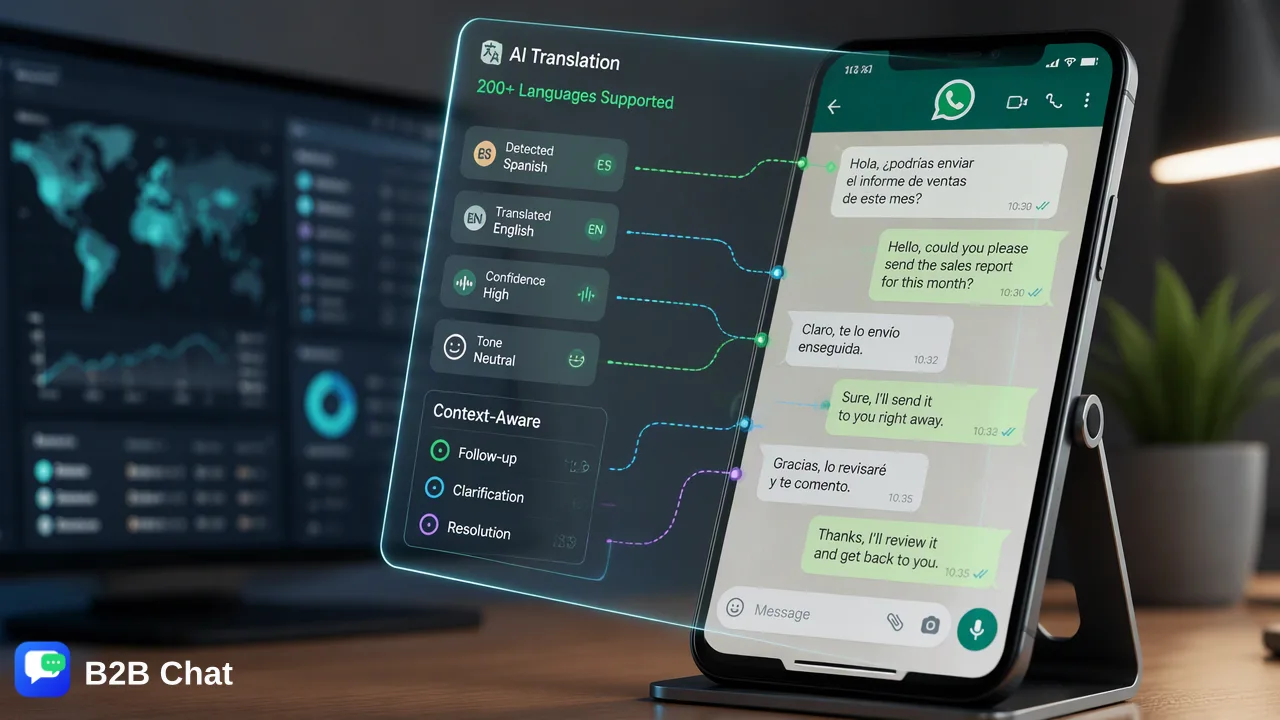
Learn how to evaluate AI customer service platforms for messaging channels like WhatsApp, Telegram, and LINE, focusing on context-aware translation and data transparency.
Evaluating AI customer service platforms for multilingual messaging requires shifting focus away from generic language model benchmarks toward messaging-native operational capabilities. Teams should assess whether an AI platform delivers context-aware translation across diverse languages, integrates directly into high-volume messaging channels like WhatsApp, Telegram, and LINE, and maintains clear transparency over message handling to support organizational data compliance.
The Limitations of Generic AI Benchmarks for Messaging Channels
Standard artificial intelligence benchmarks evaluate models on structured comprehension tasks, static document summarization, and synthetic reasoning tests. While these metrics offer a general sense of model capacity, they often fail to capture the operational realities of customer communication across messaging networks. In live messaging environments—such as WhatsApp, Telegram, or LINE—conversations are brief, asynchronous, and heavily reliant on context. Customers frequently mix languages, use localized slang, or send fragmented thoughts across multiple consecutive messages. Standard benchmarks do not measure how well an AI agent recognizes intent across disjointed turns or whether it can maintain conversational coherence without human intervention. When evaluating AI customer service platforms, organizations benefit from looking past broad benchmark leaderboards and testing how well the platform handles actual messaging streams.
Core Multilingual Criteria: Beyond Word-for-Word Translation
Cross-border support teams cannot rely on basic text-to-text translation modules that treat each sentence as an independent unit. Effective multilingual customer service requires systems that evaluate the entire conversational thread. Key technical criteria to evaluate include:
| Capability | Evaluation Focus | Operational Impact |
|---|---|---|
| Automatic Language Detection | Detection speed and reliability across 200+ languages | Helps route and process inbound messages without manual tagging |
| Context-Aware Translation | Adjustment of translation phrasing based on conversation history | Supports clearer communication and reduces misunderstandings |
| Intent Understanding | Extracting customer goals from mixed or bilingual text | Informs automated first-line replies and operator review |
| When evaluating platforms, review whether language translation dynamically adjusts based on previous turns. For instance, B2B Chat incorporates AI translation supporting 200+ languages with automatic detection, tuning expressions to conversation context to help human operators and automated flows interpret customer requests accurately. |
Navigating Regional Compliance and Operational Transparency
Data governance and regulatory compliance remain central concerns for enterprises deploying conversational AI across international markets. Because privacy laws and data localization standards differ significantly across regions, organizations must avoid assuming that a platform's generic compliance statement meets their local requirements. Evaluating a platform's compliance readiness involves assessing data transparency and architecture. Teams should inspect whether the software provides clear visibility into how inbound and outbound messages are routed, processed, and stored. For cross-border operations, understanding where processing occurs helps teams fulfill regional data obligations. Transparent systems give technical evaluators the clarity needed to determine whether an AI workflow aligns with their internal risk frameworks and local communication regulations.
Evaluating Deployment Architecture and Channel Management
Beyond algorithmic intelligence and linguistic breadth, the practical usability of an AI customer service platform depends on its client architecture and account operations. Support teams managing private-domain traffic or global inbound channels regularly encounter operational friction when forced to toggle between fragmented browser tabs and isolated mobile interfaces. Organizations should review whether a solution provides a dedicated operational workspace. For example, B2B Chat delivers a downloadable desktop client for Windows and macOS that centralizes WhatsApp, Telegram, and LINE accounts in one place. Its account aggregation and multi-login design supports connecting multiple accounts across these channels, allowing support and outbound teams to streamline day-to-day operations. Furthermore, decision-makers should balance self-serve adoption against custom enterprise rollouts. Downloadable workspaces that offer direct account aggregation allow teams to evaluate core workflows rapidly without lengthy integration delays, while providing the centralized oversight required to assist daily customer-service operations.
FAQ
Why is context-aware translation essential for customer messaging?
Context-aware translation evaluates the surrounding conversation rather than translating words in isolation. In customer messaging, phrasing, idiomatic expressions, and tone vary significantly. Adjusting the translation expression according to multi-turn dialogue context helps teams understand customer intent accurately and provide coherent assistance.
What separates messaging-first AI platforms from generic chatbots?
Generic chatbots are typically built for web-based forms or isolated document retrieval, often struggling with dynamic, conversational messaging streams. Messaging-first AI platforms are specifically designed to operate inside conversational apps such as WhatsApp, Telegram, and LINE, supporting continuous multi-turn dialogue, account aggregation, and first-line reply assistance.
How do organizations evaluate data compliance in messaging AI platforms?
Organizations evaluate data compliance by verifying transparency in how customer messages are processed, where conversational data is handled, and how operator workspaces manage credentials. Rather than relying on broad claims, technical teams should review client deployment options, data processing boundaries, and operational auditability.
Learn More
Choose the product information that fits the next step in your workflow.