Human-Only vs AI-Assisted First-Line Customer Support: A Strategic Framework
Compare human-only and AI-assisted customer support workflows. Learn how intent understanding and context help teams manage routine messaging volume efficiently.
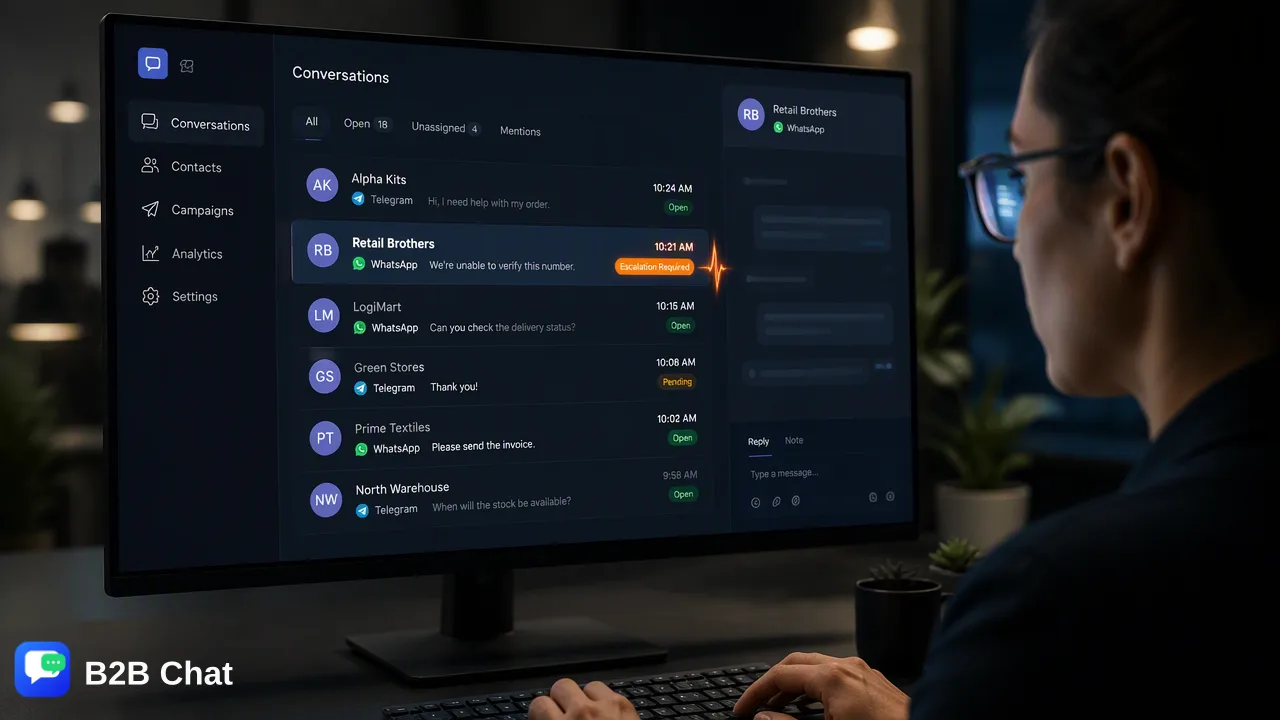
Compare human-only and AI-assisted customer support workflows. Learn how intent understanding and context help teams manage routine messaging volume efficiently while preserving human oversight for complex escalations.
Choosing between human-only and AI-assisted support depends on message volume, inquiry complexity, and the need for nuanced judgment. AI-assisted first-line support interprets customer intent and conversation context to automate routine inquiries, effectively reducing agent workload. However, human-led escalation remains essential for accountability, complex problem-solving, and maintaining high-touch service standards. A hybrid approach allows organizations to handle high-frequency requests efficiently while reserving human expertise for sensitive or high-stakes interactions.
The Evolution of First-Line Support
Support teams face increasing pressure to balance speed with quality, particularly as customer interactions shift toward instant messaging platforms like WhatsApp and Telegram. Historically, organizations relied entirely on manual responses to handle incoming inquiries. While this ensured a human touch, the growing volume of cross-border ecommerce and global marketing conversations has strained traditional operational models. Managing multiple messaging channels requires significant resources. When teams operate without assistance, they often struggle to maintain consistent response times during peak periods. The shift from manual to assisted support models emerged as a practical response to these bottlenecks. By integrating technology into the first line of defense, organizations can triage incoming messages more effectively. This evolution does not eliminate the need for human operators; rather, it reallocates their time toward tasks that require critical thinking and empathy, establishing a more sustainable workflow for high-volume environments.
Human-Only Support: Strengths and Limitations
The traditional human-only support model offers maximum empathy and nuanced judgment. Human agents excel at navigating ambiguous requests, de-escalating frustrated customers, and making contextual decisions that fall outside standard operating procedures. For high-stakes interactions, complex technical troubleshooting, or sensitive account issues, human oversight provides a level of accountability that automated systems cannot replicate. However, the scalability of a human-only approach is strictly limited by headcount and response time constraints. As message volumes increase, organizations must either hire additional staff or accept longer wait times. Human agents are also susceptible to fatigue when answering the same routine questions repeatedly, which can lead to inconsistent service quality. Furthermore, managing global operations often requires multilingual staff to cover various time zones and regions. Relying solely on human operators for every incoming message creates operational bottlenecks, making it difficult for teams to scale efficiently during sudden spikes in customer inquiries.
AI-Assisted Support: Operational Efficiency
AI-assisted support addresses the scalability challenges of manual operations by handling routine volume efficiently. Tools like B2B Chat provide a comprehensive customer service workspace for WhatsApp and Telegram, allowing teams to manage multiple accounts in one place. Through its Smart Customer Service capability, the platform interprets customer intent from incoming messages and uses conversation context to assist with automated first-line responses. This approach transforms how teams process high-frequency inquiries. Instead of manually typing answers to common questions, the system analyzes the input message and provides an automated response based on the understood intent. Because the AI evaluates the conversation context, the assistance remains relevant to the ongoing dialogue. Organizations can deploy this capability via a downloadable client for Windows or macOS, centralizing their messaging operations. By automating the initial layer of communication, AI-assisted support reduces the immediate workload on human agents, allowing them to focus their attention on escalated issues that require manual intervention. The infrastructure supports this scalability, as ports are fully open with unlimited registrations and no stated usage-duration limits.
A Hybrid Decision Framework
Organizations achieve the best operational results by implementing a hybrid workflow that leverages both automated assistance and human expertise. Establishing a clear decision framework helps teams determine when to use AI and when to escalate to a human agent. When to Use AI-Assisted Support:
- Routine Inquiries: Deploy automated responses for high-frequency, predictable questions where the customer intent is clear and easily mapped to standard answers.
- Initial Triage: Use AI to gather initial conversation context and categorize incoming messages before routing them to the appropriate department.
- Multilingual First-Line: For global operations, automated systems can assist in handling initial requests across different regions. Platforms offering Smart Translation across 200+ languages can further support teams managing cross-border conversations. When to Require Human-Only Support:
- Complex Problem-Solving: Escalate to human agents for multi-step technical issues or unique edge cases that require investigation.
- Sensitive Interactions: Route complaints, account security concerns, and high-stakes commercial discussions to human operators who can apply empathy and nuanced judgment.
- Accountability and Approvals: Ensure human oversight remains in place for final decisions regarding refunds, policy exceptions, or customized service agreements.
FAQ
Does AI-assisted support replace human agents?
No, AI-assisted support does not fully replace human agents. It is designed to interpret customer intent and assist with automated first-line responses for routine inquiries. Human agents remain essential for managing escalations, applying nuanced judgment, and handling complex or sensitive interactions that require accountability and empathy.
How does AI maintain conversation context?
AI-assisted tools, such as B2B Chat's Smart Customer Service, analyze the sequence and content of incoming messages. By evaluating this conversation context alongside the immediate customer intent, the system can provide relevant automated responses that align with the ongoing dialogue, rather than treating each message as an isolated event.
What types of inquiries are best suited for AI assistance?
AI assistance is most effective for high-frequency, routine inquiries where the customer intent is predictable. Examples include initial greetings, standard informational requests, and basic triage. Complex problem-solving, sensitive account issues, and high-stakes commercial discussions should always be escalated to human operators.