Supporting Multilingual Customers Without Losing Conversation Context
Learn how to build a multilingual customer service workflow across WhatsApp, Telegram, and LINE that preserves conversation context during human handoffs.
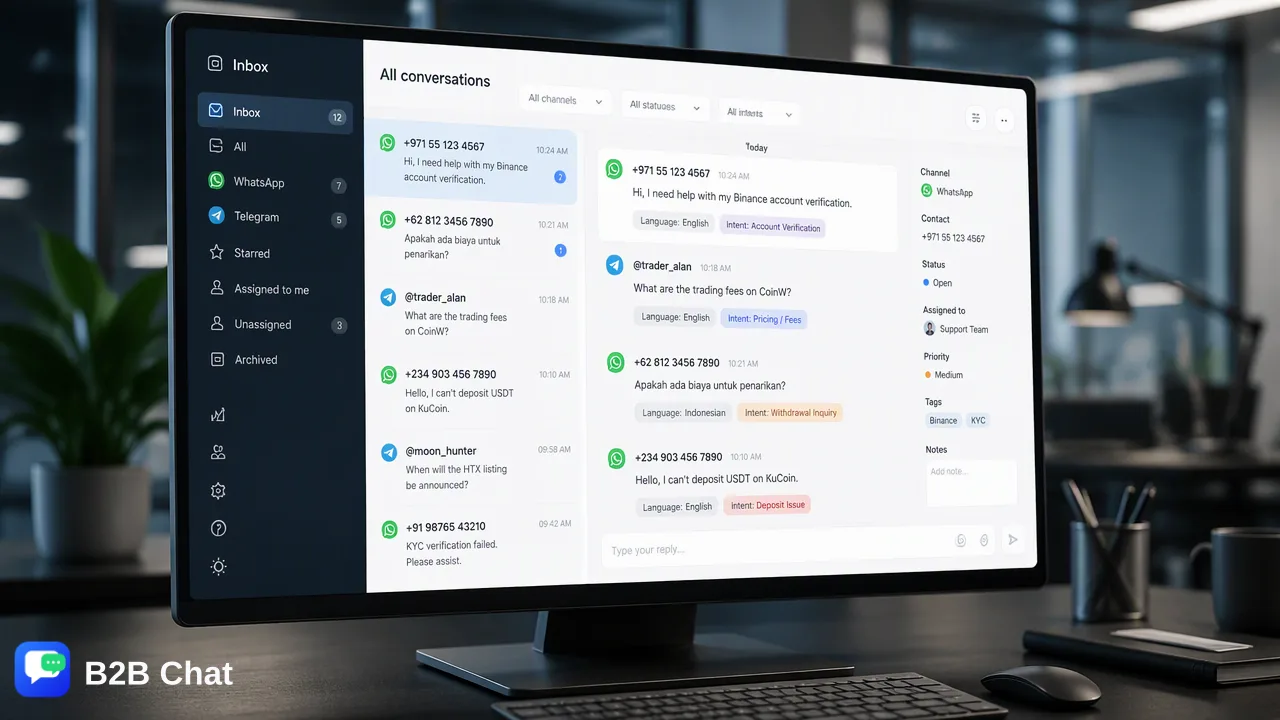
A practical guide to structuring a multilingual customer service workflow across global messaging channels while preserving conversational context during specialist handoffs.
To support multilingual customers without losing conversation context, teams require an operational workflow where message translation and intent detection dynamically incorporate prior message history. Implementing a multilingual customer service workflow across messaging channels like WhatsApp, Telegram, and LINE relies on context-aware translation tools that interpret nuance and customer intent, followed by structured conversation logs that provide human specialists with the full interaction history during a handoff.
The Challenge of Multilingual Context Fragmentation
Operating support across international boundaries introduces communication barriers that extend beyond vocabulary. In fast-paced messaging environments, customers frequently use idioms, abbreviations, and informal phrasing across platforms such as WhatsApp, Telegram, and LINE. When support workflows rely on disconnected translation windows or basic copy-paste methods, conversational nuance is readily lost. Context fragmentation typically occurs during two operational phases: initial language translation and internal specialist escalation. If an automated translator treats each incoming sentence as an isolated unit, it cannot track pronoun references, evolving customer frustration, or prior technical details mentioned earlier in the thread. When a human representative subsequently takes over the ticket, they often receive fragmented transcripts or mistranslated summaries, forcing the customer to restate their issue and lengthening resolution cycles.
Leveraging Context-Aware Translation in Daily Operations
Maintaining a coherent dialogue requires translation capabilities that adapt based on interaction history. Modern translation tooling within global messaging workflows automatically detects incoming languages across more than 200 languages, allowing support operations to accept inquiries worldwide without staffing native speakers for every territory. Rather than applying rigid literal translations, context-aware translation tools evaluate message context to adjust expression and tone. For example, technical inquiries or regional idioms are translated into practical terminology that accurately reflects customer intent. This automated adjustment assists representatives in interpreting the customer's actual operational problem rather than struggling through disjointed literal phrasing.
Streamlining the Human-AI Escalation Workflow
Automating initial responses helps teams address routine inbound queries rapidly, but complex issues inevitably require human intervention. A structured escalation path ensures that automated first-line interactions inform subsequent human handling rather than creating data silos. AI customer service systems interpret customer intent from both the latest incoming message and the preceding dialogue history. During first-line automated interactions, the system classifies inquiries, answers baseline questions, and records relevant parameters. When the interaction requires specialized intervention, the full context—including translated text, original customer inputs, and interpreted intent—remains attached to the active session. The human agent steps into an ongoing conversation with complete awareness of what has already transpired, preventing customer friction.
Operationalizing Multi-Platform Support in a Unified Workspace
Managing cross-border support across disparate applications creates administrative complexity and delays response times. Support specialists forced to toggle between native mobile apps, desktop instances, and external translation utilities struggle to maintain consistent service quality. Consolidating operations into a downloadable client—available on Windows and macOS—allows teams to manage multiple accounts across WhatsApp, Telegram, and LINE in a single interface. Centralized account aggregation supports consistent translation parameters and intent-interpretation models across all brand channels. The table below outlines how unified operations compare to fragmented channel management:
| Operational Dimension | Fragmented Multi-App Setup | Unified Workspace Setup |
|---|---|---|
| Account Management | Multiple browser tabs and mobile devices | Centralized multi-login for WhatsApp, Telegram, and LINE |
| Translation Execution | External cut-and-paste tools | Context-aware translation across 200+ languages |
| Context Retention | Lost during tool switching and retyping | Preserved across first-line automation and specialist handoff |
| Desktop Environment | Dispersed browser sessions | Dedicated client for Windows and macOS |
FAQ
How does context-aware translation differ from standard message translation?
Standard translation tools process individual messages as isolated strings, often missing colloquialisms, prior references, or shifting customer tone. Context-aware translation evaluates incoming text alongside preceding conversation history, adjusting vocabulary and phrasing to match the dialogue's ongoing intent and background.
Can AI customer service tools operate across multiple messaging platforms simultaneously?
Yes. A centralized workspace allows teams to connect accounts across WhatsApp, Telegram, and LINE, applying consistent language detection, automated first-line intent interpretation, and context retention across all connected channels from a single environment.
How do support teams prepare human specialists for an escalation?
When a complex inquiry exceeds automated first-line boundaries, the system preserves the translated exchange alongside the customer's original text. This allows the human specialist to review previous context, understand the detected intent, and continue the conversation seamlessly without requiring the customer to repeat information.
Learn More
Choose the product information that fits the next step in your workflow.