What Is Multilingual Customer Support? A Guide for Global Teams
Learn what multilingual customer support is, key operational hurdles, and how context-aware AI translation and intent automation assist global messaging teams.
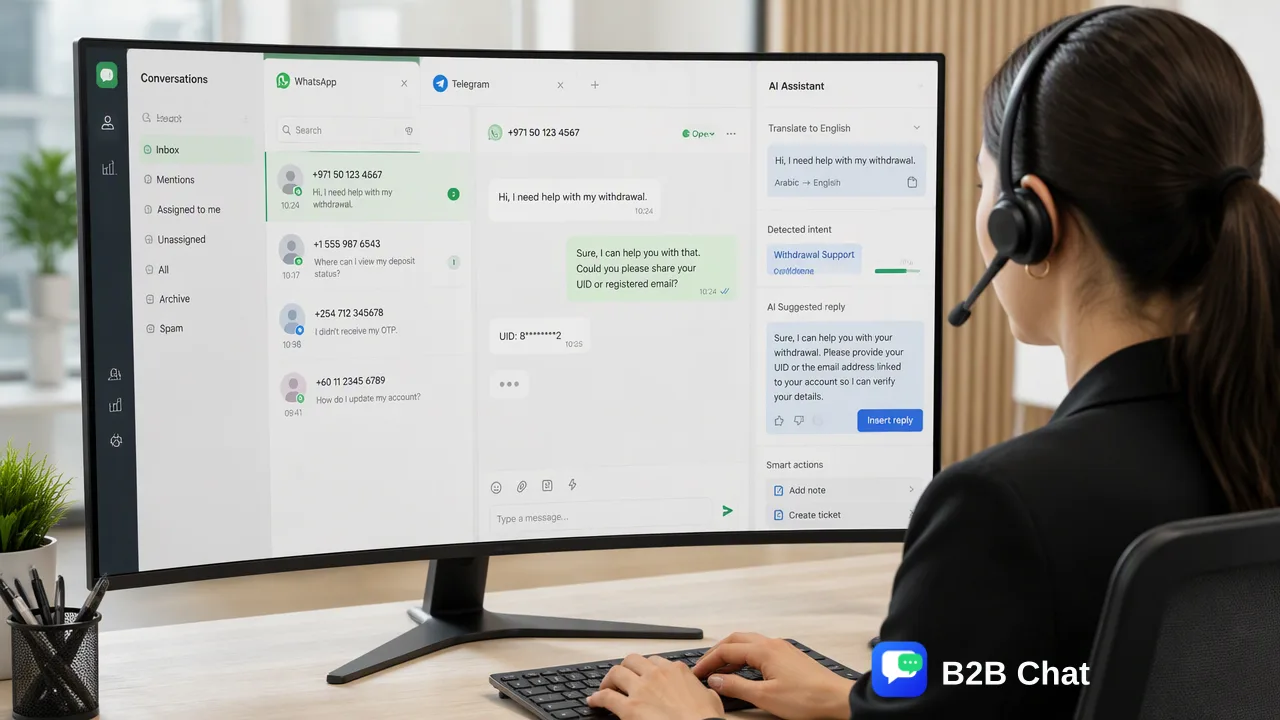
An operational overview of multilingual customer support, detailing how international teams manage cross-border inquiries with context-aware translation and intent automation.
Multilingual customer support is the operational capability of a business to assist, troubleshoot, and communicate with customers in their preferred native languages. Rather than requiring customers to adapt to a single corporate language, organizations implement multilingual workflows to handle incoming inquiries across international markets. Modern implementations combine human support specialists with AI translation and intent-based response systems to facilitate cross-border communication across global messaging channels.
Defining Multilingual Customer Support
At its core, multilingual customer support removes language barriers across the entire customer lifecycle, including presales consultation, technical troubleshooting, order tracking, and account management. For businesses expanding beyond their home market, service accessibility in a customer's primary language directly influences how easily users can resolve account issues, complete transactions, and access technical help. Historically, providing multilingual service required establishing localized regional offices or hiring native-speaking support representatives for every target market. While dedicated regional teams remain essential for complex enterprise relationships, modern organizations increasingly use hybrid operational structures. These frameworks pair core support teams with translation assistance and automated workflows, enabling existing representatives to assist users across diverse regions without needing full fluency in every regional dialect.
Core Challenges in Global Support Operations
Scaling support operations across multiple languages introduces complex operational, human, and linguistic hurdles that standard single-language teams do not encounter:
| Operational Area | Primary Challenge | Workflow Impact |
|---|---|---|
| Inquiry Routing | Identifying customer language instantly upon contact | Misrouted tickets cause delayed response times and handoff overhead. |
| Context & Nuance | Preserving technical accuracy and local tone across translations | Inaccurate machine translations can confuse users or escalate frustration. |
| Channel Fragmentation | Managing regional apps like WhatsApp, Telegram, and LINE | Agents lose efficiency toggling between isolated mobile devices and web windows. |
| Staffing & Scheduling | Covering disparate time zones with appropriate linguistic skills | Hiring native speakers for niche markets creates staffing bottlenecks and idle capacity. |
| Maintaining conversational context is particularly demanding in text-heavy social channels. When users employ colloquial idioms, technical jargon, or shorthand, traditional translation utilities often misinterpret the customer's intent, producing rigid or misleading answers that require human intervention to clarify. |
The Role of AI Translation and Intent Automation
Technology-assisted customer service bridges the gap between hiring constraints and global inquiry volume. Rather than treating language translation as a disconnected post-processing step, integrated messaging platforms incorporate translation and intent recognition directly into the conversational flow. AI translation tools automatically detect the incoming customer language and translate inbound and outbound messages across more than 200 languages. By evaluating conversational context rather than translating phrases in isolation, these tools adjust expressions to reflect appropriate phrasing for support dialogues. This capability enables an operator working in English or another primary language to review inquiries and send clear responses to international customers in real time. Complementing translation is intent-based automation. AI customer service systems analyze inbound messages to interpret what the customer needs—such as order status updates, onboarding instructions, or basic troubleshooting steps. By extracting intent from message context, the system can assist by generating automated first-line responses for routine queries, prioritizing incoming tickets, or suggesting draft responses for human agent review.
Integrating Workflows in a Centralized Messaging Workspace
In cross-border ecommerce, social marketing, and global account support, customer interactions rarely take place over traditional email alone. Global audiences heavily favor direct messaging channels, with different regions showing distinct platform preferences: WhatsApp dominates Europe and Latin America, Telegram serves crypto and private communities, and LINE leads in parts of East Asia. Operating multiple isolated accounts across these networks typically leads to fragmented records and delayed resolutions. Dedicated client applications, available for Windows and macOS desktop environments, solve this operational challenge through account aggregation and multi-login workflows. Teams can link multiple WhatsApp, Telegram, and LINE accounts into a single workspace. Within this unified interface, incoming messages flow into consolidated queues where automated language detection, context-aware translation, and first-line intent triage operate together. First-line automated systems handle high-frequency informational inquiries, while specialized human agents handle complex complaints, high-stakes sales conversations, or technical edge cases. This multi-layered approach helps organizations maintain consistent service standards across regions without multiplying operational overhead.
FAQ
How does context-aware AI translation differ from standard word-for-word translation?
Standard translation tools often convert words independently of the conversational thread, which can distort colloquial phrasing or technical support terminology. Context-aware AI translation analyzes the ongoing dialogue to adjust expressions, terminology, and tone to match the surrounding conversation context across more than 200 languages.
Can AI customer service automation completely replace human support agents?
No. AI customer service is designed to assist support operations rather than fully replace human agents. Automated systems interpret customer intent from incoming messages to handle routine first-line questions, triage tickets, and draft suggested replies, leaving complex troubleshooting, negotiations, and sensitive interactions to human operators.
Why do global teams use centralized messaging workspaces for multilingual inquiries?
International support often spans multiple regional platforms, such as WhatsApp, Telegram, and LINE. Operating within a unified desktop client reduces the friction of switching between multiple devices or browser tabs, allowing teams to aggregate accounts, monitor queue volumes, and apply translation tools consistently from one interface.
Learn More
Choose the product information that fits the next step in your workflow.