Automating Patient Communication: A Risk-Managed Guide for Clinics
Learn how clinics use patient communication automation to centralize messaging, assist routine inquiries, and maintain risk-managed human handoffs.
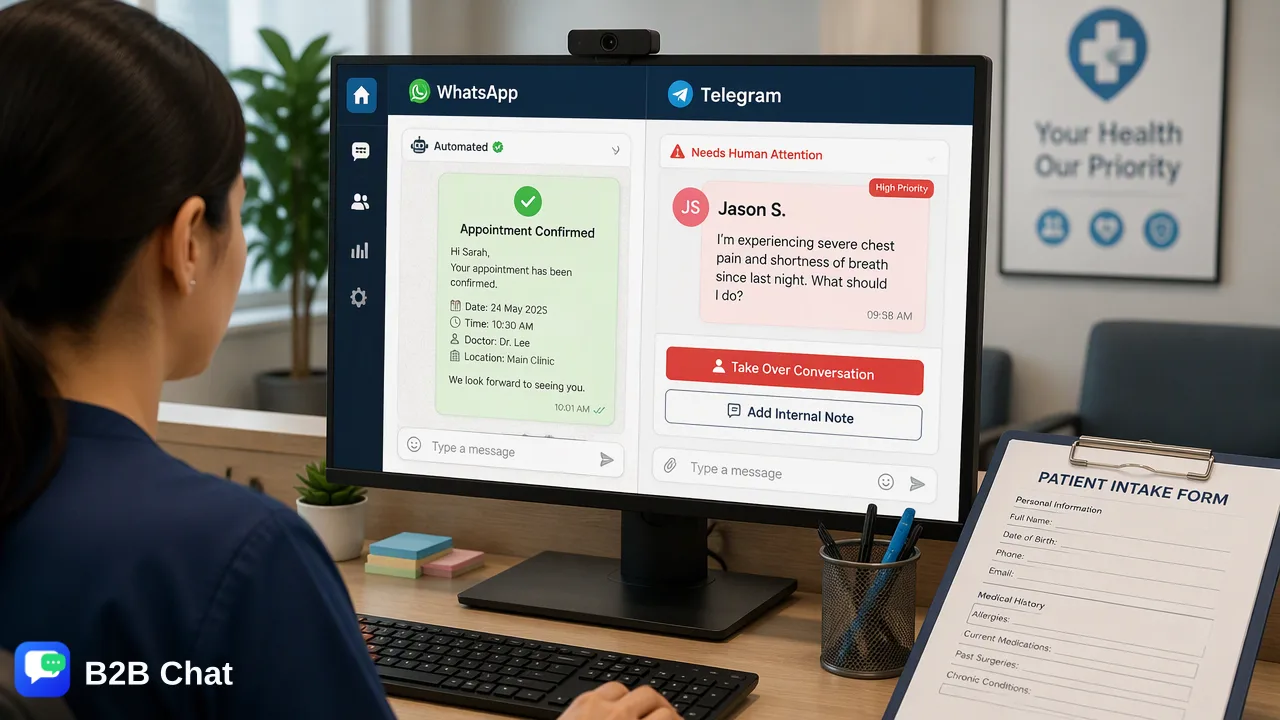
Learn how clinics can adopt patient communication automation by combining centralized messaging across WhatsApp, Telegram, and LINE with intent-based AI triage and clear human handoff protocols.
Patient communication automation allows clinics to streamline intake, appointment coordination, and routine administrative inquiries by centralizing social messaging channels and deploying intent-aware AI triage. By scoping automated assistance to structured, non-clinical tasks—such as scheduling, operating hours, and basic insurance FAQs—healthcare organizations can reduce administrative bottlenecks while routing sensitive clinical discussions directly to qualified human staff.
The Challenge of Modern Patient Communication
Healthcare providers face growing expectations to offer fast, accessible communication across modern messaging applications. Patients increasingly reach out through mobile channels such as WhatsApp, Telegram, and LINE to ask questions about availability, service pricing, insurance eligibility, and follow-up care. For many clinics, managing disparate messaging channels across separate front-desk phones or browser windows creates fragmented records and slow response times. Inquiries arriving outside operational hours can easily accumulate, creating a backlog that overwhelms administrative staff each morning. Addressing these challenges requires modernizing communication architecture without compromising operational safety.
Centralizing Operations in a Unified Workspace
A primary obstacle in multi-channel messaging is administrative fragmentation. When different staff members manage separate departmental numbers on independent devices, oversight suffers, and patient queries can be overlooked. Using a centralized workspace—such as B2B Chat's desktop client on Windows and macOS—allows administrative teams to aggregate multiple WhatsApp, Telegram, and LINE accounts into a single interface. Centralized multi-account management provides visibility over incoming volume, helps coordinate team responses, and creates an organized hub for both outbound notifications and incoming patient interactions.
Deploying Intent-Based AI for Routine Inquiries
A significant percentage of daily clinic inquiries revolve around predictable, administrative topics. Deploying AI customer service automation helps practices address high-frequency messages instantly, including after-hours inquiries. Modern AI customer service interprets incoming patient intent by evaluating message phrasing alongside the broader conversation context. This intent understanding supports automated first-line assistance for repetitive workflows:
| Workflow Area | Typical Routine Tasks | Automation Focus |
|---|---|---|
| Scheduling | Slot availability, rescheduling, cancellations | Confirming dates and updating calendars |
| Intake Coordination | Registration links, intake forms, checklist delivery | Distributing standardized documentation |
| Practice Details | Operating hours, directions, parking, clinic policies | Immediate answers to recurring questions |
| Billing & Coverage | Accepted insurance lists, standard fee schedules | Directing patients to official coverage guidelines |
| By delegating these structured interactions to intent-aware assistants, clinics can maintain continuous reachability while keeping desk staff focused on high-touch patient support. |
Maintaining Risk-Managed Handoff Protocols
Automating healthcare communication requires disciplined operational boundaries. AI assistants should strictly operate within low-risk administrative parameters; they must not offer diagnostic assessments, interpret clinical tests, or deliver prescription advice. Maintaining patient trust requires a transparent escalation protocol. When an incoming message involves ambiguous symptoms, medical distress, or complex personal scenarios, the system must trigger a direct handoff to human personnel. The conversation context collected during the initial exchange should remain visible to the human receptionist or triage nurse, supporting a smooth transition without forcing the patient to repeat their details.
Scaling Patient Communication Safely
Clinics seeking to modernize their communication should adopt an iterative deployment model rather than attempting to automate all touchpoints at once. Starting with a single, high-volume workflow—such as after-hours appointment scheduling or basic administrative FAQs—allows administrators to evaluate conversation flow and refine messaging boundaries. As staff become familiar with the centralized workspace and review patterns, practices can gradually extend automated assistance to intake guidance or post-visit follow-up instructions. Regularly reviewing conversation logs helps teams identify new recurring questions, improve intent recognition accuracy, and maintain a patient-centered balance between automation and human care.
FAQ
What types of patient inquiries are best suited for automated messaging?
Automated messaging works best for standardized, non-clinical interactions. These include appointment booking and rescheduling, office location and parking queries, operating hours, intake form distribution, and general insurance or payment FAQs. Clinical triage and symptom assessments should remain under human oversight.
How does multi-account messaging aggregation support clinic administration?
Multi-account aggregation allows healthcare practices to connect multiple messaging accounts—such as WhatsApp, Telegram, and LINE—into a unified desktop workspace on Windows or macOS. This consolidation helps reception teams monitor incoming patient messages in one place without jumping between separate mobile devices or browser tabs.
What steps should clinics take when a patient sends a sensitive medical query?
Clinics should establish explicit escalation rules within their workflow. When message intent points to clinical symptoms, emergency needs, or complex health advice, the automated system should flag the interaction and route the conversation context directly to human medical or administrative personnel for manual review.
What role does human staff maintain in an automated clinic workflow?
Human staff remain the central authority for patient care, clinical evaluation, and nuanced problem resolution. Rather than replacing clinic workers, automation serves as a first-line support tool that handles repetitive inquiries so staff can dedicate more time to urgent, complex, and empathetic patient interactions.
Learn More
Choose the product information that fits the next step in your workflow.