What Is a Social CRM? A Guide to Centralizing Messaging and Customer Data
Learn how a social CRM for business messaging centralizes WhatsApp, Telegram, and LINE conversations into a unified workspace for global support teams.
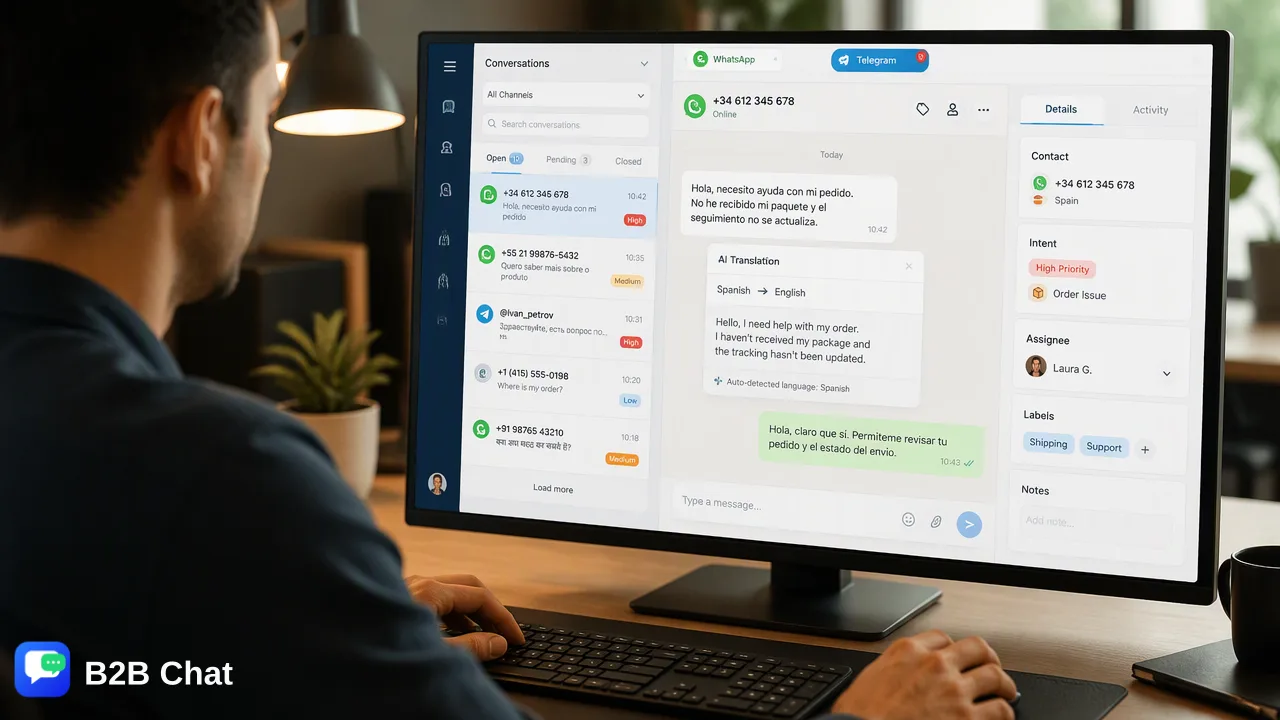
A guide to understanding Social CRM systems, explaining how consolidating WhatsApp, Telegram, and LINE conversations into a unified workspace supports team efficiency, context preservation, and cross-border communication.
A social CRM for business messaging is an operational platform that brings conversations from external chat channels—such as WhatsApp, Telegram, and LINE—into a unified workspace alongside customer context. Rather than requiring customer support and sales representatives to switch between mobile devices or isolated browser tabs, a social CRM aggregates accounts, records ongoing message histories, and integrates workflow assistance such as context-aware translation and first-line automated responses. This structure helps organizations maintain data integrity across the customer journey while improving team response coordination.
The Operational Challenge of Fragmented Messaging
Modern enterprise communication rarely stays inside a single application. Customers across international regions rely heavily on diverse direct-messaging channels, such as WhatsApp, Telegram, and LINE. When businesses manage these channels through separate physical phones or disjointed desktop tabs, communication silos quickly form. Siloed channels lead to fragmented records, where critical conversational context is trapped on individual employees' devices. This fragmentation creates several operational obstacles:
- Inconsistent service quality: Customer inquiries risk delayed responses or conflicting answers when multiple agents lack a shared view of previous discussions. * Context loss during handoffs: When an inquiry moves from a preliminary contact to technical support or account management, historical details often fail to transfer. * Administrative overhead: Operating across separate platforms forces team members to waste time juggling application windows and re-authenticating sessions. Adopting a social CRM for business messaging addresses these vulnerabilities by establishing a central hub for all incoming and outbound chat traffic.
What Is a Social CRM?
A Social CRM bridges the operational gap between conversational messaging channels and centralized organizational records. Instead of treating instant messaging apps as unmonitored external channels, a Social CRM treats chat as a primary customer relationship surface. Through tools like B2B Chat, organizations deploy a downloadable desktop client for Windows and macOS that unifies WhatsApp, Telegram, and LINE operations. The system functions as a comprehensive customer-service workspace where agents handle live inquiries, review historical interactions, and coordinate outbound messaging from a single environment. | Capability | Siloed Messaging Workflow | Centralized Social CRM Workflow | | :--- | :--- | :--- | | Workspace | Fragmented across phones and browsers | Unified desktop workspace (Windows / macOS) | | Account Access | Single-session, single-device constraints | Multi-login account aggregation | | Channel Scope | Isolated WhatsApp, Telegram, or LINE sessions | Aggregated support for multiple chat networks | | History Tracking | Stored locally on separate hardware | Consolidated conversational history |
Key Benefits of Centralized Communication Workflows
Consolidating messaging channels into a single client fundamentally changes team operations. When agents view the full trajectory of a conversation, they no longer need to ask customers to repeat details shared in previous exchanges. Key operational advantages include:
- Full conversation history visibility: Bringing interactions into one place preserves the context of earlier questions, objections, and preferences, which assists teams in delivering accurate, informed follow-ups. 2. Reduced application switching: Minimizing toggling between distinct mobile apps and web wrappers helps staff maintain concentration and respond to incoming traffic systematically. 3. Preserved organizational data: Centralizing customer interactions within a dedicated business client ensures customer records remain accessible to the team rather than remaining locked in personal hardware. These capabilities contribute to consistent brand representation and support scalable workflows for cross-border e-commerce and international customer support.
Assisting Support Workflows with AI and Automation
Managing high inquiry volumes across multiple global platforms requires assistive automation. Modern social messaging workspaces integrate targeted AI capabilities designed to assist frontline staff rather than completely replacing human oversight. ### Automated Context-Aware Translation Cross-border customer interactions often involve dozens of regional dialects. B2B Chat incorporates automated language detection and translation covering more than 200 languages. Rather than relying on rigid phrase matching, the translation expression adjusts dynamically based on the surrounding conversation context, helping staff interpret nuance and reply clearly without leaving the conversation view. ### Intent Interpretation for First-Line Responses Inbound message spikes can overwhelm support staff with repetitive inquiries. Smart customer-service tools evaluate message context to interpret intent and support automated first-line replies. This automation assists with routing inquiries, answering common introductory questions, and preparing background details before a human representative conducts detailed follow-up.
Implementing a Unified Messaging Strategy
Transitioning to a unified messaging approach requires structuring channels around practical operational habits. Organizations can begin by identifying the core channels where target audiences prefer to interact, such as WhatsApp, Telegram, or LINE. Once core channels are defined, deploying a centralized client provides teams with immediate multi-login support. This arrangement lets operators run multiple outbound marketing or customer care profiles concurrently without hitting session conflicts. By establishing clear standards for when automated assistance handles initial greetings and when human representatives step in for tailored consultations, organizations create sustainable, organized messaging operations that scale across international markets.
FAQ
How does a Social CRM differ from a traditional CRM?
Traditional CRM systems primarily record structured transactional milestones, contact records, and email threads, often requiring manual updates. A Social CRM focuses on conversational touchpoints across dynamic chat networks like WhatsApp, Telegram, and LINE, centralizing high-velocity messaging streams and real-time dialogue directly into an operational workspace.
Can teams operate multiple messaging accounts simultaneously in a single workspace?
Yes. Platforms like B2B Chat support multi-login and account aggregation, providing downloadable desktop clients for Windows and macOS. This setup lets operators run multiple WhatsApp, Telegram, and LINE accounts side by side without repeatedly logging in and out of different devices.
How does AI support multilingual customer messaging?
AI translation features automatically detect incoming languages and translate dialogue across more than 200 languages. Rather than performing literal word-for-word replacement, modern systems adapt expression according to conversation context, assisting human agents in communicating smoothly across global markets.
Learn More
Choose the product information that fits the next step in your workflow.