How to Implement WhatsApp Auto-Replies: A Guide for Scaling Customer Communication
Implement an effective WhatsApp business auto reply strategy. Scale support with context-aware AI auto-replies, lead qualification, and multi-language tools.
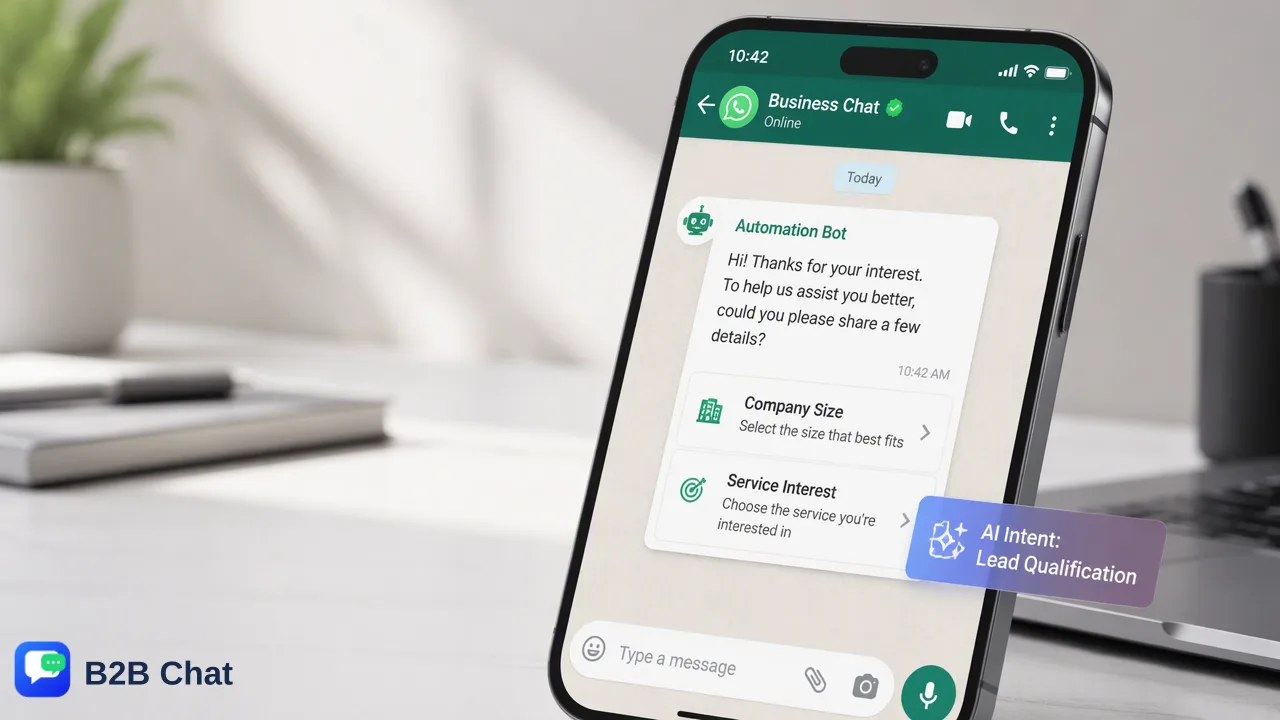
Learn how to build a scalable WhatsApp business auto-reply strategy. Move from rigid rule-based greetings to AI-driven first-line support that understands context and qualifies leads.
A successful WhatsApp business auto reply strategy combines immediate engagement with context-aware processing. Implementing auto-replies allows organizations to manage customer response expectations around the clock, establish professional first impressions, and capture essential lead qualification details automatically. Rather than relying solely on static greetings or away messages, scaling operations requires transitioning to AI-driven intent analysis that assists first-line responses while routing complex inquiries to human agents.
The Strategic Value of WhatsApp Automation
Customer communication channels like WhatsApp require rapid response times, yet maintaining manual round-the-clock coverage creates substantial staffing overhead. Establishing an automated response framework addresses this challenge at the earliest touchpoint. Automating initial customer interactions through greeting and away messages helps businesses manage response expectations, improve first impressions, and capture essential lead information without requiring constant manual attention. When a customer reaches out outside standard operating hours, an automated away message sets clear expectations regarding availability. Similarly, immediate greeting messages acknowledge receipt instantly, reducing drop-off from prospects who might otherwise seek alternatives. Beyond basic acknowledgment, automated first-touch interactions can prompt prospects for preliminary details, such as company size, preferred service, or regional location. This first-touch qualification provides support and sales teams with actionable context before an agent even opens the chat.
Moving Beyond Basic Rules: The Role of AI Intent Understanding
Traditional auto-responders operate on rigid logic: if a user texts outside business hours, send Message A; if a user types a specific keyword, send Message B. While useful for simple scenarios, keyword-based branching often fails when customers write nuanced, compound sentences or express complex issues. Modern communication workflows address these limitations by incorporating AI customer service capabilities. Rather than scanning for exact keyword matches, AI customer service interprets customer intent from incoming messages and surrounding conversation context to assist automated first-line responses. This allows automated responses to sound natural and directly address the inquiry, whether the user is asking about order tracking, service specifications, or pricing structures. Importantly, AI auto-replies should be positioned as intelligent first-line assistance rather than a wholesale replacement of human staff. By interpreting intent and addressing straightforward requests, the system handles repetitive inquiries while smoothly surfacing complex or sensitive conversations for human intervention.
Comparing Messaging Automation Approaches
To evaluate how different automation tiers support operational goals, consider the practical differences between static rules and context-aware systems:
| Capability | Static Rule-Based Auto-Replies | AI-Driven First-Line Automation |
|---|---|---|
| Trigger Mechanism | Fixed schedules or exact keyword matches | Contextual interpretation of customer intent |
| Message Flexibility | Pre-written, unchanging template text | Dynamically generated or context-adjusted responses |
| Lead Qualification | Linear, menu-driven form prompts | Conversational intake guided by customer dialogue |
| Handling Edge Cases | Reverts to generic fallback error messages | Identifies conversational nuance or escalates to human review |
| Language Handling | Requires distinct manual rules per language | Automated language detection and translation across 200+ languages |
| Transitioning from basic rules to context-aware workflows allows organizations to maintain high service standards even as inbound message volumes fluctuate. |
Operational Benefits for Global and Multilingual Teams
Scaling customer operations across international markets introduces two operational friction points: escalating labor costs for routine support and language barriers across diverse regions. Automating routine FAQ responses substantially reduces repetitive manual labor, allowing support personnel to focus on high-touch accounts and complex problem resolution. For organizations operating across borders, this operational leverage is multiplied when paired with multilingual capabilities. Workspaces like B2B Chat integrate AI translation covering 200+ languages with automatic detection, adjusting translation expression based on conversational context. This enables support teams to communicate across languages without requiring localized support desks in every target market. When an automated first-line reply or human agent engages with a global customer, language barriers are minimized within the unified workspace.
Implementing an Effective Messaging Workflow
Building an effective WhatsApp business auto reply strategy involves clear operational planning:
- Establish Core Availability and Expectation Messages: Define baseline away and greeting messages that accurately inform customers of operating hours and typical human response windows. 2. Map Frequent Inquiries for First-Line Automation: Identify repetitive questions regarding order status, business hours, and service overviews. Deploy AI customer service to interpret user intent and deliver context-aware answers to these common prompts. 3. Centralize Multi-Account Operations: For teams managing outreach across multiple accounts, operating through a dedicated desktop workspace—such as B2B Chat client applications available on Windows and macOS—streamlines multi-login management and keeps cross-channel conversations organized. 4. Incorporate Human Review and Escalation Paths: Ensure clear thresholds exist where complex inquiries, sensitive complaints, or high-value leads are routed directly to human agents for personalized review.
FAQ
How do auto-replies help with lead qualification?
Automated replies serve as an immediate first-touch filter by asking structured intake questions when a conversation begins. They capture essential context—such as project requirements, account identifiers, or urgency—before a human representative takes over, allowing teams to prioritize inquiries effectively.
What is the difference between rule-based and AI-driven auto-replies?
Rule-based auto-replies rely on predefined triggers and static templates, such as generic away messages or exact keyword matches. AI-driven auto-replies interpret customer intent from incoming messages and conversation context, assisting in generating relevant, natural first-line replies tailored to the specific user inquiry.
Can AI-driven customer service handle multiple languages?
Yes. Advanced workspaces incorporate AI translation across 200+ languages with automatic detection, adjusting translation expression based on conversational context to support smooth cross-border communication.
Learn More
Choose the product information that fits the next step in your workflow.