Optimizing Your WhatsApp Messaging Strategy: A Guide to Navigating New Meta Pricing
Learn how to optimize WhatsApp messaging costs under Meta pricing rules with message consolidation, Free Entry Point windows, and AI support workflows.
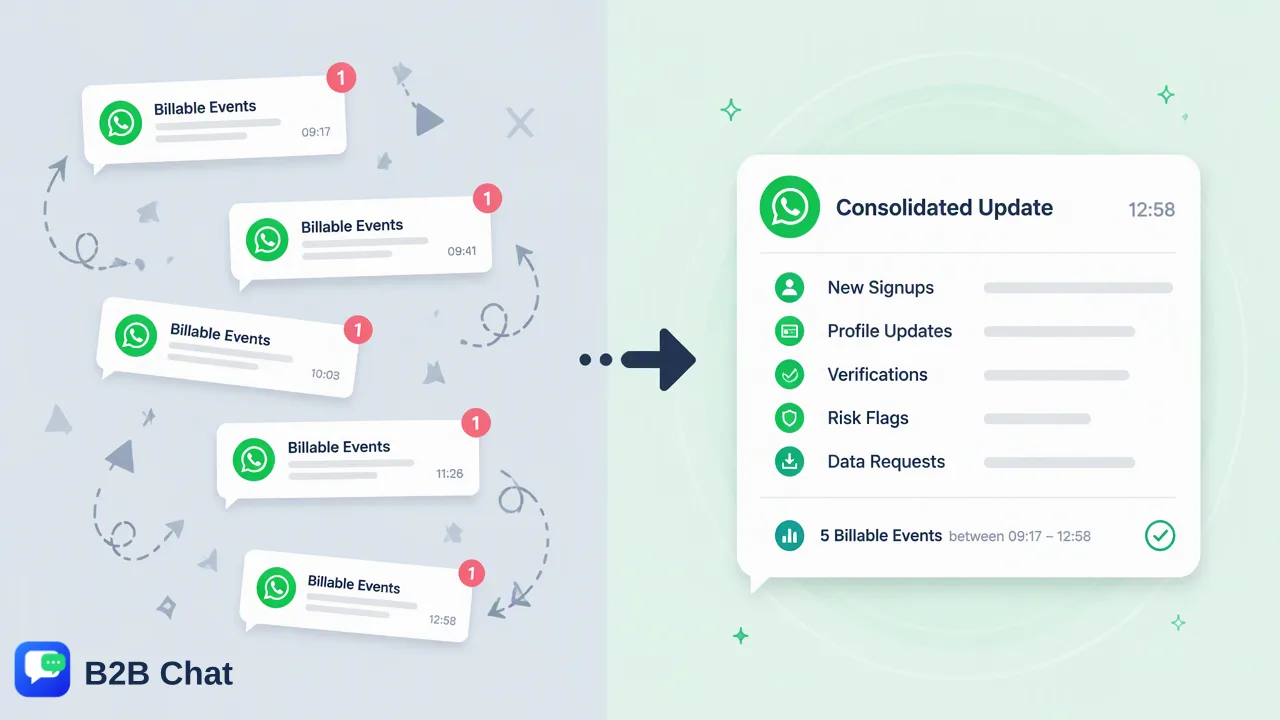
A practical operational guide to managing WhatsApp messaging costs under Meta pricing rules through message consolidation, Free Entry Point windows, and AI-assisted support workflows.
Navigating Meta's updated pricing structure requires organizations to adopt strategic message consolidation and maximize inbound engagement windows. With service messages and utility templates transitioning to a chargeable model within the standard 24-hour customer service window, teams can maintain budget predictability by condensing disparate notifications into comprehensive messages, utilizing the monthly 1,000 free service message allowance per number, taking full advantage of 72-hour Free Entry Point (FEP) windows, and deploying AI-driven first-line customer support to interpret intent and resolve inquiries in fewer conversational turns.
The Evolving Structure of WhatsApp Business Messaging Costs
Managing messaging operations at scale requires a clear understanding of Meta's commercial rules for the WhatsApp Business platform. Previously, businesses operated with broad free messaging flexibility inside the 24-hour customer service window. Under the updated framework, service messages and utility templates transition into a chargeable model inside that 24-hour service window once baseline thresholds are crossed. To balance this change, Meta allocates a tier of 1,000 free service conversations per registered phone number each month. For organizations operating high-volume help desks, regional marketing campaigns, or post-purchase support lines, exceeding this allowance happens rapidly if messaging discipline is lacking. Beyond Meta's platform charges, organizations must also audit provider markups. Business solution providers (BSPs) and messaging gateways frequently attach processing fees, routing premiums, or per-message surcharges above base Meta fees. Conducting regular vendor audits helps confirm that the enterprise pays standard rates rather than compounding overhead across thousands of customer interactions.
Strategic Message Consolidation and Free Entry Points
A primary operational defense against escalating conversation volume is message consolidation. Fragmented messaging patterns—such as sending separate notifications for order confirmation, shipping updates, tracking links, and satisfaction requests—generate multiple billable events or exhaust free tiers prematurely. Consolidating pertinent details into concise, structured updates allows organizations to satisfy customer requirements in fewer billable interactions. In addition to message bundling, teams should actively design communication flows around the 72-hour Free Entry Point (FEP) window. When a customer initiates contact via designated entry points, such as Meta click-to-WhatsApp ads or platform call-to-action buttons, a 72-hour non-chargeable window opens. During this timeframe, standard template charges do not apply to business responses. | Conversation Phase | Standard Service Window | Free Entry Point (FEP) Window | | :--- | :--- | :--- | | Trigger | Inbound organic customer inquiry | Specific click-to-chat ads or CTA entry buttons | | Duration | 24 hours | 72 hours | | Cost Profile | Chargeable service messages after free tier | Non-chargeable response messaging | | Operational Focus | Fast issue resolution & message consolidation | Comprehensive onboarding & customer discovery | Capitalizing on these non-chargeable windows helps support teams resolve complex issues, share onboarding materials, and gather relevant account information before standard per-message billing cycles resume.
Deploying AI Customer Service for Context-Aware First-Line Support
Message optimization is not solely about restricting outgoing alerts; it requires optimizing the efficiency of two-way conversations. Deploying AI customer service automation provides structured first-line support that interprets customer intent directly from message context. Rather than routing customers through repetitive clarification prompts, an intent-aware AI assistant evaluates incoming text and generates an accurate, relevant reply immediately. Automating first-line responses within the active 24-hour window assists teams in resolving straightforward questions—such as return policies, product specifications, or service statuses—in a single interaction. When complex scenarios require human intervention, the support specialist receives a well-defined context thread, allowing them to conclude the inquiry quickly without extending conversations across multiple billable days. This approach maintains high service quality while preventing conversational sprawl.
Operational Workflows for Multilingual and Multi-Account Teams
Global operations often maintain several regional WhatsApp phone numbers to serve distinct markets, product lines, or support tiers. Because Meta provides the 1,000 free service conversation tier on a per-phone-number basis, centralizing account management across regional numbers helps distribute inbound workloads efficiently. Workspaces that support account aggregation and multi-login via downloadable desktop clients on Windows and macOS allow support teams to monitor multiple WhatsApp channels concurrently from a single interface. Centralized visibility reduces missed inbound queries and ensures conversations are handled promptly within active sessions. Furthermore, linguistic misunderstandings often cause unnecessary back-and-forth messaging, consuming customer service allocations. Utilizing context-aware AI translation across 200+ languages assists cross-border teams in understanding and responding to international inquiries accurately on the first attempt. Clear cross-language communication minimizes clarifying questions, shortens conversation lengths, and supports overall messaging cost optimization.
FAQ
How can organizations minimize billable WhatsApp messages?
Organizations can control costs by consolidating multiple conversational touchpoints into comprehensive single messages, structuring responses to resolve customer issues within existing conversation windows, utilizing the 1,000 free monthly service messages per phone number, and leveraging the 72-hour Free Entry Point window triggered by specific inbound interactions.
What is the operational role of the 72-hour Free Entry Point window?
The Free Entry Point (FEP) is a 72-hour conversational window initiated when a customer contacts a business through specific entry mechanisms such as click-to-WhatsApp ads or designated call-to-action buttons. During this window, messages sent by the business do not incur standard template fees, making it an essential period for comprehensive customer support and onboarding communication.
How does AI customer service support cost management in messaging workflows?
AI customer service tools interpret intent and conversation context from incoming messages to assist automated first-line replies. By delivering precise, context-aware answers immediately, AI assistance helps address customer queries in fewer interaction turns within open service windows, reducing unnecessary back-and-forth messaging and manual routing delays.
Why is auditing provider markups critical for messaging budgets?
Third-party messaging software providers and business solution providers often apply per-message surcharges or management markups on top of Meta's underlying conversation rates. Auditing these markups helps businesses confirm they are paying standard wholesale platform rates rather than inflated per-message fees that compound conversational costs.
Learn More
Choose the product information that fits the next step in your workflow.