Closing the Attribution Gap: How to Connect WhatsApp Conversations to CRM Revenue
Connect WhatsApp conversations to CRM revenue by bridging click tracking gaps, syncing conversation context, and accounting for true messaging costs.
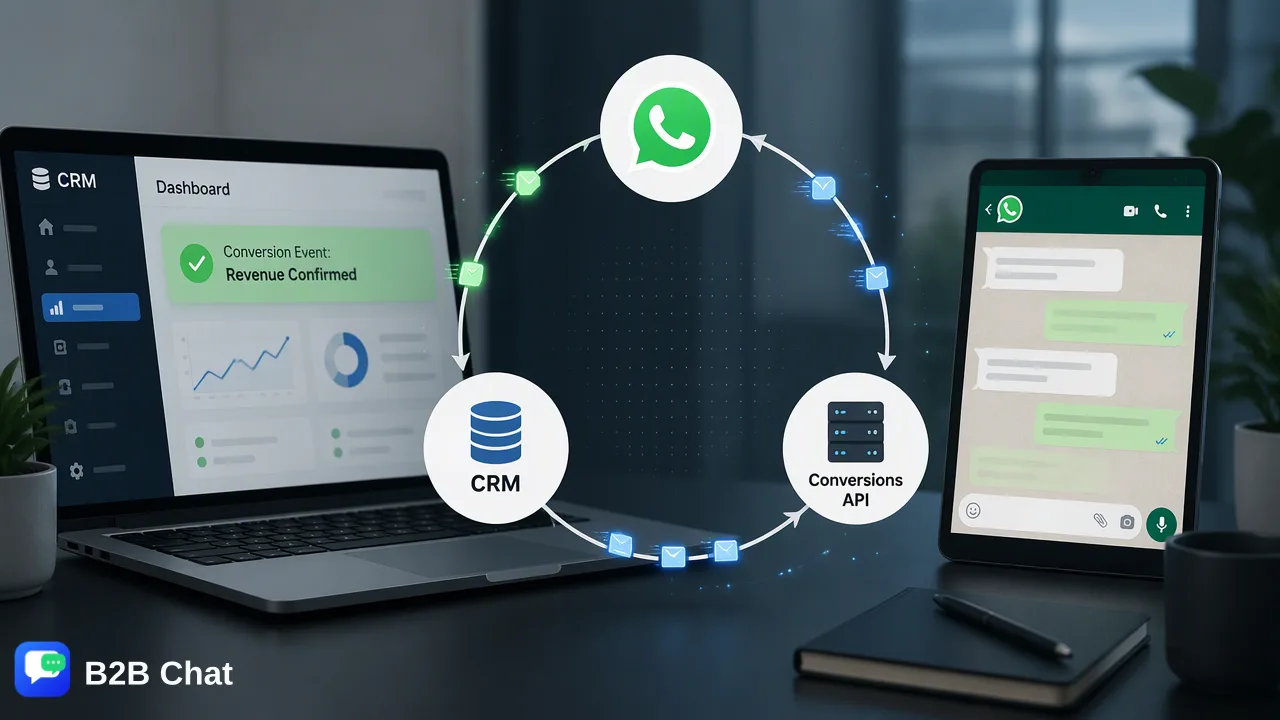
Learn how organizations bridge the attribution gap between WhatsApp conversations and CRM revenue by capturing intent data, integrating offline payments, and measuring true conversation costs.
The attribution gap in conversational sales occurs because standard advertising platforms track user engagement only up to the initial ad click or chat initiation, leaving a visibility blind spot during the messaging exchange where qualification, negotiation, and conversion decisions occur. To close this gap and connect WhatsApp conversations to CRM revenue, organizations must sync conversational touchpoints and intent indicators directly to CRM deal records, map offline and external payments back to unique chat identifiers, and transmit downstream conversion events back to ad networks via server-side frameworks like Conversions API (CAPI).
The Limitations of Click-Based Attribution in Messaging Funnels
Standard digital marketing funnels rely heavily on browser-based tracking pixels, UTM parameters, and session cookies to monitor customer actions from ad impression to digital checkout. However, when an ad campaign directs prospects into a messaging channel such as WhatsApp, that direct tracking thread breaks. Ad platforms record a successful click or conversation-started event, but they possess no native visibility into what transpires inside the chat window. This disconnection creates an attribution gap. In high-consideration purchases, cross-border commerce, and B2B workflows, prospects rarely convert on the initial message. Conversations frequently unfold over several hours or days, involving product evaluations, custom negotiations, shipping inquiries, and objection handling. Because advertising dashboards register only the initial click, marketing teams cannot discern which ad creatives, targeting parameters, or campaigns generated paying customers versus low-intent inquiries. Without an intentional framework to bridge chat activities with pipeline data, organizations risk allocating budget toward campaigns that produce high message volumes but negligible actual revenue.
Structuring Conversation Data for CRM Deal Records
Connecting messaging interactions to bottom-line revenue requires treating the conversation as a structured pipeline stage rather than an isolated support exchange. Operational teams achieve this by capturing key identifiers at the start of the interaction and syncing them directly to CRM contacts, leads, and opportunity records. A reliable data-syncing structure connects three core elements:
| Data Component | Source Channel | CRM Destination Field |
|---|---|---|
| Campaign Identifier | Click-to-WhatsApp ad parameters or referral code | Lead source and campaign attribution fields |
| Contact Identity | Phone number and platform profile | Primary CRM contact record |
| Deal Context & Intent | Chat qualification and AI context analysis | Deal stage, opportunity value, and lead score |
| Workspaces like B2B Chat support multi-account management across WhatsApp, Telegram, and LINE, centralizing conversation flow so operators can manage client interactions in a single environment. By deploying AI customer service capabilities that interpret intent from incoming messages and conversational context, teams can automatically extract prospect requirements, categorize buyer interest, and append actionable context directly to CRM records. This qualification context ensures that sales representatives receive enriched deal histories rather than unparsed conversation transcripts. |
Bridging the Gap: Offline Payments and Conversions API
A significant proportion of WhatsApp-driven revenue concludes outside automated online storefronts. In international commerce and enterprise sales, buyers routinely finalize transactions through bank wire transfers, manual invoices, cash-on-delivery arrangements, or in-store point-of-sale systems. When payment processing occurs offline, the transaction is completely decoupled from the originating messaging thread unless organizations implement disciplined reconciliation practices. To bridge this divide, teams should assign unique transaction references, invoice IDs, or customer account numbers within the chat before the customer completes their payment. When finance or operations teams log the completed transaction in the CRM, the matching reference ties the realized revenue back to the specific WhatsApp thread and the representative who handled it. Once revenue is confirmed in the CRM, organizations can complete the feedback loop by leveraging server-side integrations such as Conversions API (CAPI). Instead of relying on client-side browser events, CAPI allows CRM systems to send verified purchase events, transaction values, and hashed contact identifiers back to ad network servers. This server-to-server data transmission informs ad platform optimization algorithms about which conversational interactions yielded tangible revenue, refining lookalike modeling and ad delivery without depending on browser cookies.
Calculating True Cost per Conversation and Operational ROI
Attribution models often fall short by measuring success solely against direct ad spend. A marketing team might celebrate an ad campaign yielding low acquisition costs per chat inquiry, only to find that operational margins deteriorate during the sales cycle. To evaluate authentic profitability, organizations must calculate the true cost per conversation. A complete cost model incorporates three distinct expenditure layers:
- Acquisition Expenditure: Direct media spend allocated to click-to-chat campaigns, QR code placements, and lead-generation ads. 2. Platform and Software Overhead: Dedicated workspace management tools, desktop client software, account connectivity, and automated workflow services. 3. Human Resource Investment: The cumulative time customer-facing representatives spend reviewing inquiries, drafting replies, and conducting manual deal follow-ups. Incorporating AI customer service assistance helps teams optimize operational costs by handling repetitive first-line inquiries and contextual qualification. When automated systems interpret incoming context and prepare responses, representatives can focus their manual time on high-intent negotiation and closing. Comparing fully loaded operational costs against closed-won CRM revenue provides leadership with an accurate return-on-investment figure, demonstrating the precise financial impact of WhatsApp sales operations.
FAQ
Why is it difficult to track revenue from WhatsApp conversations?
Traditional analytics and advertising platforms track user actions through cookies, browser pixels, and URL parameters that terminate the moment a user transitions into a private messaging environment like WhatsApp. Because messaging happens outside the browser session, subsequent interactions—such as product inquiries, custom quotes, qualification discussions, and offline payment transfers—remain isolated from ad performance dashboards unless explicitly tied to CRM deal stages.
How does AI intent understanding support CRM data quality?
AI customer service tools can evaluate incoming message text and ongoing conversation context to detect customer intent, product interests, and urgency levels during early-stage messaging. When this contextual data is passed into CRM systems, it enriches contact and deal records with structured attributes, helping sales teams prioritize high-value opportunities and maintain clear audit trails of what motivated each purchase.
What factors should be included in a true cost-per-conversation calculation?
Calculating an accurate cost per conversation requires evaluating total operational inputs rather than relying solely on paid ad spend. Organizations should factor in platform workspace fees, messaging usage fees, agent handling time, and team overhead alongside acquisition costs to determine the true return on investment for each conversational channel.
Learn More
Choose the product information that fits the next step in your workflow.