How to Automate WhatsApp Group Moderation: A Risk-Managed Framework for Community Managers
Learn how WhatsApp group moderation automation supports community operations by pairing clear rulesets and AI intent analysis with human review workflows.
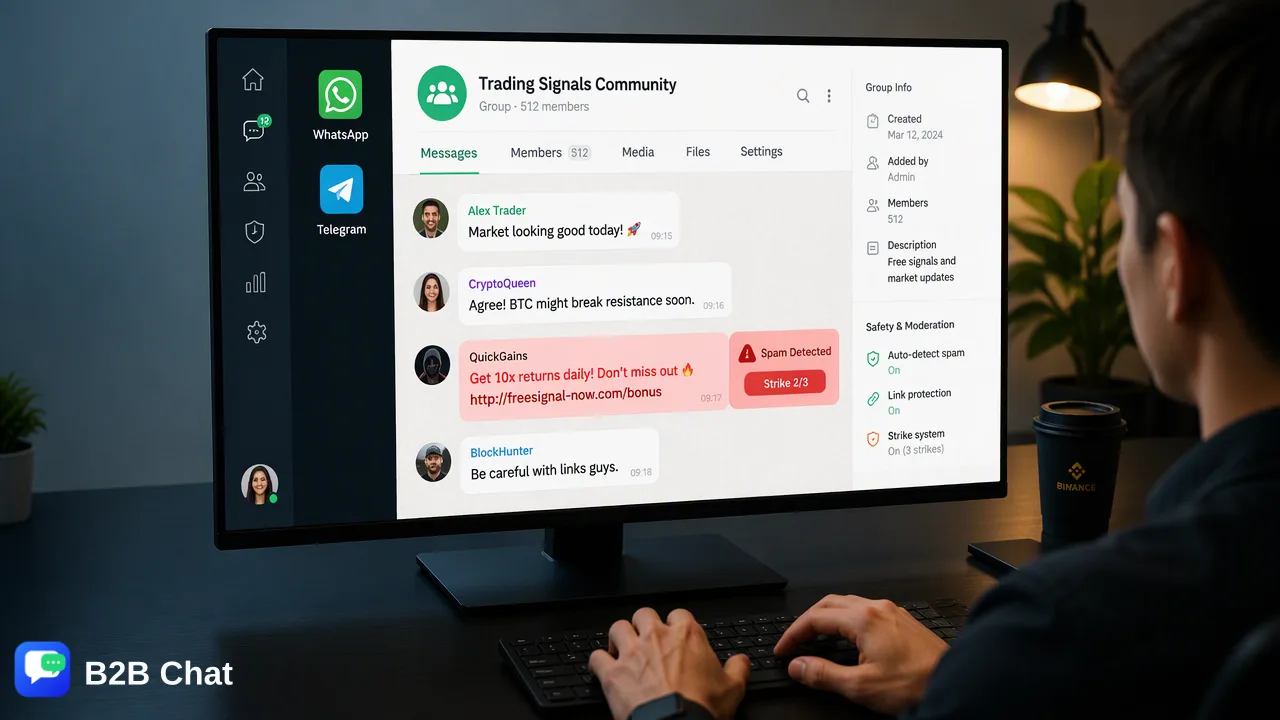
Manual WhatsApp group moderation often breaks down at scale. Discover how combining structured community rulesets, AI-driven intent analysis, and centralized workspace management supports sustainable group governance.
WhatsApp group moderation automation helps community operations teams maintain compliant, productive conversations by replacing slow manual oversight with automated message evaluation. Manual moderation of high-volume groups often fails because volume outpaces human capacity, leading to missed violations and inconsistent rule enforcement. By using AI customer service tools that evaluate conversation context and message intent, teams can automatically flag spam, detect offensive language, and route edge cases to human operators without slowing down group activity.
The Challenges of Manual WhatsApp Moderation
Managing messaging communities manually becomes unsustainable as membership numbers rise. In high-traffic WhatsApp groups, hundreds of messages can arrive within minutes, burying promotional links, unsolicited advertisements, and abusive exchanges beneath legitimate community conversation. Relying solely on human moderators introduces several operational bottlenecks:
- Coverage Gaps: Community activity often spans multiple time zones, leaving groups vulnerable during off-hours when moderators are offline. * Inconsistent Enforcement: Different moderators apply subjective thresholds when interpreting ambiguous statements, confusing group members about community standards. * Operational Fatigue: Human reviewers spent checking high volumes of routine text can miss critical policy violations or experience burnout from constant review cycles. These constraints make manual review inefficient for large communities. Without automated assistance, organizations face increased operational risk and degraded member engagement.
Defining Your Moderation Ruleset
Before configuring automation, community managers must establish a comprehensive, unambiguous ruleset. Automated systems require explicit parameters to evaluate whether an incoming post adheres to group standards. An operational moderation framework typically categorizes violations into clear enforcement tiers:
| Violation Tier | Example Behaviors | Recommended Automated Action |
|---|---|---|
| Spam & Promotion | Unsolicited affiliate links, crypto pitches, external group invites | Message removal, immediate automated warning |
| Harmful Content | Hate speech, harassment, explicit media, personal attacks | Content deletion, account removal, human escalation |
| Disruption | Repetitive flooding, off-topic arguments, hostile tone | Temporary mute, conversational reminder |
| Standardizing these definitions helps automated filters identify clear violations while establishing transparent expectations for group members. Documenting these rules also provides the foundation for consistent compliance reviews. |
Leveraging AI for Real-Time Content Analysis
Traditional moderation tools depend heavily on static keyword lists. However, bad actors routinely evade static filters by using phonetic spellings, spaced characters, or misleading phrasing. Advanced automated moderation moves beyond rigid keyword matching by incorporating AI customer service tools that evaluate incoming messages and conversation context. AI-driven intent understanding interprets the underlying objective of a message rather than assessing words in isolation. By evaluating the surrounding conversational context, the system can determine whether an ambiguous comment is part of a benign discussion or represents targeted harassment. Furthermore, global communities frequently encounter multilingual message traffic. With AI translation tools supporting automatic language detection across 200+ languages, community management workspaces can interpret and evaluate incoming communications regardless of the member's regional dialect. This context-aware evaluation assists first-line screening, helping teams spot subtle policy infractions without disrupting normal community interactions.
Building a Scalable Moderation Workflow
An automated moderation architecture combines programmatic content evaluation with human oversight. Rather than attempting to eliminate human involvement entirely, automation acts as an initial filter that handles repetitive tasks and surfaces complex edge cases for team review. A scalable workflow includes three essential operational layers:
- First-Line Automated Triage: Incoming messages undergo immediate intent analysis. Blatant spam and prohibited links trigger automated warnings or removal. 2. Strike-Tracking Governance: Systems log infractions against repeat offenders. A progressive escalation model—such as a warning on the first strike, temporary muting on the second, and removal on the third—ensures transparent enforcement. 3. Centralized Multi-Account Management: Organizations operating across multiple groups or channels benefit from desktop workspaces that connect WhatsApp, Telegram, and LINE accounts into a single interface. Centralizing group oversight across Windows or macOS clients helps managers enforce identical guidelines across multiple communities without constant tool-switching. 4. Audit Trails and Human Review: Every automated moderation action should generate an auditable record. Storing message logs, flagged timestamps, and applied actions gives compliance teams the evidentiary trail needed to resolve appeals fairly.
FAQ
Why is manual moderation difficult for large WhatsApp groups?
High message volume in growing communities makes continuous manual oversight difficult to sustain. Human moderators face fatigue, delayed review cycles, and subjective decision-making, which increases the likelihood of missed spam or harassment.
How does AI improve the accuracy of content moderation?
Simple keyword blockers frequently misinterpret normal discussions or fail to catch obfuscated text. AI-driven intent understanding interprets incoming messages within their broader conversation context, helping teams distinguish between benign chatter and disruptive intent.
Can AI moderation handle multiple languages in a global community?
Yes. Platforms equipped with AI translation support automatic language detection and translation across 200+ languages, adjusting phrasing according to context so moderators can evaluate non-native interactions across regional groups.
What is the role of conversation context in automated moderation?
Conversation context helps automated systems evaluate whether a word or phrase represents a rule violation or harmless conversation. Considering message history alongside intent helps reduce false positives during first-line screening.
Learn More
Choose the product information that fits the next step in your workflow.