WhatsApp vs Telegram for Business Customer Communication
Compare WhatsApp vs Telegram for business communication. Learn how audience fit, multi-account aggregation, and AI tools shape messaging operations.
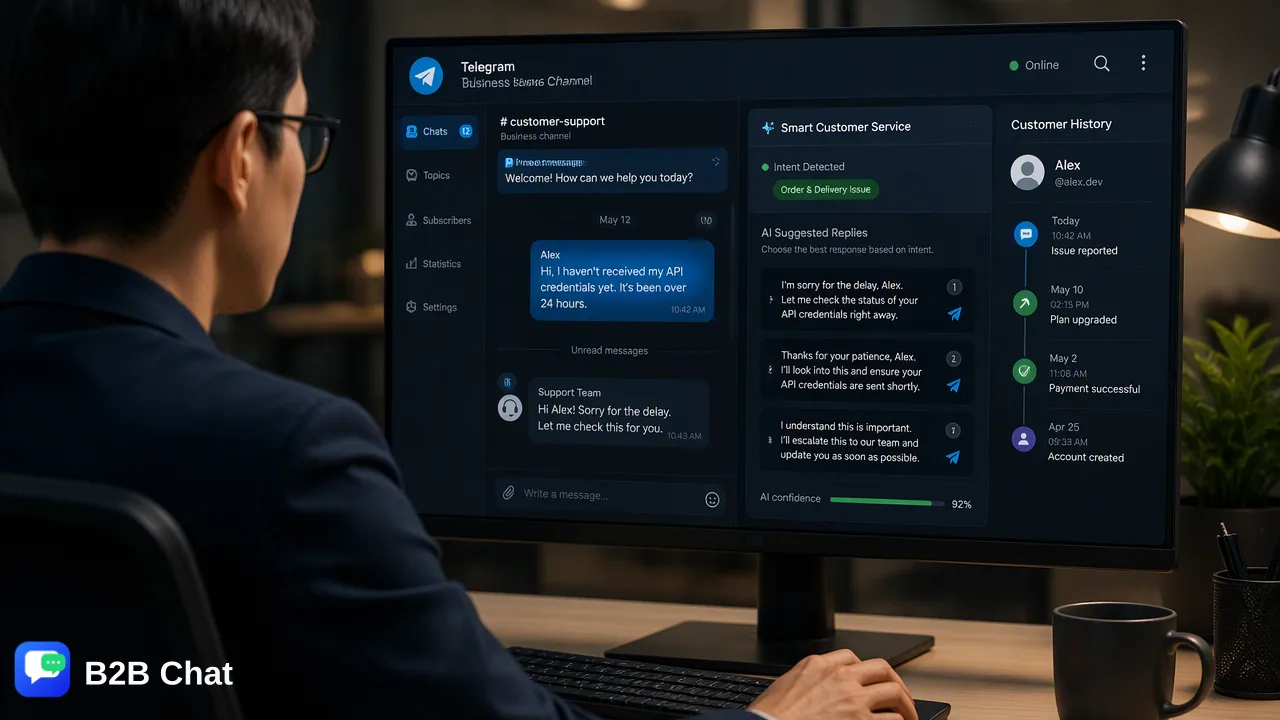
A strategic comparison of WhatsApp and Telegram for business customer communication, examining audience fit, multi-account operations, and AI-assisted workflows.
Choosing between WhatsApp and Telegram for business communication depends on where target customers reside and how internal teams manage conversational scale. WhatsApp serves widespread direct consumer messaging across global regions, while Telegram provides flexible group structures and broadcast-style interactions. Rather than treating them as mutually exclusive, organizations frequently adopt both, relying on aggregated desktop workspaces, multilingual translation, and intent-aware AI assistance to maintain operational efficiency across distributed accounts.
Evaluating Messaging Platforms for Business
Selecting the right social messaging channel requires aligning platform capabilities with customer expectations and regional usage habits. WhatsApp remains deeply embedded in everyday personal communication across Europe, Latin America, Southeast Asia, and India, making it a primary touchpoint for one-on-one customer support, transactional updates, and direct relationship nurturing. Telegram, by contrast, thrives in tech-forward communities, private-interest groups, and broadcast-oriented audiences seeking fluid community discussions and channel-based updates. When evaluating these environments, teams must assess how each channel fits their communication model:
| Operational Dimension | WhatsApp Focus | Telegram Focus |
|---|---|---|
| Core Interaction Style | High familiarity, direct one-to-one messaging | Community-centric, broadcast channels, open groups |
| Audience Profile | General consumer demographics, regional mobile-first markets | Privacy-focused users, specialized niches, global crypto/tech groups |
| Operational Complexity | High expectation of immediate, personalized service | Mixed inquiries spanning private chats and active public threads |
| Workflow Goal | Direct customer issue resolution and relationship management | Community engagement, content broadcasting, and tier-one support |
| Selecting a channel is rarely an either-or decision. International enterprises often find that their total audience is split across both ecosystems. Consequently, success hinges on establishing standard operational practices that accommodate the unique communication style of each platform. |
Operational Considerations for Multi-Channel Support
Expanding into multiple messaging ecosystems introduces immediate operational hurdles. Customer service and growth teams managing disparate accounts often face application switching, missed messages, siloed conversation histories, and inconsistent response pacing. When staff members must juggle separate web interfaces or mobile devices for WhatsApp, Telegram, and complementary channels like LINE, productivity degrades and oversight becomes difficult. Centralizing operations within a unified workspace directly addresses these friction points. B2B Chat provides a downloadable client for Windows and macOS that allows teams to aggregate, connect, and operate multiple WhatsApp, Telegram, and LINE accounts in one place. By removing the need to cycle through independent browser sessions or distinct hardware terminals, unified account aggregation supports smoother daily operations. Furthermore, the platform offers open port management with unlimited account registrations and no stated duration caps, providing cross-border marketing and support teams the flexibility needed to scale multiple regional outreach accounts alongside core inbound support handles.
Scaling Communication with AI Tools
As incoming message volume expands across international channels, human-only teams encounter language barriers and repetitive inquiry bottlenecks. Leveraging embedded AI capabilities helps organizations handle scale while maintaining contextual relevance. ### Multilingual Translation Across Global Markets Cross-border customer interactions frequently require staff to converse in languages they do not natively speak. B2B Chat incorporates Smart Translation covering 200+ languages with automated language detection. Rather than relying on rigid, word-for-word translation engines, the system adjusts translation phrasing according to conversation context, assisting teams in delivering clear, natural phrasing in both inbound comprehension and outbound messaging. ### Contextual Intent Understanding for First-Line Responses High inquiry volume often centers on repetitive informational queries, status checks, or common workflow questions. Smart Customer Service interprets incoming customer intent from message content and broader dialogue history. This capability assists first-line automated responses, handling routine touchpoints so operational teams can review, prioritize, and step in for complex escalations. Rather than acting as an autonomous replacement for human staff, these AI features serve as practical operational assistants that reduce manual keystrokes and support uniform responsiveness.
Decision Framework: Which Channel Fits Your Business?
Deciding how to allocate resources between WhatsApp and Telegram involves balancing audience presence, resource capacity, and team infrastructure. Organizations can evaluate their deployment strategy against three practical criteria:
- Audience Demographics and Geography: If your market centers on regions where WhatsApp is the default communication utility, prioritizing direct one-on-one support lines there is essential. Conversely, if your product serves technical, trading, or global online communities that organize via groups, Telegram should form a major pillar of your engagement strategy. 2. Interaction Volume and Structure: For structured, high-touch support workflows, direct messaging queues are ideal. For community discussions, mass announcements, and broader inbound interaction, Telegram channels and groups provide superior group scalability. 3. Operational Infrastructure: If managing multiple platforms threatens to stretch team bandwidth, organizations should not limit customer reach by abandoning channels. Instead, implementing an aggregation workspace like B2B Chat allows teams to maintain a presence across WhatsApp, Telegram, and LINE concurrently. By uniting channel presence under a single operational roof and utilizing context-aware translation and intent assistance, businesses can meet customers on their preferred platforms without compromising team efficiency.
FAQ
How can teams manage WhatsApp and Telegram accounts in one place?
Teams can aggregate operations by utilizing dedicated multi-account workspaces such as B2B Chat. The downloadable client connects multiple WhatsApp, Telegram, and LINE accounts within a unified interface on Windows and macOS, eliminating repetitive logins and manual tool switching.
What role does AI play in modern customer service messaging?
AI tools support conversational support by detecting languages across 200+ options, adjusting translations according to contextual nuance, and interpreting incoming customer intent to assist first-line automated replies. Rather than replacing human agents, AI tools act as operational assistants that help teams handle initial inquiries more rapidly.
Should businesses deploy a single messaging channel or support multiple platforms?
Operating multiple messaging platforms is often preferable for businesses serving cross-border or diverse demographics. Because customer preferences vary significantly by geography and community culture, supporting both WhatsApp and Telegram—supported by a centralized client—helps organizations remain accessible without fragmenting internal workflows.
Learn More
Choose the product information that fits the next step in your workflow.