AI Customer Service Knowledge Base: How to Prepare One for WhatsApp
What to put in the knowledge base behind a WhatsApp AI agent: product facts, shipping, payment, after-sales rules, escalation triggers, and a review routine.
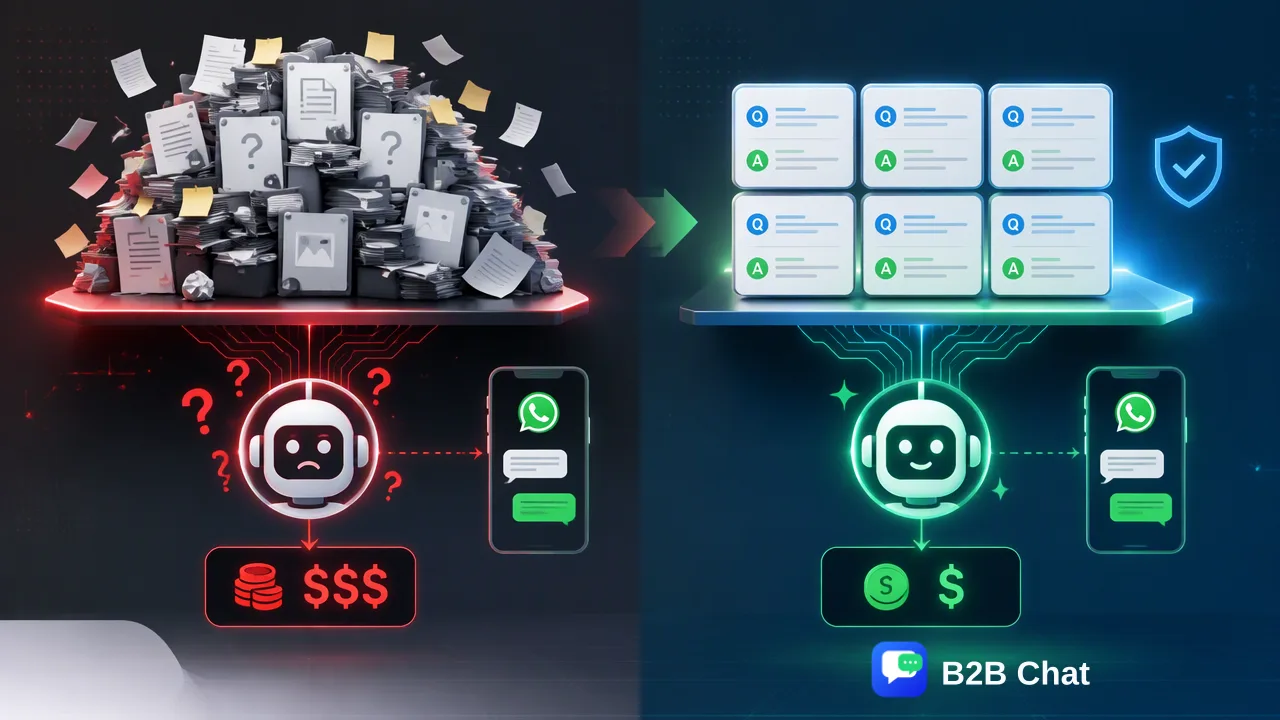
A practical guide for overseas sales teams on building, sizing and reviewing the knowledge base behind an AI customer service agent on WhatsApp.
An AI customer service knowledge base for WhatsApp should hold the facts buyers ask about every day: products, shipping, payment steps, after-sales rules, and a written list of cases the AI must hand to a person. Keep it short, current and written as clear question-and-answer entries. A smaller, cleaner knowledge base gives the agent less to misread and, where billing depends on input size, costs less per reply. Staff then review a sample of the AI's replies every day and fix the knowledge base, not the individual chat.
What an AI customer service knowledge base should contain
Most vendor guides list generic content types (help articles, manuals, internal docs). For a team selling overseas over WhatsApp, the useful content is narrower and more concrete:
| Section | What to include | Example entry |
|---|---|---|
| Product facts | Models, sizes, materials, MOQ, what is in stock vs. made to order | "Model A comes in S–XL; XL ships in 7 days." |
| Shipping | Regions served, carriers, typical transit time per region, who pays duties | "Jakarta: 5–8 days by sea freight." |
| Payment | Accepted methods and the exact steps; what proof of payment to send | "Send the transfer receipt in this chat." |
| After-sales | Return window, damaged-goods process, warranty conditions | "Photos of damage within 3 days of delivery." |
| Tone and identity | Store name, greeting style, formal vs. informal address | "Address buyers as Kak in Indonesian." |
| Escalation triggers | Cases the AI must not answer | "Custom pricing → hand to sales." |
The example entries above are placeholders; every number in a real knowledge base should come from the team's own current terms. Leave out internal margins, supplier names, staff phone numbers and anything not meant for a buyer to read.
How to write entries an AI agent can use correctly
AI agents answer from what they are given. Content that is clear to a colleague can still be misread by a model. Write entries so they cannot be confused:
- One fact per entry, phrased as the buyer would ask it. "How long does delivery to Mexico City take?" followed by the answer.
- State conditions next to the fact. "Free shipping over the threshold applies to Indonesia only" beats a separate footnote.
- Remove old versions. If last season's price list and this season's are both present, the agent may quote either. Delete, do not archive inside the knowledge base.
- Use units and currencies explicitly. Write "USD" and "kg"; buyers in Latin America and Southeast Asia read numbers differently.
- Keep product names and SKUs untranslated and list them exactly as they appear on the order form.
Define escalation triggers before the agent goes live
A knowledge base is also a list of what the AI should not handle. WhatsApp's Business Policy expects businesses that automate chats to offer prompt, clear escalation paths to a human agent. Write the triggers down and give the agent the hand-off wording:
- The buyer asks for a person, a call or a manager.
- Price negotiation, bulk or custom quotes, and discounts outside published terms.
- Refunds, chargebacks, missing payments or disputed amounts.
- Complaints, damaged goods, or an angry or repeated message.
- Customs, legal, certification or safety questions.
- Anything the knowledge base does not cover. The agent should say it will check with the team rather than guess.
Decide who picks up each trigger and how fast during working hours, and what the buyer is told outside them.
How knowledge-base size affects per-reply cost
Many AI agents read the relevant knowledge plus the recent conversation for every reply, so a larger knowledge base means more input per reply. In B2B Chat, Smart Service, the AI agent for routine replies, is billed per reply; the charge starts at a base rate and rises with the amount of input it reads, and the main factor is the size of the robot's knowledge base. Current rates are on the pricing page.
Practical ways to keep the knowledge base lean:
- Cut duplicates. The same return policy pasted under three headings is read three times.
- Remove marketing copy. Brand stories and long product descriptions rarely answer a buyer's question.
- Keep only markets the agent actually serves. If the AI agent only answers one market's numbers, other markets' shipping rules are dead weight.
- Prefer tables of facts over paragraphs. They carry the same information in less text.
Lean content also tends to produce better answers, because the agent has fewer conflicting passages to choose between.
How staff review the replies the AI agent sends
The AI customer service agent in B2B Chat handles routine, multi-turn replies across parallel conversations; its knowledge and behaviour are configured in the AI robot settings of the CRM console, and support seats keep human agents assigned to conversations. A review routine keeps it honest:
| Stage | What staff do | What to change |
|---|---|---|
| Before launch | Send 30–50 real past questions from internal test accounts | Missing or wrong entries |
| First two weeks | Read a daily sample of AI conversations, plus every escalated one | Wording, triggers, tone |
| Ongoing | Weekly sample; review every complaint that followed an AI reply | Outdated facts |
| After any policy change | Update the entry the same day, then re-test the related questions | The changed entry |
When a reply is wrong, fix the knowledge-base entry that caused it. Correcting the single chat leaves the same mistake waiting for the next buyer.
Common mistakes when preparing an AI customer service knowledge base
- Uploading everything. Full catalogs, contracts and old chat exports add cost and contradictions.
- No owner. Assign one person to approve changes, the same way a price list has an owner.
- Promises the team cannot keep. If the knowledge base says "reply within one hour", the AI will repeat it at 3 a.m.
- Mixing keyword rules and AI answers for the same question. A fixed keyword auto-reply and an AI reply firing together confuse buyers; decide which one owns each question type.
- Launching on all numbers at once. Start with one market or one number, review, then widen.
FAQ
How can teams decide what goes into an AI customer service knowledge base?
Export a few weeks of real buyer questions, group them by topic, and write one clear entry for each recurring question. Product facts, shipping, payment steps and after-sales rules usually cover most of them; anything requiring judgment becomes an escalation trigger instead.
How often should the knowledge base behind an AI agent be updated?
Update an entry on the day the underlying fact changes, such as a new shipping rate or holiday schedule, and do a full review at least monthly. Stale entries are a common source of wrong AI replies.
Does a bigger knowledge base make AI replies more expensive?
It can. Where billing depends on how much input the agent reads per reply, as with B2B Chat's Smart Service, a larger knowledge base raises the per-reply charge. Removing duplicates and marketing copy keeps it lean.
How can staff check AI replies without reading every conversation?
Review a daily sample during the first weeks, every escalated conversation, and every complaint that followed an AI reply. Then fix the knowledge-base entry behind each wrong answer rather than the individual chat.
Learn More
Choose the product information that fits the next step in your workflow.