How to Launch Your First Customer-Facing AI Agent Without Risking Your Brand
Learn best practices for customer service AI agent deployment. Discover how to automate first-line responses on WhatsApp and Telegram safely.
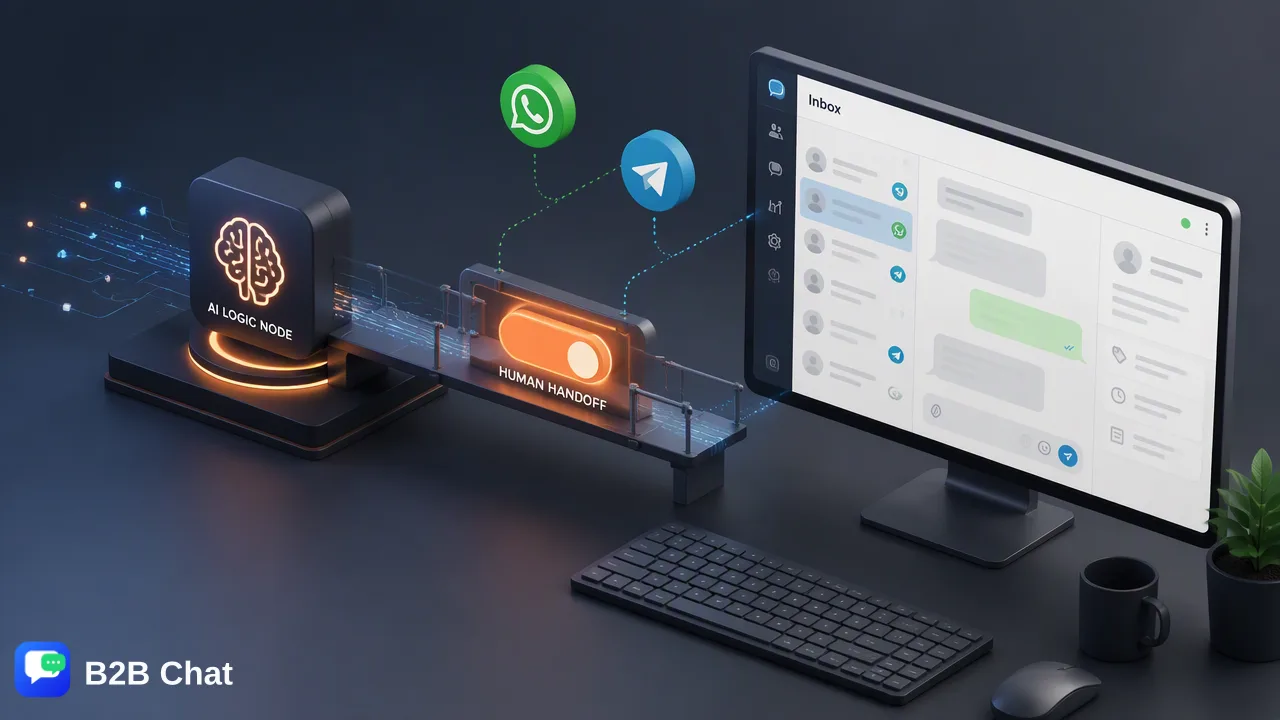
A strategic guide to deploying customer service AI agents on messaging platforms. Learn how to implement phased rollouts, utilize context-aware automation, and establish clear human handoff protocols to protect your brand.
Launching a customer-facing AI agent requires a phased strategy: start with a single, high-volume use case to refine performance, establish clear guardrails for human escalation, and utilize context-aware AI that understands conversation history. By focusing on task completion rather than simple deflection, businesses can automate first-line responses while maintaining brand integrity and service quality. For teams managing global communications, platforms like B2B Chat centralize WhatsApp and Telegram accounts, allowing organizations to deploy AI customer service tools that interpret customer intent from incoming messages and assist with automated first-line responses.
The Strategic Approach to AI Deployment
When organizations begin a customer service AI agent deployment, the most common risk is attempting to automate too many complex workflows at once. Successful AI deployment relies on starting with a single, high-volume use case. By isolating one specific operational challenge—such as answering standard order status inquiries or providing basic business hours—teams can monitor the AI's performance closely. This measured approach helps organizations refine the knowledge base and adjust the agent's behavior before expanding its responsibilities. Using a centralized workspace like B2B Chat, which supports WhatsApp and Telegram for centralized customer communication, allows teams to manage these initial deployments across multiple accounts in one place.
Defining the Scope: Intent and Context
Modern messaging environments require more than rigid keyword triggers. AI agents should interpret customer intent and conversation context to provide accurate, natural responses. When a customer reaches out on WhatsApp or Telegram, their messages often contain fragmented thoughts or refer back to previous statements. An effective AI customer service implementation evaluates the entire incoming message and the surrounding conversation context to assist automated first-line responses. This capability ensures that the automated replies align with the actual needs of the user, reducing frustration and maintaining a professional brand presence. B2B Chat provides this intent-understanding capability within its downloadable client for Windows and macOS, giving operators the tools to deploy context-aware assistance directly within their existing messaging workflows.
Establishing Guardrails for Human Handoff
Automated systems cannot resolve every customer inquiry. Clear boundaries must be defined for when an AI agent must escalate a conversation to a human. Establishing these guardrails protects the brand from providing incorrect information or frustrating users who have complex, nuanced, or highly sensitive issues. Teams should configure their workflows so that the AI handles routine, first-line responses, but immediately routes the conversation to a human operator when it detects unrecognized intent, high-priority keywords, or repeated user frustration. Because B2B Chat allows users to manage multiple WhatsApp and Telegram accounts in one place, human operators can seamlessly take over escalated chats within the same interface, ensuring continuity of service without requiring the customer to repeat their issue.
Measuring Success Beyond Deflection
Many organizations mistakenly evaluate their customer service AI agent deployment solely by how many tickets it deflects from the human support team. However, deflection alone does not indicate customer satisfaction. Success should be measured by task completion rates rather than just deflection metrics. A high deflection rate might simply mean the AI is making it difficult for customers to reach a human, leading to abandoned conversations rather than resolved problems. Teams must analyze whether the AI successfully answered the user's question or completed the requested workflow. By reviewing conversation logs and intent-understanding accuracy, support managers can identify areas where the AI's knowledge base requires improvement, ensuring that automated first-line responses actually deliver value to the end user.
Phased Rollout and Real-World Testing
Before launching an AI agent to the entire customer base, organizations should validate its performance in a controlled environment. Use a phased rollout approach, starting with a small group of customers to identify edge cases. This testing phase allows teams to observe how the AI handles unexpected phrasing, regional dialects, or complex multi-part questions on platforms like WhatsApp and Telegram. During this period, human operators should closely monitor the automated first-line responses, ready to intervene and correct the system's behavior. Once the AI consistently demonstrates high task completion rates and accurate intent interpretation within the initial test group, the organization can confidently expand the deployment across all active messaging channels.
FAQ
How do organizations ensure an AI agent maintains brand voice?
Maintaining brand voice requires providing the AI with a highly accurate and structured knowledge base. The quality of the AI's response is directly tied to the accuracy and structure of the provided knowledge base. Teams should train the system using approved company documentation, past successful support transcripts, and clear stylistic guidelines. Additionally, utilizing an AI that interprets customer intent and conversation context helps ensure that responses remain relevant and natural, rather than robotic or disconnected from the user's specific situation.
What is the role of conversation context in AI customer service?
Conversation context allows an AI agent to understand the full scope of a user's inquiry rather than reacting to isolated keywords. In messaging apps like WhatsApp and Telegram, users often send multiple short messages or refer to previous statements. By analyzing the conversation context, the AI can accurately interpret customer intent and assist with automated first-line responses that directly address the ongoing dialogue. This reduces misunderstandings and provides a more seamless experience for the user.
When should an AI agent escalate a query to a human operator?
An AI agent should escalate a query whenever it encounters a scenario outside its defined scope or knowledge base. Clear boundaries must be defined for when an AI agent must escalate a conversation to a human. Common escalation triggers include unrecognized customer intent, requests for complex troubleshooting, sensitive account issues, or signs of user frustration. By managing these handoffs within a centralized workspace, human operators can review the conversation history and resolve the issue without forcing the customer to repeat themselves.