How to Launch Your First Customer Service AI Agent Without Disrupting Your Team
Learn the best practices for launching customer service AI agent workflows. Discover how to manage intent, context, and human handoff for WhatsApp and Telegram.
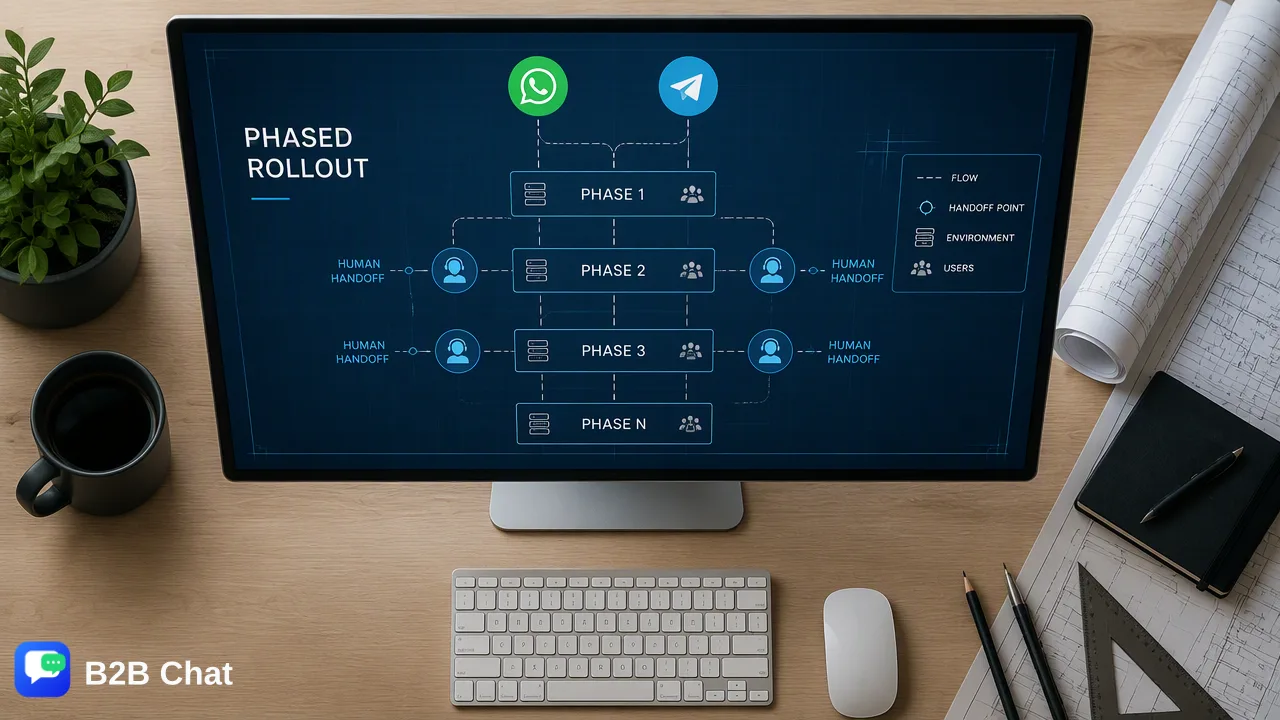
A strategic guide to deploying AI customer service agents by focusing on incremental implementation, context-aware automation, and clear human-handoff protocols for WhatsApp and Telegram.
Launching a customer service AI agent is most successful when organizations start with a single, high-volume use case rather than attempting immediate, full-scale automation. By defining clear guardrails for human handoff and grounding the AI in specific conversation context, businesses can assist first-line responses on platforms like WhatsApp and Telegram while maintaining high service quality. A phased approach prioritizes team stability, helping support staff focus on complex inquiries while the AI handles repetitive, automated interactions.
The Strategic Approach to AI Integration
Organizations evaluating AI deployment often face the challenge of integrating new technology without disrupting existing support workflows. The most effective method for launching customer service AI agent capabilities is an incremental, phased rollout. Rather than attempting to automate all support inquiries at once, teams should identify and start with one high-volume, repetitive task. This might include answering standard business hours questions, providing basic order status updates, or handling initial greeting routing. Prioritizing iterative testing over complex, multi-functional builds helps support teams monitor the AI's performance in a controlled environment. Successful deployment requires testing with realistic scenarios and a limited customer group before a full-scale rollout. This controlled testing phase helps identify gaps in the AI's knowledge base and provides an opportunity to refine the automated responses before they reach the broader customer base. By focusing on a narrow initial scope, organizations minimize operational risk and help keep human agents from being overwhelmed by misrouted or poorly handled automated interactions.
Defining the Scope: Intent and Context
The effectiveness of an AI customer service agent relies heavily on its ability to accurately interpret customer needs. Modern AI customer service agents can interpret customer intent from incoming messages and conversation context to assist with automated first-line responses. This contextual awareness is critical for supporting natural, relevant interactions that do not frustrate the end user. When an AI agent processes an incoming message, it must evaluate the current inquiry against the broader conversation history. Context-aware responses help the automated system avoid asking for information the customer has already provided. For global teams managing cross-border communications, this contextual understanding can also extend to language. Systems that automatically detect and translate customer messages across multiple languages, adjusting the translation expression based on conversation context, further streamline the support process. By grounding the AI in specific conversation context, organizations help keep automated first-line responses accurate, helpful, and aligned with the customer's actual intent.
Establishing Human-Handoff Guardrails
A critical component of launching customer service AI agent workflows is recognizing the limitations of automation. AI should be positioned to assist first-line responses, not to fully replace human support. To maintain service quality, organizations must define clear boundaries for when the AI must escalate a conversation to a human agent. These human-handoff guardrails are essential for managing complex, sensitive, or high-value inquiries that require empathy and nuanced decision-making. Teams should configure their workflows so that the AI agent automatically routes the conversation to a human representative when it encounters unrecognized intent, repeated customer frustration signals, or specific high-priority topics. Establishing these protocols provides customers with a path to human assistance when needed. Furthermore, human oversight remains essential for continuously reviewing escalated conversations, identifying areas where the AI's knowledge base can be improved, and updating internal playbooks to handle future inquiries more effectively.
Centralizing Operations for WhatsApp and Telegram
Deploying an AI agent is most efficient when the underlying communication channels are consolidated into a single workspace. For organizations relying heavily on social messaging, managing multiple accounts across different devices can create operational bottlenecks. B2B Chat provides a comprehensive customer service tool for WhatsApp and Telegram, letting users manage multiple accounts in one place. Delivered through a downloadable client available for Windows and macOS, this centralized approach reduces tool switching and provides a unified interface for both AI and human agents. When all WhatsApp and Telegram communications flow through a single workspace, the AI agent can consistently apply its intent understanding and context-aware responses across all connected accounts. This unified infrastructure supports seamless human handoff, as human agents can take over escalated conversations within the same interface, complete with the full conversation history and context gathered by the AI.
Measuring Success Beyond Deflection
After launching customer service AI agent capabilities, organizations must establish appropriate metrics to evaluate performance. A common operational mistake is measuring success solely based on the volume of conversations deflected from human agents. While deflection rate is a useful metric, it does not account for customer satisfaction or whether the underlying issue was actually resolved. Instead, teams should measure success based on task completion rates. This metric evaluates whether the AI successfully guided the customer to a resolution without requiring human intervention. High task completion rates indicate that the AI is accurately interpreting intent and providing relevant, context-aware responses. Additionally, organizations should monitor the escalation rate and the reasons for human handoff. Analyzing why conversations are escalated helps teams refine the AI's knowledge base, adjust the handoff guardrails, and continuously improve the overall support workflow.
FAQ
How do teams choose the first task for an AI agent?
Organizations should identify a single, high-volume, repetitive task to automate first. Starting with common inquiries, such as basic routing or standard informational responses, helps teams test the AI with realistic scenarios before a full-scale rollout.
How does an AI agent maintain context in a conversation?
AI customer service agents interpret customer intent from incoming messages and the ongoing conversation context. This helps the system assist with automated first-line responses that are natural and relevant, avoiding repetitive questions and supporting accurate support.
What is the role of human agents after AI deployment?
Human agents remain essential for handling complex, sensitive, or escalated inquiries. Organizations must define clear boundaries for when the AI must escalate a conversation to a human agent, maintaining human oversight for issues that require nuanced decision-making.
How can organizations manage AI across multiple messaging platforms?
Teams can use a comprehensive customer service tool to manage multiple accounts in one place. For example, B2B Chat provides a downloadable client for Windows and macOS that centralizes WhatsApp and Telegram communications, helping AI and human agents operate within a single workspace.