Beyond the Phone System: Why Modern Business Communication Requires a Messaging-First Strategy
Discover why a messaging-first business communication strategy using unified WhatsApp and Telegram workspaces improves global customer support.
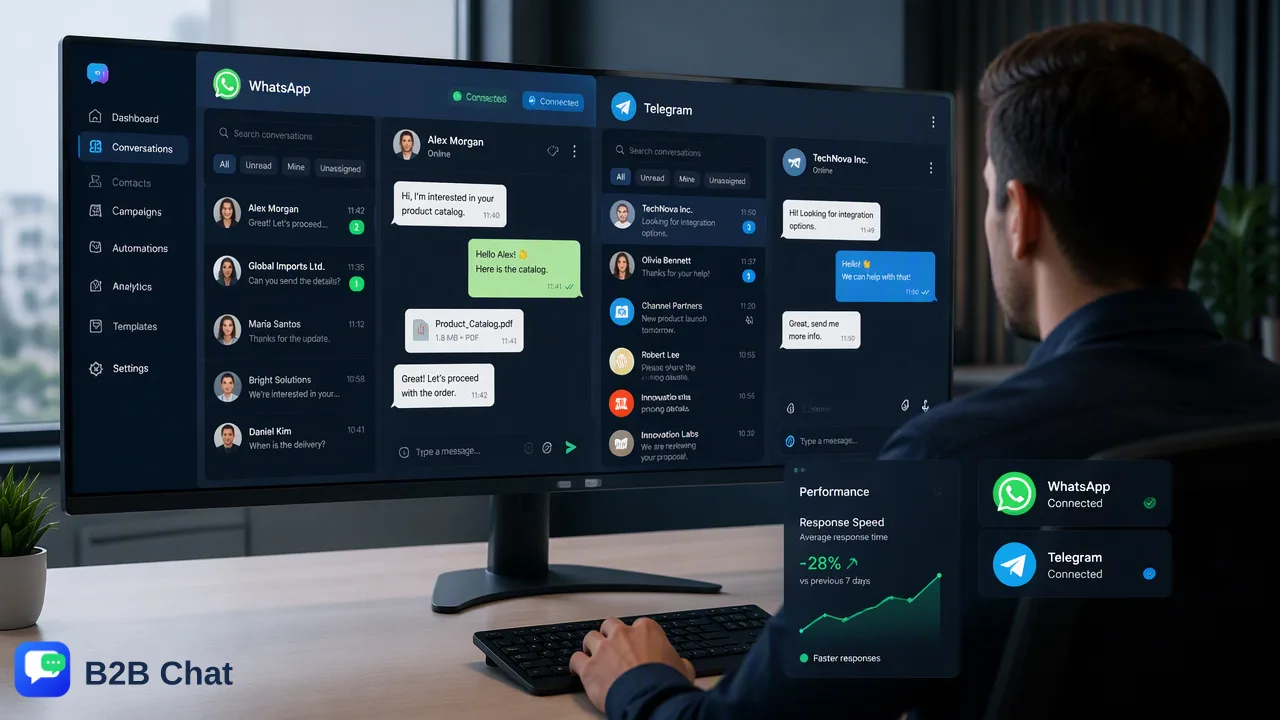
A messaging-first business communication strategy replaces fragmented voice systems with unified WhatsApp and Telegram workspaces, utilizing AI automation to accelerate first-line customer support.
Modern business communication is shifting from voice-only VoIP systems to a messaging-first architecture. By centralizing WhatsApp and Telegram into a unified workspace and deploying AI for first-line response and translation, organizations can meet customer demands for speed, maintain continuous availability, and eliminate the communication silos that lead to missed opportunities. A messaging-first business communication strategy allows cross-border ecommerce and support teams to process high-volume interactions asynchronously, ensuring that initial inquiries receive immediate, context-aware replies before routing to human operators for complex resolution.
The Limitations of Voice-Only Communication
Traditional phone systems inherently restrict customer service teams to synchronous, one-to-one interactions. When inbound inquiry volumes spike, voice-only infrastructure forces customers into holding queues, increasing abandonment rates and degrading the overall customer experience. Because voice communication requires both parties to be present simultaneously, it creates operational bottlenecks that are difficult to scale without linearly increasing headcount. Furthermore, voice-only systems create communication silos. As customers increasingly prefer messaging over waiting on hold, they often attempt to reach businesses through fragmented social channels or direct messaging apps. When organizations lack a centralized system to capture these text-based inquiries, support teams resort to using disconnected mobile devices or individual web logins. This fragmentation prevents comprehensive oversight, delays response times, and ultimately results in lead leakage where potential sales or critical support requests are lost in unmonitored inboxes.
The Messaging-First Architecture
A messaging-first business communication strategy resolves the inefficiencies of legacy voice systems by prioritizing asynchronous, text-based channels as the primary interface for customer interaction. To execute this strategy effectively, organizations require a unified communication platform that aggregates multiple accounts into one workspace. Unified communication platforms allow teams to manage multiple WhatsApp and Telegram accounts from a single client. For example, B2B Chat provides a downloadable desktop client for Windows and macOS that centralizes these messaging channels. By connecting and operating multiple accounts from a single interface, teams can handle outbound marketing and inbound support without constantly switching between different applications or physical devices. Centralization prevents lead leakage and improves team efficiency by providing a single pane of glass for all customer interactions. With fully open ports and unlimited registrations, a unified workspace scales alongside the organization's needs, ensuring that every WhatsApp or Telegram message is captured, tracked, and routed appropriately within the centralized desktop environment.
Scaling Support with AI Automation
Transitioning to a messaging-first architecture provides the necessary foundation for deploying artificial intelligence in customer service workflows. When messaging channels are centralized, AI tools can process incoming text to accelerate response times and reduce the manual burden on human operators. AI customer service assists by interpreting customer intent and conversation context to provide automated first-line responses. Instead of relying on rigid keyword menus, smart customer service tools analyze the incoming message to understand the user's underlying request. This allows the system to deliver immediate, relevant answers to routine questions, ensuring that customers receive instant acknowledgment while human agents focus on more complex escalations. For global operations, language barriers often slow down response times. AI translation across 200+ languages breaks down global communication barriers by automatically detecting the customer's language and translating messages in real time. Advanced translation features adjust the translation expression based on the conversation context, ensuring that technical terms or localized nuances are preserved. These AI capabilities operate on a per-request usage model, allowing teams to scale automated translation and first-line support efficiently as their cross-border traffic grows.
Operational Best Practices for Messaging Success
Implementing a messaging-first business communication strategy requires clear operational guidelines to maximize efficiency while maintaining high-quality customer interactions. Organizations must structure their workflows to balance automation with human oversight. First, teams must distinguish between AI triage and human-led deep conversation. AI should be deployed to handle immediate first-line responses, gather initial context, and resolve basic inquiries. However, complex support issues, sensitive account modifications, and nuanced sales negotiations must be routed to human operators. Clearly defining this handoff prevents automated systems from frustrating customers who require specialized assistance. Second, organizations should use unified dashboards to maintain context across multiple messaging channels. When a human agent takes over a conversation from the AI, they must have full visibility into the preceding automated interaction. Operating from a single downloadable client ensures that the entire conversation history on WhatsApp or Telegram is preserved, allowing the agent to resume the dialogue seamlessly without asking the customer to repeat information.
FAQ
Why is a messaging-first strategy better than traditional VoIP?
A messaging-first strategy prioritizes asynchronous communication, allowing support teams to handle multiple conversations simultaneously rather than being restricted to one-to-one synchronous phone calls. This approach aligns with customer preferences for text-based interactions, reduces hold times, and prevents the communication silos and lead leakage commonly associated with legacy voice-only systems.
How does AI improve customer service response times?
AI customer service assists by interpreting customer intent and conversation context to provide automated first-line responses. By instantly analyzing incoming messages and delivering relevant answers to routine inquiries, AI ensures customers receive immediate support, while simultaneously translating cross-border messages across 200+ languages to eliminate manual translation delays.
Can a unified platform manage multiple WhatsApp and Telegram accounts?
Yes, unified communication platforms allow teams to manage multiple WhatsApp and Telegram accounts from a single client. Solutions like the B2B Chat downloadable client for Windows and macOS enable organizations to connect and operate unlimited registrations in one centralized workspace, streamlining both outbound marketing and inbound customer support workflows.