Multi-Turn AI Customer Service: Keeping Context Across a Long WhatsApp Conversation
See how multi-turn AI customer service follows changes in a buyer's request, where keyword replies differ, and what staff should review.
Multi-turn context helps an AI agent answer the current question in light of earlier messages, while staff review commercial commitments and unresolved cases.
Multi-turn AI customer service uses earlier messages in a conversation to interpret the buyer's next question. When a buyer asks for a price, then shipping, then changes the quantity, the last reply should address the revised request rather than repeat the first answer. Teams still need approved source information and a human review path for prices, specifications, and exceptions.
What multi-turn AI customer service means in a buyer chat
A conversation is multi-turn when an answer depends on more than the latest message. Consider a clearly illustrative exchange: a buyer asks whether an item is available, then asks about shipping, then says the quantity has changed. The phrase 'what about the new total?' only makes sense if the previous product, destination, and revised quantity remain in context. An agent that treats the sentence in isolation may answer the wrong question.
Useful context is a small working set of facts, not a license to invent missing details. The agent needs to distinguish what the buyer stated, what the business has confirmed, and what is still open. A destination mentioned earlier may be relevant to shipping; an old quoted amount may no longer apply after the quantity changes. The better response may be a clarifying question, not a confident total.
For teams using several WhatsApp numbers, a long conversation may span staff shifts. B2B Chat combines WhatsApp, Telegram and LINE messaging accounts in a desktop client and offers Smart Service for routine, parallel replies with multi-turn context. That capability helps a team keep the immediate exchange coherent. It does not make the AI an authority on case-specific prices, shipping promises, or custom order approvals.
How context differs from a keyword auto-reply
A keyword rule reacts to configured matching words. It is useful when a buyer's message maps to a stable, approved answer: for example, a standard request for office hours or the next step in a published process. A multi-turn agent instead considers how a message relates to preceding turns. 'Can that arrive sooner?' needs the earlier destination and requested delivery period; a rule triggered by 'arrive' cannot reliably infer them.
B2B Chat's CRM console includes a reply library and keyword auto-replies, while Smart Service is the separate AI capability that reads conversation context. Keep their jobs distinct. Use the library for vetted facts and phrasing. Use context-aware assistance for routine questions whose meaning depends on the conversation. Route a case to staff when the answer requires an exception, a disputed fact, or an approval.
The distinction also matters for maintenance. Updating a keyword response fixes a known phrase and its approved answer. Improving multi-turn answers requires checking whether the information supplied to the agent is current and whether the agent understood a change in the buyer's request. A team should not judge either method simply by how fluent its message sounds. A polished reply can still refer to an outdated quantity.
Track the changing facts, not just the topic
For a buyer who asks about price, shipping, and a quantity change, review the conversation as a sequence of decisions. First identify the product and initial quantity. Then identify the destination and any shipping question. Finally mark the quantity revision as the current request. If the buyer has not supplied a necessary detail, ask for it. If the team has no approved quote for the revised combination, hand the decision to a person.
This sequence avoids a common failure: the agent remembers the topic but carries forward an obsolete value. Another failure is combining details from two separate inquiries by the same contact. Staff should check which order or proposed order the latest message concerns before accepting an automated reply. A customer record can help organize that context, but the conversation still needs reading.
Treat confirmations carefully. 'We can check shipping options for the revised quantity' is different from promising a delivery date. 'A colleague will review the quote' is different from approving a discount. The wording should reflect what has actually been verified. If an AI response has already implied a commitment, staff should correct the record clearly rather than silently continuing from it.
For multilingual conversations, preserve the buyer's original terms when a number, size, material, or deadline is at issue. B2B Chat's WhatsApp chat translator provides two-way, context-aware translation, but a staff member should inspect consequential wording before agreeing to a commercial term. Translation can keep the flow moving while review protects the meaning of the final answer.
Set a review boundary before turning on routine replies
A practical review plan begins with the categories of messages the agent may answer from approved information. List routine product facts, process explanations, and simple clarifying questions. Then define triggers for human attention: negotiated price, a changed specification, a complaint, conflicting order facts, repeated misunderstanding, or a buyer asking to speak with a person. Give each trigger an owner, so a handoff is an action rather than a label.
Before a shift, check that the reply library and AI knowledge base reflect current policies. Remove outdated descriptions instead of asking the agent to remember that they are obsolete. During a shift, sample completed multi-turn conversations. Look for whether the agent recognized the latest revision, asked only for missing details, and stopped before making an unsupported promise. Record a short correction when a pattern appears.
After a handoff, the staff member should read the last several messages and the customer record, identify the open question, and answer it directly. Asking the buyer to restate the entire exchange defeats the purpose of keeping context. AI customer service can cover routine replies across time zones, while named staff retain responsibility for negotiated and sensitive outcomes. This is a process choice teams must define; no automated setting substitutes for a clear owner.
A short checklist for evaluating a long conversation
Reviewers can use five questions. Did the reply refer to the latest quantity and destination? Did it distinguish a buyer statement from a confirmed business fact? Did it answer the buyer's current question rather than the first question? Did it ask for the one missing detail needed to proceed? Did it stop and pass the case to a person before making a new commitment?
Use the checklist on both successful and problematic chats. A single correct answer does not prove the agent will handle a later change of scope. Conversely, a handoff can be the right outcome even when the AI could draft a plausible sentence. The goal is a coherent service process in which the next responder knows what changed and what still requires judgment.
Platform-native tools can complement that process. WhatsApp Business provides messaging tools for quickly responding to customers, and Telegram Business describes preset quick replies. Those features are useful for repeatable messages; the review problem in a changing multi-turn exchange remains the same: the current answer must be grounded in the current facts.
FAQ
How can teams tell whether an AI agent retained the right context?
Check whether its latest reply uses the buyer's newest quantity, destination, and requested action, while treating earlier values as superseded where appropriate. Review any commercial commitment against approved facts.
How does a keyword auto-reply differ from a multi-turn AI reply?
A keyword auto-reply triggers from configured matching words in a reply library. A multi-turn AI reply interprets the latest message alongside preceding turns, which helps with follow-up questions but still requires accurate information and review.
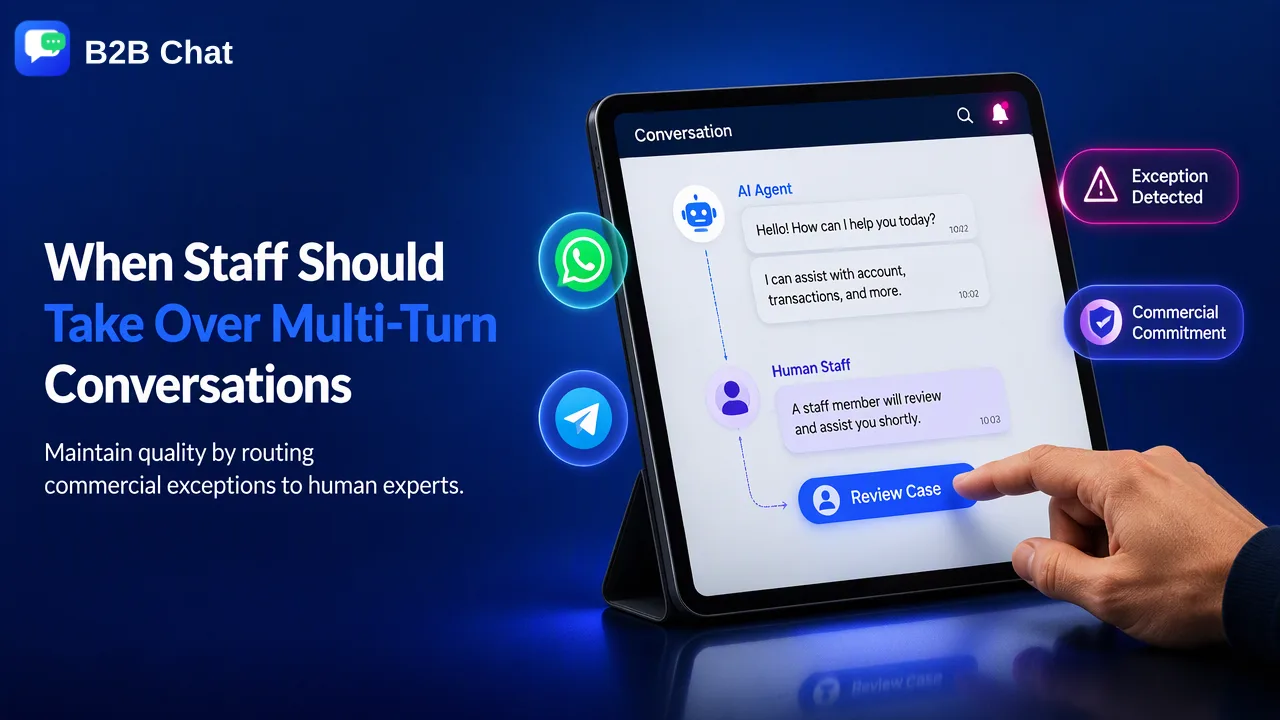
When should staff take over a multi-turn conversation?
Staff should take over when the next answer needs a price exception, a custom specification, complaint resolution, or another decision outside approved routine guidance. Repeated misunderstanding is also a practical handoff trigger.
Can translation be used during a long buyer conversation?
Yes. Two-way translation can help staff and an AI agent follow the exchange, but people should verify original wording for consequential details such as quantities, prices, and deadlines before committing to them.
Learn More
Choose the product information that fits the next step in your workflow.