Setting Up a Multilingual AI Customer Service Agent for WhatsApp Buyers
Prepare one reviewed knowledge base, translate buyer conversations, and set human review boundaries for multilingual WhatsApp support.
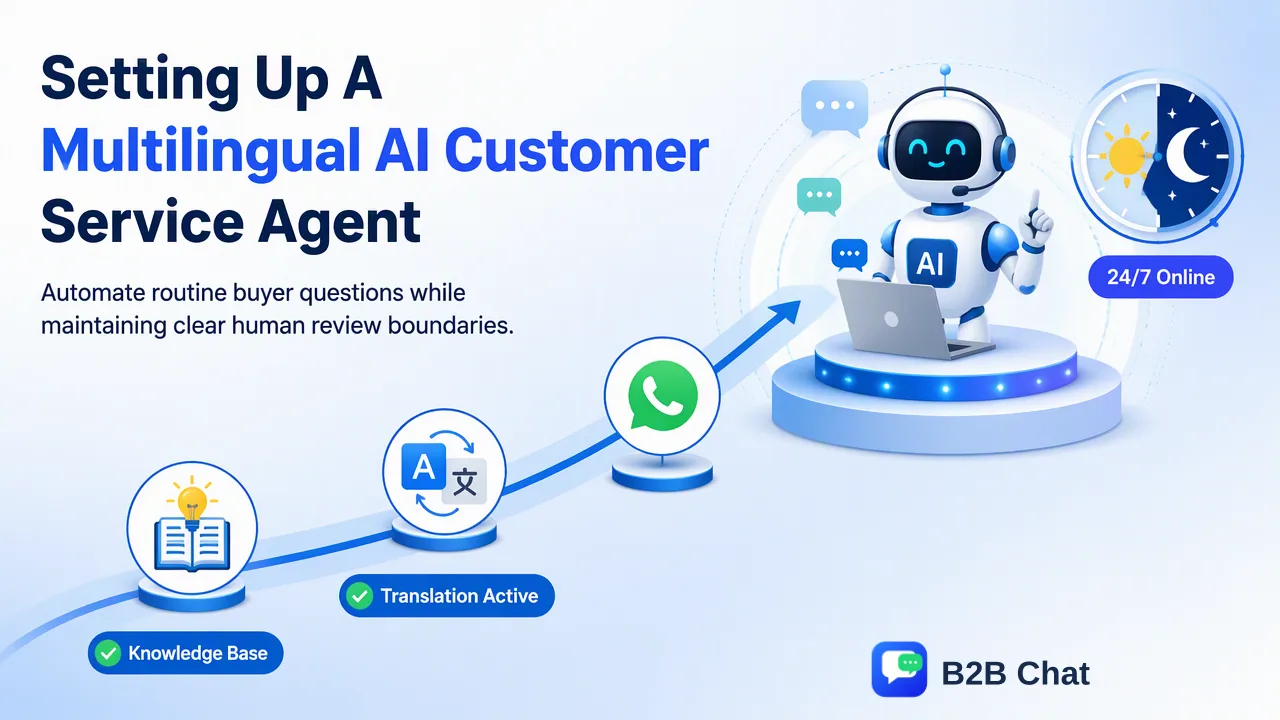
A multilingual support workflow starts with approved answers and clear human ownership, then uses translation and AI for routine questions.
A multilingual AI customer service agent can help a WhatsApp team answer routine buyer questions across languages, but the team must first prepare accurate source answers and decide which cases belong to staff. Keep the product facts in one reviewed knowledge base, use translation to bridge the buyer language, and test complete conversations before widening coverage. A person should own exceptions, negotiated terms and any answer the agent cannot ground in approved information.
Define the multilingual AI customer service agent’s job
Start with the questions that recur and have stable answers: where to find a product specification, what information the team needs to prepare a quote, or which support hours apply. Separate those from decisions that depend on the customer, a current order, a negotiated agreement or an unavailable fact. The agent can assist with first-line routine replies; a sales or support representative retains the decision on a customized commercial answer.
Write a one-page scope statement before building the knowledge base. Name the supported customer channels, the topics covered, the approved source for each topic and the person responsible for changes. For example, a team can decide that an agent may explain how to request a quotation but may not promise a price, shipment date or exception. That is an illustrative operating choice, not a product default. The difference matters because a natural-sounding answer can still contain an unapproved commitment.
The B2B Chat AI customer service page describes an AI agent for routine, parallel conversations with multi-turn context. In this workflow, the desktop client runs WhatsApp sessions while staff review the conversations. The team should treat the agent as a first-line assistant, not as a replacement for staff judgment.
Prepare a source knowledge base in one working language
A multilingual rollout does not require a separate, independently edited policy for every buyer language. Choose a working language that the team can review well. Organize approved answers by buyer intent rather than by scattered documents: product identity, available variants, order information required, shipping questions, returns or complaints, and what to do when information is missing. For each answer, record an owner and an effective date in the team’s own source material. Avoid putting temporary promises into a permanent answer.
Make each entry complete enough to stand alone. “Shipping depends” gives the agent little useful information; an approved entry can instead explain which facts staff need before they can confirm shipping. If a buyer asks for a date, the safe response is to request the order details and refer the date to the responsible person. This is a sample internal rule, not a claim that the product automatically routes such a question.
Keep numbers and specialized terms in a controlled glossary. A product code, unit of measure or packaging description should have one approved spelling. Where a term has multiple regional interpretations, explain the intended meaning in the source answer. This makes later translation review more concrete. Store only information the team is authorized to use in customer replies. If the underlying policy changes, revise the source entry before allowing the agent to answer from it again.
Translate the question and the answer as one conversation
A buyer may write in Indonesian, Spanish or Portuguese while the support desk works in English or Chinese. B2B Chat Smart Translation detects language and supports two-way, context-aware translation across more than 200 languages. The team can use that capability to understand an incoming question and prepare a buyer-language response while the AI agent handles routine intent. Translation and answering are two different checks: a faithful translation can preserve an incorrect source answer, and an accurate source answer can be damaged by a mistranslated unit or term.
Use a test sequence rather than a list of isolated phrases. Ask about a product variant, change the requested quantity, then refer to “the earlier size” without repeating its name. Multi-turn context matters because the last message depends on the first two. Review whether the reply uses the right variant and whether the translated answer maintains the same qualification. If the original answer says that staff will confirm a date, the buyer-language version should not turn that into a confirmed date.
Meta's WhatsApp translation announcement describes native message translation and says Android can translate future incoming messages in a chat automatically. That helps readers understand incoming text on supported devices. A support workflow still needs an approved answer, a reviewed outgoing message and a person for exceptions. Teams should compare the entire conversation when deciding whether native translation alone meets their needs.
Set human review boundaries before the first live shift
Make the handoff rules legible to staff. A simple list can cover requests for a human, unclear product identity, custom orders, a complaint, repeated misunderstanding, a changed price or quantity, and anything involving a disputed delivery or payment commitment. Assign an owner for each category. Tell staff where the source of truth lives and who can revise it; otherwise a corrected answer may remain wrong in the next conversation.
A human reviewer should see the buyer’s original wording, the translated version, the relevant earlier messages and the approved knowledge-base answer. They should check what the buyer actually requested before replying. B2B Chat includes customer records and support seats in its CRM console, which can help a team coordinate ownership of ongoing conversations. Do not assume a specific automatic handoff button or routing rule without seeing it in the current product. Teams can define their own review and takeover practice around the shared client.
If the agent cannot find an approved answer, it should avoid inventing one. A team-approved holding response can acknowledge the question and say that staff will review it, without making a time promise the team cannot meet. A bilingual colleague should review high-impact outgoing wording, especially prices, specifications, safety information and complaints. Routine greetings need lighter review than a revised contract term.
Run a small, realistic acceptance test
Choose a limited set of routine intents and a small number of staff-supervised conversations first. Build a test sheet with buyer language, original question, relevant earlier context, approved source answer, expected escalation condition and a reviewer’s assessment. Include short messages, spelling errors, a language switch within the thread and a request that falls outside the knowledge base. The point is to find where the workflow needs better source material or earlier human intervention, not to produce a flattering success figure.
Review each answer for three separate properties. First, is the factual answer supported by the approved source? Second, did the translation preserve the qualification and the important nouns and numbers? Third, did the correct person take ownership when the question exceeded the agent’s scope? Record any repeated failure as a source or process issue, then revise the answer or boundary. Do not widen coverage merely because the agent sounds confident.
For teams supporting buyers in several regions, the Indonesian buyer support page and Latin American buyer support page give the relevant channel context. Local language review should still use the team’s actual product terminology and commercial policy. The same reviewed core answer can serve several languages, while people verify whether each localized reply is understandable and appropriately qualified.
FAQ
How can teams prepare one knowledge base for several buyer languages?
Keep one set of approved answers in a language the team can review, with owners and current source facts. Use translation for the buyer-facing conversation and have native or bilingual reviewers inspect important terms.
How should teams choose the first questions for an AI agent?
Choose frequent, stable questions with a clear approved answer. Put negotiated, disputed or customer-specific decisions on a human review list.
Can teams rely on translation without checking the source answer?
No. Translation can preserve a source error, and a correct source answer can lose a qualification in another language. Review both factual grounding and translated wording.
How can teams test multi-turn buyer conversations?
Use a sequence in which the buyer changes quantity or refers to an earlier product, then check whether the reply uses the right context and escalates uncertainty.
Learn More
Choose the product information that fits the next step in your workflow.