How to Prepare Your Team for AI-Assisted Customer Service
Learn how teams can prepare for AI-assisted customer service by defining response boundaries, escalation rules, and multi-language support workflows.
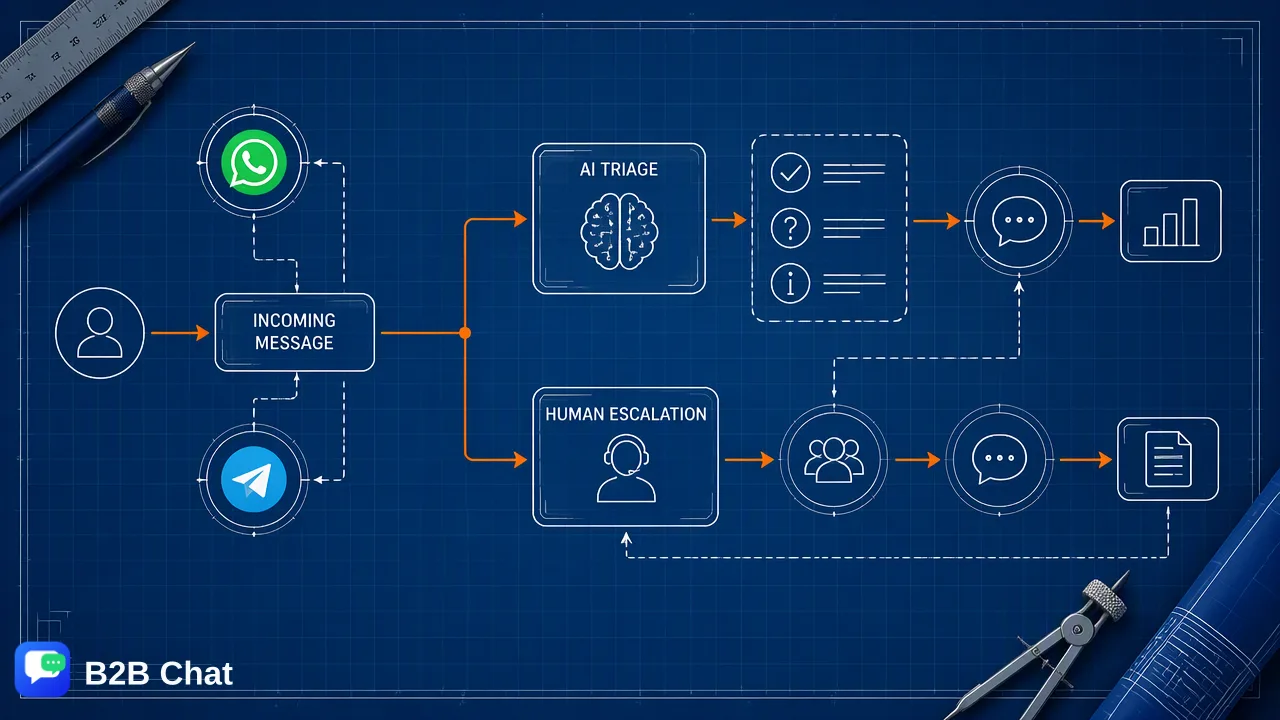
A comprehensive guide for organizations on preparing teams for AI-assisted customer service, focusing on defining response boundaries, standardizing terminology, and establishing escalation rules for WhatsApp and Telegram workflows.
To prepare for AI-assisted customer service, organizations must define clear response boundaries, establish escalation protocols for human intervention, and standardize terminology across supported channels. By leveraging platforms like B2B Chat, teams can integrate AI intent understanding and context-aware translation to automate first-line responses across WhatsApp and Telegram. This preparation ensures that AI handles routine inquiries effectively while human agents manage complex, high-value interactions that require nuanced oversight.
Defining the Scope of AI Assistance
When deploying AI for customer support, the first operational step is defining exactly which interactions belong to automated systems and which require human agents. AI customer service modules are designed to interpret customer intent from incoming messages and conversation context to assist with automated first-line responses. Teams should map out their most common inbound queries—such as order status requests, basic product information, or business hours—and assign these to the AI workflow. Because B2B Chat operates as a comprehensive customer service tool for WhatsApp and Telegram, teams can centralize these messaging channels into a single downloadable client for Windows or macOS. By routing initial WhatsApp and Telegram messages through an AI intent-understanding layer, organizations can filter out repetitive questions. However, the scope must be strictly defined. AI assistance supports the support team by handling the initial triage and basic replies, but it does not replace the need for human operators to handle nuanced or sensitive customer issues.
Standardizing Terminology and Tone
Maintaining a consistent brand voice is critical when automating first-line responses. Teams must standardize their terminology so that AI outputs align with corporate guidelines. This becomes especially important in global operations where messages cross cultural and linguistic boundaries. Modern AI translation features automatically detect and translate customer messages, adjusting the translation expression based on the conversation context. This means the AI does not just swap words; it interprets the surrounding dialogue to maintain the appropriate tone. To prepare for this, organizations should document their preferred phrasing, industry-specific terms, and brand voice guidelines. When using B2B Chat, the Smart Translation capability processes these contextual cues to ensure that automated replies sound professional and contextually accurate. Establishing these linguistic baselines before deployment helps prevent off-brand messaging and ensures that the AI customer service module reflects the organization's standards.
Establishing Escalation Rules
No automated system can resolve every customer inquiry. Establishing clear escalation rules is a mandatory step when you prepare for AI-assisted customer service. Teams must define the specific triggers that prompt a handoff from the AI to a human agent. Since AI customer service is built to assist automated first-line responses, workflows should be configured to recognize when a conversation exceeds the AI's defined scope. Escalation triggers might include unrecognized intents, expressions of customer frustration, or requests for complex technical support. In a centralized workspace managing multiple WhatsApp and Telegram accounts, human agents can monitor the AI's ongoing conversations. When an escalation rule is triggered, the human operator steps in, reviewing the conversation context gathered by the AI to seamlessly continue the interaction. This collaborative model ensures that customers receive efficient initial responses without losing the safety net of human oversight for complex problems.
Managing Multi-Language Support
Global customer service operations require the ability to communicate across diverse regions without maintaining a massive, multilingual human workforce around the clock. Preparing for multi-language support involves integrating translation capabilities directly into the messaging workflow. AI translation covers over 200 languages, automatically detecting the language of incoming customer messages. For teams managing international private-domain traffic on WhatsApp and Telegram, this capability is highly valuable. Instead of routing a Spanish or Mandarin inquiry to a specialized regional desk, the AI translation module processes the message instantly. The translation expression is adjusted based on conversation context, allowing the AI customer service module to interpret the intent accurately and formulate a relevant first-line response in the customer's native language. Organizations can utilize these Smart Translation and Smart Customer Service features on a per-request basis—publicly listed at $0.002 per translation request and $0.02 per customer service request—allowing teams to scale their global support operations predictably.
FAQ
How do AI systems determine the appropriate first-line response?
AI customer service tools interpret customer intent by analyzing incoming messages and the surrounding conversation context. This allows the system to assist with automated first-line responses that are relevant to the user's specific inquiry.
Can automated support workflows handle multiple languages simultaneously?
Yes, AI translation can automatically detect and translate customer messages across more than 200 languages. The system adjusts the translation expression based on the conversation context to maintain accuracy and tone.
What role do human agents play in an AI-assisted messaging workflow?
Human agents remain essential for handling complex, sensitive, or escalated interactions. While AI assists with first-line responses and intent understanding, human operators provide the necessary oversight and intervention when a conversation exceeds the automated system's defined boundaries.
How can teams centralize their messaging channels for AI deployment?
Organizations can use comprehensive customer service tools like B2B Chat, which provides a downloadable client for Windows and macOS. This allows teams to manage multiple WhatsApp and Telegram accounts in one place, applying AI translation and customer service features across all connected profiles.