When Should an AI Customer Service Agent Hand a Chat to a Human?
A practical handoff checklist for WhatsApp and Telegram teams handling complaints, negotiations, custom orders, and unclear requests.
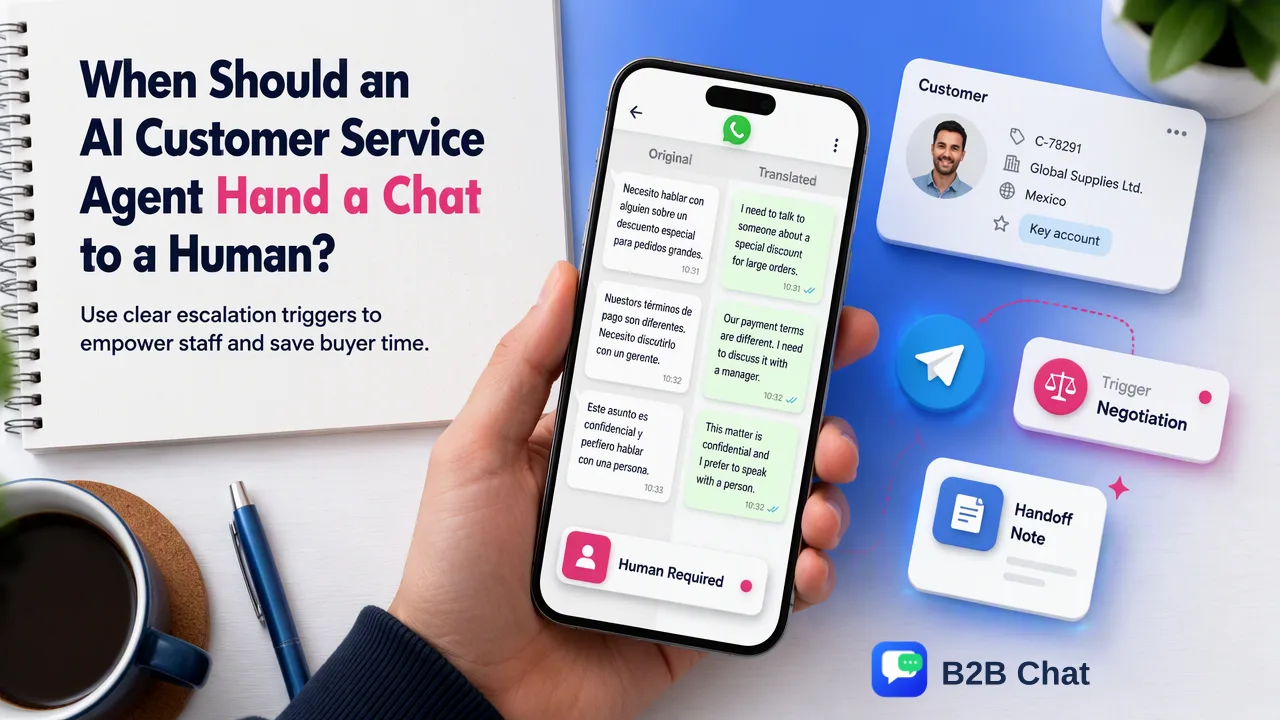
Use clear escalation triggers and a compact context note so staff can take over a customer conversation without asking the buyer to start again.
An AI customer service agent should hand a chat to a human when the answer requires judgment, authority, or information the agent cannot reliably establish. Price negotiations, complaints, custom orders, repeated misunderstandings, and signs of frustration are practical triggers. A good handoff gives the staff member the buyer's request, what has already been said, and the unresolved decision before the next reply goes out.
When AI customer service should hand off to a human
A handoff rule should describe a situation that staff can recognize, not a vague instruction to escalate important chats. Start with five triggers and let the team refine them after reviewing actual conversations.
- Negotiation: The buyer asks for a special price, payment terms, a concession, or approval of an exception. The agent can acknowledge the request and collect the needed details, but a person with commercial authority should decide the offer.
- Complaint or dispute: A buyer says an order is wrong, a promised date was missed, or a prior answer was misleading. Staff need to check records and take responsibility for the next step. An automatic apology alone can sound like a final resolution when none has been agreed.
- Custom order: A question depends on specifications, minimum quantities, packaging, or a delivery arrangement that is outside the approved knowledge base. The next reply should be checked against the actual order details.
- Repeated misunderstanding: The buyer corrects the agent, repeats the same question, or says the reply does not answer it. After one attempt to clarify, further automated guesses can compound the confusion.
- Angry or urgent tone: A message signals frustration, a deadline, or a risk to the relationship. Even if the surface question looks routine, a person should decide the tone and priority of the response.
These are operating examples, not claims that a product automatically detects every trigger. Teams should assign an owner and define what the AI may say while a person is unavailable. A simple acknowledgment that the request has been passed to the team is more honest than promising an outcome or a response time the team cannot meet.
Separate routine answers from decisions
A useful test is whether the next reply can be drawn from a maintained, approved answer without changing a commitment. Routine questions about documented product information, order preparation, or standard process may be suitable for first-line assistance. A new concession, a disputed fact, or a case-specific remedy needs review. This distinction is stronger than a rule based only on message length: a two-word complaint can need human attention, while a longer factual question may be straightforward.
B2B Chat's AI customer service handles routine replies with multi-turn conversation context across WhatsApp, Telegram, and LINE conversations in the desktop client. Staff should still own the decisions above. The CRM console includes customer records, support seats, a reply library, keyword auto-replies, and AI robot settings. These documented capabilities give a team places to organize replies and ownership; they do not imply an automatic escalation detector or a specific handoff button.
A keyword auto-reply is different from an AI reply. It fires from configured matching words in the reply library. An AI agent works from conversation context. Neither should be treated as authorization to negotiate, settle a complaint, or interpret a custom specification on the business's behalf.
What a handoff note must contain
The person taking over needs enough context to answer the buyer's current question, not a long transcript pasted into another channel. A compact handoff note can record the account and customer record, the latest request in plain language, relevant quantities or dates, the answer already given, the point of uncertainty, and the next decision owner. Distinguish a buyer's claim from a verified business fact. For example, write 'buyer says the shipment is late; order status requires checking' rather than treating the shipment as confirmed late.
When translation is involved, preserve the buyer's original wording alongside the working translation for any disputed price, dimension, deadline, or complaint. B2B Chat supports context-aware two-way translation, but a human should check high-stakes terms against the source message before making a commitment. A translated phrase can be useful for triage without being adequate evidence for a final commercial answer.
If the buyer has spoken across several messages, summarize the sequence: first question, clarification, previous answer, and what changed. This matters especially when a buyer starts by asking for a quote, then changes the quantity and asks about shipping. The staff member should reply to the newest request without losing the earlier constraints. Centralizing WhatsApp accounts and customer records can reduce tool switching while the team reconstructs that sequence.
A practical handoff workflow for a shared client
Before enabling routine AI replies, decide which team owns each category of exception. Sales can own quote changes; support can own complaints; an operations colleague can confirm shipping facts. Use a shared reply library for approved factual language, and make clear which phrases are placeholders awaiting review. Assign staff coverage for the messaging accounts that receive those requests.
During a conversation, the agent can gather missing information without pretending to decide the case: which product or order, what quantity, what date, and which detail needs confirmation. Once an escalation trigger appears, staff should review the recent messages and the customer record, check the original wording if translation was used, and decide who will respond. The first human reply should identify the exact open issue and ask only for information that is still missing. Repeating questions the buyer already answered makes the handoff feel broken.
After the case, review whether the approved knowledge base lacked a factual answer or whether the issue inherently needed judgment. Add a verified routine answer to the reply library where appropriate. Keep true exceptions in the human queue. This review prevents a team from treating every unusual question as a content gap that automation ought to fill. For teams covering distant time zones, document what the agent may acknowledge overnight and what waits for a staff decision in the next coverage period.
Review the handoff as a customer experience
A team can audit a small sample of escalated conversations for three questions: Did the system stop making new commitments after the trigger? Could the staff member see what had already happened? Did the next response address the buyer's actual unresolved question? These checks are more useful than counting handoffs alone. A high handoff count might reflect cautious routing, an incomplete knowledge base, or a run of complex orders; the count by itself does not explain quality.
Also inspect chats that were never escalated. Look for repeated customer corrections, unanswered changes of scope, and polite but irrelevant automated replies. Compare those findings with the team's trigger definitions and approved answers. This is an internal quality practice, not a promised product analytics feature.
For WhatsApp conversations, keep escalation available and respect the platform's rules for business messaging. WhatsApp's Business Messaging Policy describes clear escalation routes for automated responses on its Business Platform. The policy is a useful reference when designing a service process, though teams should apply the rules relevant to their own account and messaging method. For any channel, a human review path gives the buyer a way to resolve questions that routine automation cannot settle.
FAQ
How can teams tell when a chatbot answer needs human approval?
Route the conversation when the next answer changes a price, promise, remedy, specification, or other case-specific commitment. Repeated corrections and visible frustration are also strong triggers, even if the original question was routine.
How can staff take over without asking the buyer to repeat everything?
Review the recent conversation and customer record, then prepare a short note covering the latest request, prior answer, open uncertainty, and decision owner. The first human response should address that open issue directly.
How should multilingual teams handle a disputed translated message?
Keep the source message available and have a staff member check important terms such as prices, quantities, and dates before committing to an answer. Translation supports triage but does not remove the need for judgment.
Can an AI agent resolve every WhatsApp or Telegram customer request?
No. It can assist routine replies and retain multi-turn context, while negotiations, complaints, custom orders, and unclear cases still need staff review and decisions.
Learn More
Choose the product information that fits the next step in your workflow.